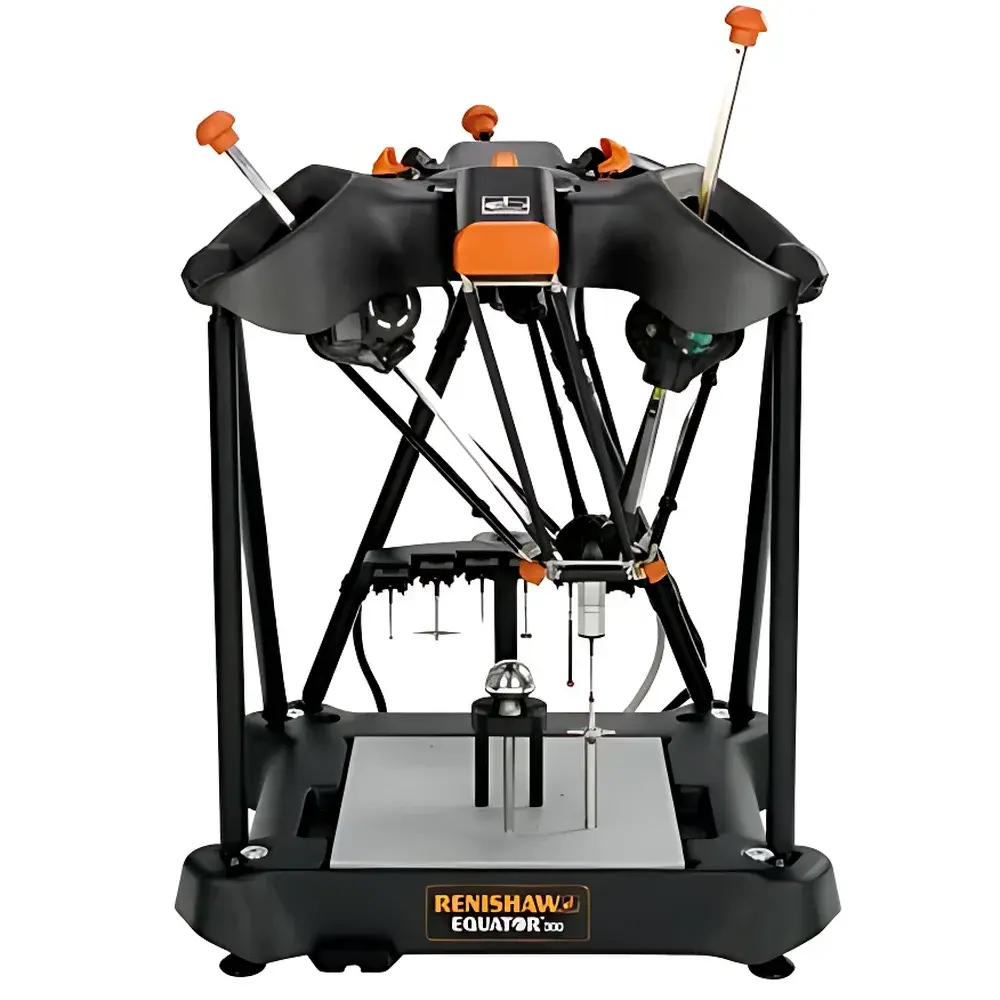
Renishaw Equator™ Multifunctional Comparative Measuring Machine
| Brand | Renishaw |
|---|---|
| Origin | United Kingdom |
| Model | Equator™ |
| Type | Comparative Measurement System for Geometric Dimensioning and Tolerancing (GD&T) |
| Structural Principle | Parallel-Kinematic Mechanism with Kinematic Coupling |
| Measurement Method | Relative Comparison Against Master Parts Using Touch-Trigger and High-Speed Scanning Probes |
| Compliance Basis | Traceable to CMM-Calibrated Reference Parts per ISO 10360, ISO 14253, and ASME B89.4.1 |
| Software Platform | MODUS™ Equator (DMIS-compliant), MODUS™ Organiser (Operator Interface) |
| Probe System | Renishaw SP25 Micro-High-Accuracy Scanning Probe with SM25 Modular Styli Exchange |
| Thermal Compensation | Real-Time Re-Zeroing via Master Part Re-Reference |
| Fixture Requirement | ±1 mm Positioning Tolerance |
| Controller | Integrated Industrial PC-Based Equator Controller (No External PC Required) |
Overview
The Renishaw Equator™ Multifunctional Comparative Measuring Machine is an industrial-grade, parallel-kinematic comparative measurement system engineered for high-repeatability, high-throughput verification of geometric dimensioning and tolerancing (GD&T) in production environments. Unlike conventional coordinate measuring machines (CMMs) or dedicated go/no-go gauges, the Equator operates on a relative comparison principle: it measures deviations of production parts against a certified master part—calibrated traceably to a temperature-stabilized CMM—thereby decoupling absolute metrology from shop-floor thermal variability. Its patented kinematic architecture combines lightweight structural rigidity with rapid feature-to-feature traversal and sub-second probing cycle times, enabling full GD&T inspection—including profile, position, concentricity, and form analysis—within seconds per part. Designed specifically for integration into flexible manufacturing systems, the Equator delivers metrological confidence without requiring climate-controlled rooms, expensive custom fixtures, or extensive operator training.
Key Features
- Parallel-kinematic motion platform: Delivers simultaneous high-speed scanning and precise point-to-point repeatability (typically < 1 µm 2σ over repeated measurements under stable conditions), maintaining mechanical stability during dynamic probing sequences.
- Integrated SP25 scanning probe with SM25 modular stylus exchange: Supports up to six pre-calibrated stylus configurations; automatic in-cycle exchange eliminates manual requalification and ensures consistent probe geometry across multi-feature inspections.
- Self-contained industrial controller: Embedded Windows-based control unit includes all necessary motion control electronics, real-time firmware, and MODUS™ software stack—no external PC required, eliminating driver conflicts and OS-related instability.
- Thermal drift mitigation: Employs master-part re-reference as a real-time zeroing procedure; recalibration takes less than 10 seconds and compensates for ambient temperature fluctuations typical in machining cells (15–30 °C operating range).
- DMIS-compliant programming: Full support for industry-standard DMIS 5.3 syntax; enables seamless transfer of measurement routines between CMMs and Equator systems, ensuring consistency across metrology workcells.
- Dual-tier software licensing: MODUS™ Equator (engineer-level) for program creation and optimization; MODUS™ Organiser (operator-level) for one-click execution, SPC data export, and pass/fail visualization—both share identical geometric algorithms and uncertainty models.
Sample Compatibility & Compliance
The Equator accommodates a broad spectrum of machined components—from small precision medical implants ( 600 mm)—provided they can be positioned within ±1 mm of nominal location using low-cost modular fixturing. No high-precision granite base or vacuum chucking is required. All measurements are referenced directly to CAD-defined datums, with traceability established through CMM-measured master parts calibrated per ISO 17025-accredited laboratories. The system supports full compliance with ISO 9001, IATF 16949, and FDA 21 CFR Part 11 when configured with audit-trail-enabled MODUS™ software and secure user authentication. Measurement uncertainty budgets are generated automatically per ISO/IEC Guide 98-3 (GUM) and documented in exported reports.
Software & Data Management
MODUS™ Equator provides full GD&T evaluation using ASME Y14.5–2018 and ISO 1101 logic, including true profile, composite position, and surface texture overlay. All programs store raw probe data, statistical summaries (X̄/R, Cp/Cpk), and annotated deviation maps. Data export formats include CSV, XML (for MES integration), PDF (with digital signature), and native DMIS for cross-platform reuse. SPC modules support real-time control charting with alarm thresholds, trend detection, and automated non-conformance flagging. Audit trails log every program edit, calibration event, and operator action—including timestamps, user IDs, and IP addresses—meeting GLP/GMP documentation requirements. Calibration files (e.g., probe qualification matrices, thermal compensation coefficients) are digitally signed and version-controlled within the controller’s secure file system.
Applications
- Aerospace: Rapid verification of turbine blade root profiles, bracket hole patterns, and composite layup alignment features.
- Automotive: In-line validation of engine block cylinder bores, transmission case mating surfaces, and EV battery housing flatness.
- Medical device manufacturing: Batch inspection of orthopedic implant geometries, dental abutment thread forms, and minimally invasive surgical tool dimensions.
- General machining: First-article approval, in-process capability studies, and end-of-line final inspection for CNC-milled and turned components.
- Toolroom support: Quick validation of EDM electrode geometry prior to mold cavity machining.
FAQ
How does the Equator achieve traceability without a traditional calibration certificate?
Traceability is established by calibrating a master part on a certified CMM in a controlled environment; that CMM’s calibration is accredited to ISO/IEC 17025. The Equator then references this master part repeatedly—its measurement results inherit the CMM’s uncertainty budget via documented procedural equivalence per ISO 14253-1 Annex B.
Can the Equator replace a CMM for first-article inspection?
It is not intended as a substitute for initial dimensional validation against drawing tolerances; however, once a master part is qualified on a CMM, the Equator becomes the primary tool for ongoing production verification—with equivalent statistical confidence for relative change detection.
Is MODUS™ Equator compatible with third-party CAD systems?
Yes—native import of STEP AP214, IGES, and Parasolid (.x_t) files is supported; GD&T annotations are parsed automatically, and datum reference frames are mapped directly to probe strategy generation.
What maintenance is required beyond routine stylus cleaning and master-part re-reference?
No scheduled mechanical maintenance is specified; the parallel-kinematic mechanism contains no belts, gears, or lubricated bearings. Annual firmware updates and optional remote diagnostics are available via Renishaw’s SupportLink portal.
Does the system support automated reporting for quality audits?
Yes—customizable report templates generate PDFs with embedded digital signatures, revision-controlled headers, and SPC charts compliant with AIAG CQI-15 and VDA Volume 5 requirements.