
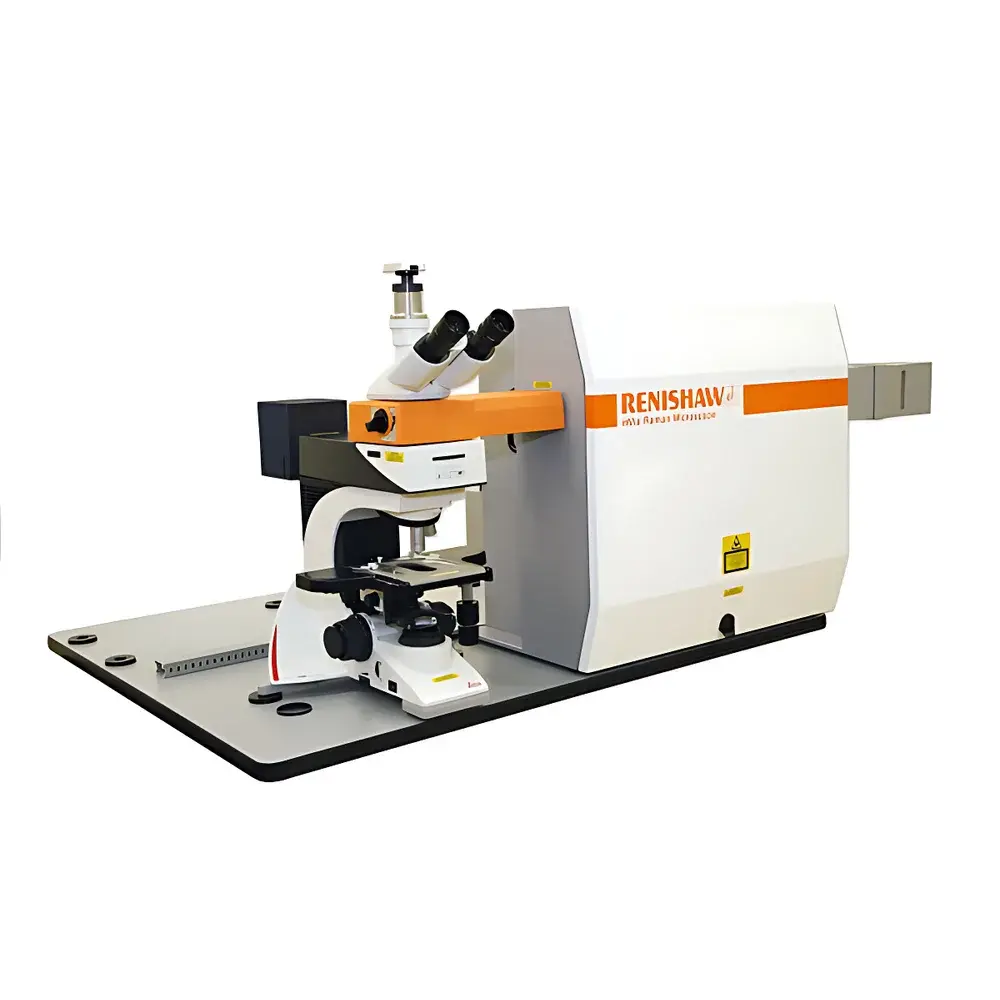
Renishaw inVia Basis Confocal Raman Microscope
| Brand | Renishaw |
|---|---|
| Origin | United Kingdom |
| Model | inVia Basis |
| Instrument Type | Confocal Raman Microscope |
| Spectral Range | 100–4000 cm⁻¹ |
| Spectral Resolution | ≤1 cm⁻¹ |
| Spatial Resolution | XY ≈ 1 µm, Z ≈ 2 µm |
| Low-Wavenumber Limit | 10 cm⁻¹ |
| Spectral Reproducibility | ≤0.1 cm⁻¹ |
Overview
The Renishaw inVia Basis Confocal Raman Microscope is a research-grade, entry-level confocal Raman spectroscopy system engineered for precision, stability, and long-term scientific utility. Based on Renishaw’s proven optical architecture—refined since the introduction of the RM series in 1992—the inVia Basis implements true confocal spatial filtering via a motorized pinhole and high-numerical-aperture microscope optics to deliver depth-resolved chemical mapping with sub-micron lateral resolution. It operates on the principle of inelastic light scattering (Raman effect), where monochromatic laser excitation induces vibrational mode shifts in molecular bonds, producing a fingerprint-like spectrum unique to chemical composition, crystallinity, stress state, and phase distribution. Designed for laboratory environments requiring rigorous repeatability and regulatory compliance, the inVia Basis supports both routine quality control and advanced materials characterization across academia, pharmaceutical development, semiconductor process engineering, and geosciences.
Key Features
- Confocal optical design with motorized pinhole for precise depth sectioning and rejection of out-of-focus signal
- Consistent high-performance specifications aligned with the full inVia platform—including ≤1 cm⁻¹ spectral resolution and ≤0.1 cm⁻¹ wavenumber reproducibility over time
- UV–Vis–NIR broadband compatibility: accommodates multiple laser wavelengths (e.g., 244 nm, 325 nm, 488 nm, 532 nm, 633 nm, 785 nm) via integrated beam routing and automatic laser selection
- Dual-stage high-sensitivity detection: up to four back-illuminated, deep-depletion CCD detectors with thermoelectric cooling (−70 °C), optimized for low-light Raman signal capture
- Modular mechanical architecture enabling seamless hardware expansion—including automated XYZ stages with encoder feedback, motorized filter wheels, and polarization optics
- Scalable platform: the inVia Basis can be upgraded to the fully automated inVia Reflex configuration without replacement of core optical or spectroscopic components
Sample Compatibility & Compliance
The inVia Basis accepts standard microscope slides, silicon wafers, polished metal sections, thin-film substrates, biological tissue sections, and encapsulated electrochemical cells. Its open optical path and modular sample stage interface support custom environmental chambers—including cryogenic (−196 °C to +600 °C), high-pressure (up to 10 GPa), and electrochemical flow cells—enabling in situ and operando studies. The system complies with ISO/IEC 17025 requirements for analytical instrument qualification and supports GLP/GMP workflows through traceable calibration protocols. Wavenumber calibration adheres to NIST-traceable standards (e.g., silicon at 520.7 cm⁻¹, cyclohexane peaks), and spectral data integrity meets FDA 21 CFR Part 11 criteria when used with Renishaw’s WiRE software configured for audit trail and electronic signature enforcement.
Software & Data Management
Controlled exclusively by Renishaw’s WiRE (Windows-based Raman Environment) software, the inVia Basis provides an integrated environment for acquisition, processing, multivariate analysis (PCA, cluster analysis), and publication-ready visualization. WiRE supports batch spectral acquisition, hyperspectral image stitching, false-color chemical mapping, and quantitative peak fitting using Voigt or Lorentzian models. All raw spectra are stored in vendor-neutral HDF5 format with embedded metadata (laser wavelength, objective magnification, integration time, grating position, calibration history). Data export options include ASCII, CSV, and JCAMP-DX for third-party chemometric tools. Software validation documentation (IQ/OQ/PQ templates) and version-controlled release notes are available for regulated laboratories.
Applications
- Pharmaceutical solid-state analysis: polymorph identification, API-excipient interaction mapping, and tablet coating uniformity assessment
- 2D materials characterization: layer count determination in graphene and TMDCs, strain and doping profiling in heterostructures
- Microplastics identification and polymer degradation analysis in environmental samples
- Geological mineral phase mapping in thin sections and fluid inclusions
- Failure analysis in microelectronics: stress-induced shifts in Si/SiO₂ interfaces, contaminant identification in packaging layers
- Correlative multimodal imaging: synchronized acquisition with SEM-EDS, AFM topography, and fluorescence lifetime imaging (FLIM)
FAQ
Can the inVia Basis perform low-wavenumber Raman measurements down to 10 cm⁻¹?
Yes—the system incorporates a high-transmission, low-stray-light spectrograph with holographic notch filters and optional ultra-low-wave-number optics to achieve reliable detection from 10 cm⁻¹, critical for lattice modes in perovskites, phonons in layered materials, and intermolecular vibrations.
Is the inVia Basis compatible with non-Renishaw microscope frames?
No—the inVia Basis integrates directly with Renishaw’s proprietary inverted or upright research microscopes; third-party microscope coupling requires optical re-engineering and voids factory calibration and warranty.
Does the system support automated spectral calibration verification during long-duration experiments?
Yes—WiRE software enables scheduled auto-calibration checks using internal reference sources, logging deviations in real time and flagging drift beyond ±0.05 cm⁻¹ for user review.
What level of training and technical support is provided with the inVia Basis?
Renishaw offers on-site installation, two-day operator training, and annual application workshops. Remote diagnostics, firmware updates, and priority response SLAs are included in the standard service agreement.
Can I add polarization-resolved Raman capability post-purchase?
Yes—polarization accessories (rotatable half-wave plates, polarizing beam splitters, and analyzer modules) are field-installable and fully supported by WiRE’s polarization analysis toolkit.





