
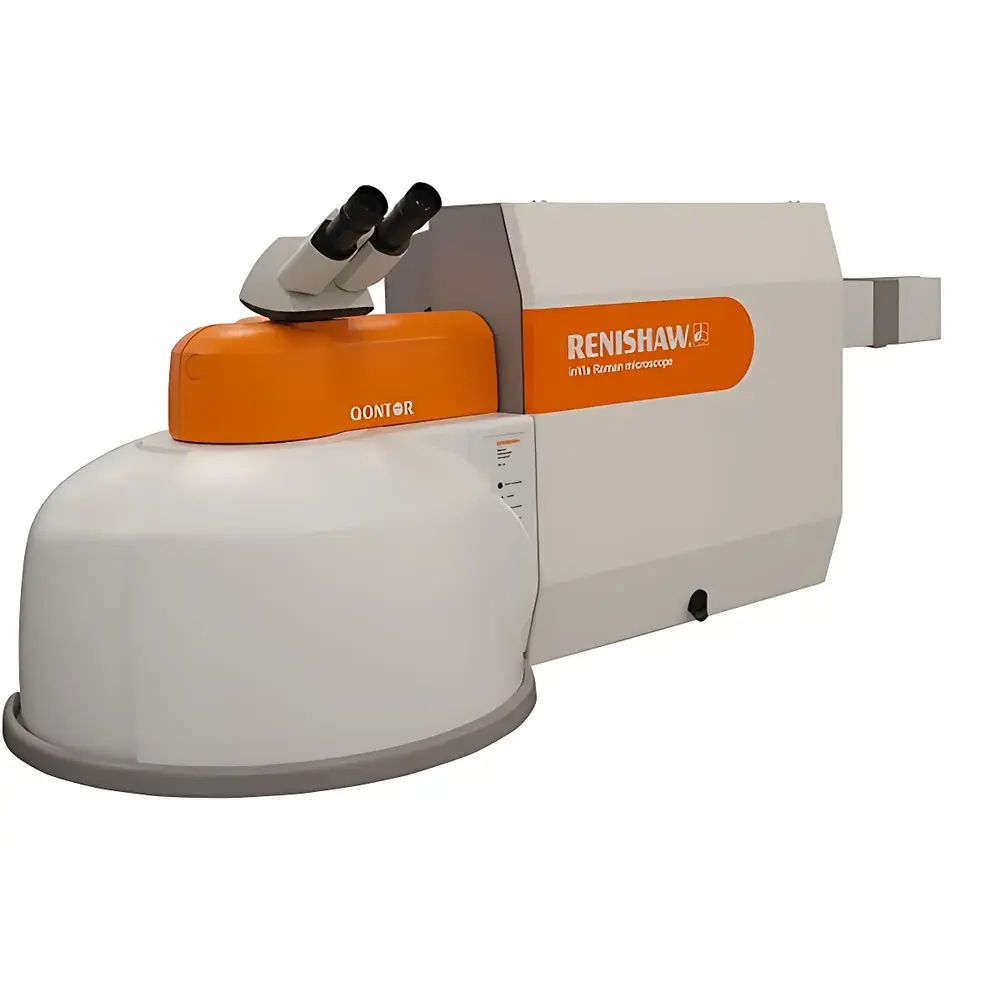
Renishaw inVia Qontor Confocal Raman Microscope
| Brand | Renishaw |
|---|---|
| Origin | United Kingdom |
| Model | inVia Qontor |
| Instrument Type | Confocal Raman Microscope |
| Spectral Range | 100–4000 cm⁻¹ |
| Spectral Resolution | ≤1 cm⁻¹ |
| Spatial Resolution | XY ≈ 1 µm, Z ≈ 2 µm |
| Low-Wavenumber Limit | 10 cm⁻¹ |
| Spectral Reproducibility | < ±0.1 cm⁻¹ |
Overview
The Renishaw inVia Qontor Confocal Raman Microscope represents the culmination of over three decades of innovation in micro-Raman spectroscopy. Engineered on the proven inVia platform—first introduced in the 1990s and since adopted as the global benchmark for research-grade confocal Raman systems—the Qontor iteration integrates Renishaw’s proprietary LiveTrack™ real-time focus tracking technology to overcome a fundamental limitation in conventional confocal Raman imaging: depth-dependent defocus on non-planar, rough, or dynamically evolving samples. Unlike traditional step-scan or static-focus approaches, LiveTrack employs continuous optical feedback from the sample surface via integrated white-light interferometry, enabling synchronous adjustment of the objective focal plane during both widefield imaging and Raman spectral acquisition. This architecture is grounded in confocal optical design principles, where spatial filtering through a pinhole ensures diffraction-limited lateral resolution (~1 µm) and axial sectioning capability (~2 µm), while the high-throughput Czerny–Turner spectrometer delivers true confocal spectral fidelity across the full 10–4000 cm⁻¹ range—including ultra-low wavenumbers down to 10 cm⁻¹—without compromise.
Key Features
- LiveTrack™ real-time focus tracking: Maintains optimal focus on irregular, tilted, or time-varying surfaces without pre-scanning or manual intervention—critical for in situ reaction monitoring, biological tissue analysis, and heterogeneous material characterization.
- Confocal architecture with motorized XYZ stage and piezo-driven objective: Enables true 3D Raman tomography with sub-micron spatial registration and reproducible depth profiling.
- Dual-mode optical path: Seamless switching between high-resolution white-light microscopy and confocal Raman mapping within a single instrument configuration.
- Multi-laser excitation capability: Integrated support for UV (e.g., 244 nm), visible (e.g., 532 nm, 633 nm), and NIR (e.g., 785 nm) lasers, each optimized for specific sample classes (e.g., resonance enhancement, fluorescence suppression, or deep-penetration probing).
- High-quantum-efficiency back-illuminated CCD detectors: Up to four synchronized detectors allow simultaneous multi-spectral acquisition or rapid spectral stitching across extended ranges.
- Modular optical design: Compatible with upright or inverted research-grade microscopes; supports polarization-resolved, transmission, and fiber-coupled configurations.
Sample Compatibility & Compliance
The inVia Qontor accommodates diverse sample geometries—from polished wafers and thin-film stacks to hydrated biological specimens, powder aggregates, and in-operando electrochemical cells—without mandatory flattening or conductive coating. Its open-stage architecture accepts standardized environmental modules including cryo-stages (−196 °C to +600 °C), heating/cooling stages with thermal control accuracy ±0.1 °C, electrochemical flow cells compliant with ASTM D7212 for corrosion studies, and sterile cell culture chambers meeting ISO 13485 biocompatibility requirements. All hardware and software components are designed to support GLP/GMP workflows: audit trails, user access levels, electronic signatures, and data integrity controls align with FDA 21 CFR Part 11 and EU Annex 11 expectations. Spectral calibration traceability follows NIST-traceable standards (e.g., silicon Raman peak at 520.7 cm⁻¹), and spectral reproducibility (< ±0.1 cm⁻¹) meets ISO 17025 validation criteria for quantitative vibrational spectroscopy.
Software & Data Management
WiRE™ 6.x software provides an integrated environment for instrument control, spectral acquisition, multivariate analysis (PCA, cluster analysis, spectral unmixing), and correlative imaging. Raw spectra are stored in vendor-neutral HDF5 format with embedded metadata (laser wavelength, power, integration time, objective NA, stage coordinates). The software supports batch processing pipelines compliant with ASTM E2822 for automated particle identification and enables export to third-party platforms (MATLAB, Python via SciPy-compatible APIs) for custom algorithm development. Full version control, project archiving, and encrypted database storage ensure long-term data preservation and regulatory readiness.
Applications
- Materials science: Phase mapping of battery cathodes, strain distribution in 2D materials (e.g., graphene, MoS₂), crystallinity assessment in pharmaceutical polymorphs.
- Life sciences: Label-free chemical imaging of lipid droplets, protein conformational changes in live cells, extracellular matrix composition in tissue sections.
- Semiconductors: Dopant profiling, stress/strain quantification in finFET structures, defect identification in epitaxial layers.
- Geosciences: Inclusion analysis in minerals, carbon speciation in meteorites, fluid composition in fluid inclusions.
- Forensics & art conservation: Pigment identification, polymer degradation assessment, ink differentiation without sampling.
FAQ
What is the minimum wavenumber accessible with the inVia Qontor?
The system achieves reliable spectral acquisition down to 10 cm⁻¹ using optimized notch filters and low-noise detection electronics—enabling observation of lattice modes, interlayer vibrations, and acoustic phonons.
Can the inVia Qontor be integrated with an AFM or SEM?
Yes. Renishaw offers certified co-localization interfaces for atomic force microscopy (AFM-Raman) and scanning electron microscopy (SEM-Raman), enabling nanoscale correlative topographical, electrical, and chemical analysis.
Is spectral calibration traceable to international standards?
All factory calibrations are performed using NIST-traceable reference materials (e.g., silicon, cyclohexane, sulfur), with documented uncertainty budgets available upon request.
How does LiveTrack improve measurement throughput for rough samples?
By eliminating the need for time-consuming surface topography pre-scans and iterative focus optimization, LiveTrack reduces total acquisition time by up to 60% for uneven samples such as fractured ceramics or unpolished geological sections.
Does the system support quantitative analysis under regulated environments?
WiRE software includes 21 CFR Part 11-compliant features—including role-based permissions, electronic signatures, and immutable audit logs—validated for use in pharmaceutical QC and clinical research settings.




