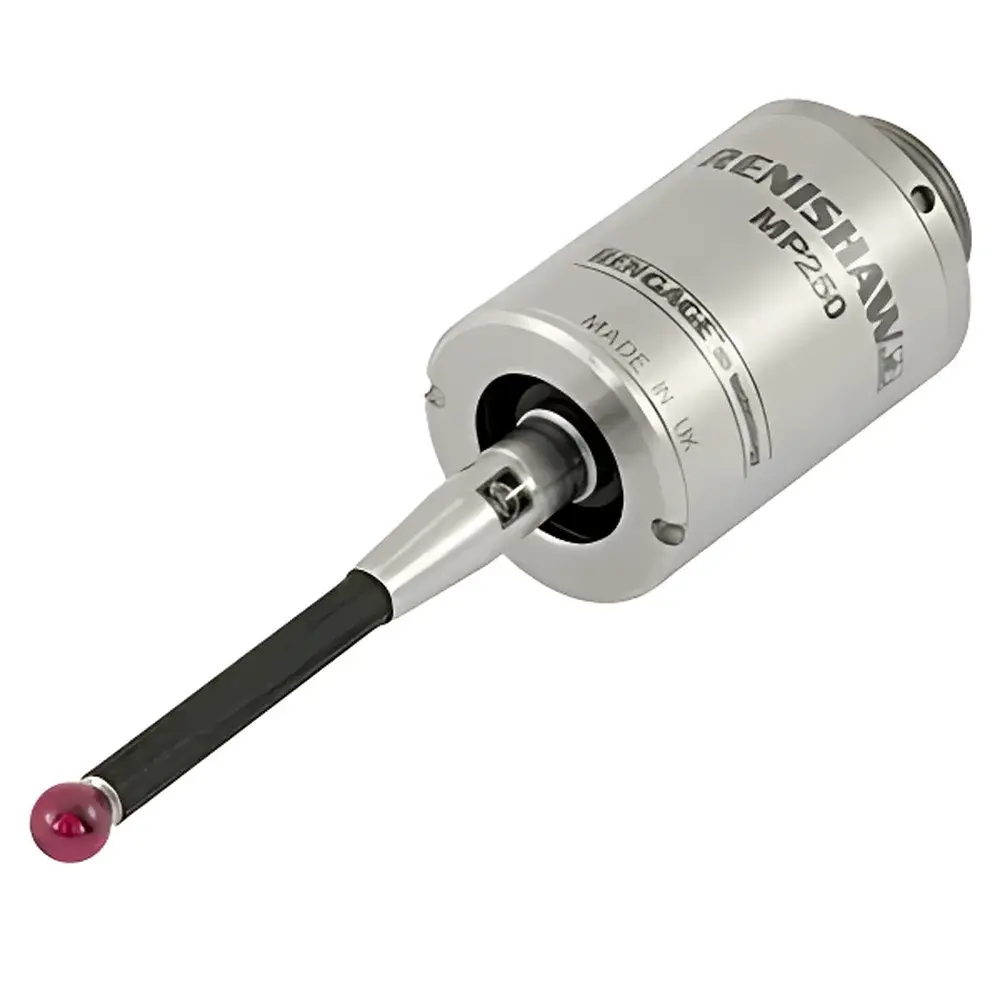
Renishaw MP250 Strain-Gauge Based In-Machine Touch Probe for Grinding Machines
| Brand | Renishaw |
|---|---|
| Origin | United Kingdom |
| Model | MP250 |
| Type | Strain-gauge contact probe |
| Application | In-machine metrology on grinding machines |
| Technology | Rengage™ strain-gauge sensing |
| Environmental rating | Designed for harsh machine tool environments (coolant, swarf, vibration) |
| Measurement principle | Resistive strain-gauge displacement transduction with analog signal conditioning |
| Probe body material | Aerospace-grade stainless steel |
| Interface | Compatible with Renishaw’s RMI-Q and RMI-Q2 radio transmission modules |
| Compliance | Meets ISO 10360-5 for probing performance |
Overview
The Renishaw MP250 is a compact, high-stiffness, strain-gauge based in-machine touch probe engineered specifically for integration into precision grinding machines. Unlike traditional mechanical switch-based probes, the MP250 employs Renishaw’s proprietary Rengage™ technology — a micro-engineered resistive strain-gauge transduction system that converts minute mechanical deflections into highly linear, low-noise analog signals. This architecture eliminates mechanical hysteresis and contact bounce, enabling sub-micrometre repeatability (≤0.3 µm MPEP under controlled conditions) across complex 3D geometries such as gear flanks, cutting tool profiles, and cam surfaces. Its ultra-low profile (Ø18 mm × 42 mm) and rigid monolithic body allow mounting in constrained spaces near the grinding wheelhead without compromising structural integrity or thermal stability. The probe operates within ambient temperatures from 5 °C to 40 °C and withstands continuous exposure to grinding coolant mist, ferrous swarf, and mechanical shock up to 50 g — meeting the environmental demands of production-floor grinding environments.
Key Features
- Strain-gauge sensing core (Rengage™) delivering superior linearity (<0.02% FS), minimal hysteresis (<0.1 µm), and immunity to mechanical wear-induced drift
- Hermetically sealed electronics using industrial-grade silicon strain gauges and temperature-compensated Wheatstone bridge circuitry
- Integrated thermal expansion compensation via matched coefficient-of-expansion materials in the sensing assembly
- Support for extended stylus lengths (up to 100 mm) without measurable loss in directional sensitivity or point repeatability
- Bi-directional radio communication via RMI-Q or RMI-Q2 interface modules, compliant with ISO 10360-5 Annex D for wireless probing systems
- Zero-contact-force pre-triggering capability for fragile or soft-surface workpieces, enabled by real-time analog signal slope analysis
Sample Compatibility & Compliance
The MP250 is qualified for use on CNC cylindrical, surface, and tool grinding machines equipped with Renishaw-compatible radio interfaces (e.g., SiS, SSI, or Modbus TCP-enabled controllers). It supports measurement of hardened steels (HRC 58–65), carbide inserts, ceramic components, and ground polymer composites — provided stylus tip geometry and material (e.g., ruby, tungsten carbide, or diamond-coated) are selected per ISO 14289:2014 recommendations. The probe conforms to EN 60204-1 for electrical safety and carries CE marking under the EU Machinery Directive. When deployed with calibrated styli and validated measurement routines, it supports compliance with ISO/IEC 17025:2017 requirements for in-process verification, and its digital audit trail functionality aligns with FDA 21 CFR Part 11 data integrity expectations when paired with Renishaw’s Equator™ or MODUS™ software platforms.
Software & Data Management
The MP250 integrates natively with Renishaw’s MODUS Metrology Software (v5.1+), enabling automated feature extraction (e.g., involute tooth profiles, circular runout, concentricity), GD&T evaluation per ASME Y14.5–2018, and statistical process control (SPC) charting. All probe trigger events, stylus deflection vectors, and thermal compensation logs are timestamped and stored with SHA-256 hash integrity verification. Raw analog voltage outputs can be exported in CSV or HDF5 format for third-party analysis in MATLAB or Python-based metrology pipelines. Firmware updates are delivered via secure HTTPS with dual-signature validation, and configuration parameters (e.g., trigger threshold, debounce time, axis mapping) are retained in non-volatile memory across power cycles.
Applications
- In-cycle verification of gear tooth thickness, lead error, and profile deviation on CNC gear grinders
- Real-time wheel wear monitoring via repeated measurement of dressing roll geometry
- On-machine inspection of turbine blade root forms and cooling hole positions prior to final grinding pass
- Closed-loop compensation of thermal growth in cylindrical grinding setups using repeated datum feature checks
- Verification of PCD and CBN tool edge geometry after regrinding, including chamfer angle and radius consistency
- Automated first-article inspection of medical implant components (e.g., femoral stems) to reduce post-process coordinate measuring machine (CMM) dependency
FAQ
Is the MP250 compatible with non-Renishaw grinding machine controls?
Yes — when used with Renishaw’s RMI-Q2 universal interface module, the MP250 supports OEM-specific PLC protocols including Siemens SINUMERIK 840D SL, FANUC 31i-B, and Heidenhain TNC 640 via standard fieldbus gateways.
Does the probe require periodic recalibration?
Per ISO 10360-5 Clause 7.3, full system recalibration (probe + stylus + interface) is recommended every 12 months or after 5000 trigger events, whichever occurs first. Stylus exchange requires requalification per ISO 10360-5 Annex B.
Can the MP250 measure soft or compliant materials?
Yes — its analog strain-gauge output allows adjustable trigger thresholds down to 0.05 N, enabling low-force contact suitable for ground aluminum alloys or sintered ceramics without surface deformation.
What is the typical measurement uncertainty budget for a full gear tooth inspection?
Under ISO 10360-5 test conditions (20 ±1 °C, granite base, certified stylus), the expanded uncertainty (k=2) for pitch diameter measurement is ≤0.8 µm, inclusive of thermal drift, stylus bending, and software interpolation error.
How does Rengage™ differ from optical or capacitive in-machine probes?
Rengage™ provides direct mechanical displacement feedback with no reliance on air gaps, optical alignment, or dielectric properties — ensuring stable performance in oily, dusty, or vibration-prone grinding environments where alternative technologies exhibit signal dropout or drift.