Renishaw RMP40 Compact Radio Transmission In-Machine Touch Probe
| Brand | Renishaw |
|---|---|
| Origin | United Kingdom |
| Model | RMP40 |
| Form Factor | Ultra-compact (Ø40 mm × 50 mm) |
| Transmission Method | Bidirectional Radio Frequency (RF), 2.4 GHz ISM Band |
| Operating Range | Up to 3 m line-of-sight (typical), extended via optional repeater modules |
| Environmental Rating | IP67 (probe body), IP54 (receiver unit) |
| Battery Life | ≥12 months (alkaline AA cells, typical usage) |
| Compatibility | Renishaw RMI-Q / RMI-QE receivers, MP250/MP300 interface modules |
| Signal Protocol | Proprietary RF with CRC error checking and automatic retransmission |
| Temperature Range | −10 °C to +50 °C (operational) |
Overview
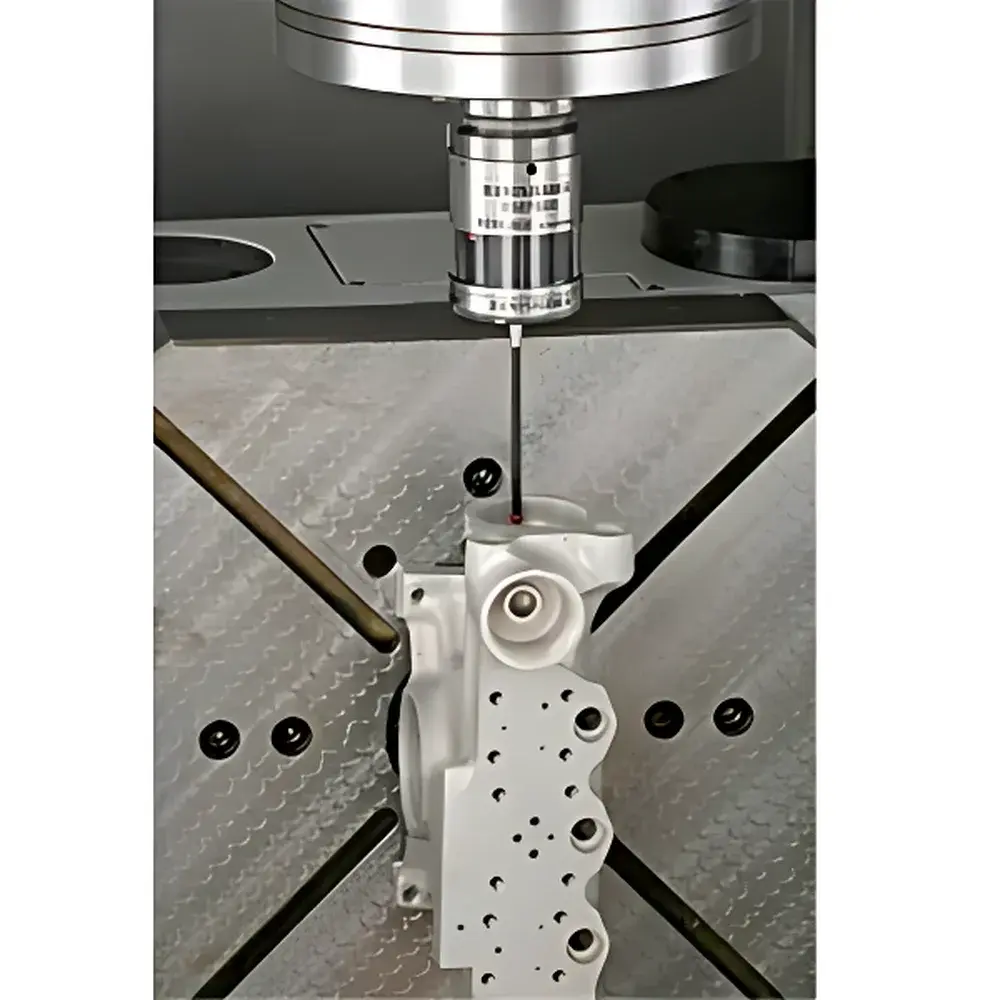
The Renishaw RMP40 is an ultra-compact, radio-based in-machine touch probe engineered for high-reliability dimensional verification directly on CNC machine tools. Unlike optical or infrared transmission systems—whose performance degrades when line-of-sight is obstructed—the RMP40 employs a robust 2.4 GHz bidirectional RF communication protocol. This enables stable, low-latency signal exchange between probe and receiver even in complex multi-axis machining environments where physical obstructions (e.g., tooling, fixtures, or rotating turrets) routinely interrupt optical paths. Its cylindrical form factor—measuring just Ø40 mm × 50 mm—minimizes interference with spindle travel, tool clearance, and part envelope, making it particularly suitable for Swiss-type lathes, mill-turn centers, and 5-axis machining centers where spatial constraints are critical. The probe operates on standard alkaline AA batteries, delivering over 12 months of service life under typical cycle conditions without requiring machine downtime for replacement.
Key Features
- Ultra-compact mechanical design (Ø40 mm × 50 mm) optimized for tight-spindle and multi-tasking machine integration
- 2.4 GHz ISM-band radio transmission with CRC-protected data frames and automatic packet retransmission for high signal integrity
- IP67-rated probe body and IP54-rated receiver housing ensure resistance to coolant mist, metal chips, and shop-floor contaminants
- Support for both single-point and scanning measurement modes via compatible Renishaw software interfaces (e.g., Inspect, Productivity+)
- Configurable trigger force thresholds (0.5–3.5 N) to accommodate delicate surfaces or rigid workpiece materials
- Seamless interoperability with Renishaw’s RMI-Q and RMI-QE radio receivers, as well as MP250/MP300 machine interface modules
- No external antenna required—integrated RF antenna design eliminates cable routing complexity and electromagnetic coupling risks
Sample Compatibility & Compliance
The RMP40 is designed for use with metallic, composite, ceramic, and hardened alloy workpieces encountered in precision turning, milling, and grinding operations. It supports standard ISO 10360-compliant geometrical accuracy verification workflows—including sphere calibration, stylus qualification, and probe-to-probe matching—when deployed with Renishaw’s certified calibration artifacts. The system complies with EN 61000-6-2 (immunity) and EN 61000-6-3 (emissions) for industrial electromagnetic environments. While the probe itself does not carry CE marking as a standalone medical or safety-critical device, its integration into CNC machine control architectures adheres to ISO 13849-1 PLd functional safety requirements when used with appropriate safety-rated PLC logic and emergency stop coordination.
Software & Data Management
The RMP40 integrates natively with Renishaw’s suite of machine tool metrology software, including Inspect (for manual inspection routines) and Productivity+ (for automated in-process gauging and adaptive machining). All measurement data—including trigger timestamp, contact vector, deviation values, and thermal drift compensation logs—is structured in ASCII CSV or XML format, enabling traceable export to MES platforms such as Siemens Opcenter, Rockwell FactoryTalk, or custom SQL-based quality databases. Audit trails include operator ID, program name, machine axis positions (X/Y/Z/A/B), and environmental temperature readings (via optional external sensor input). Full compliance with FDA 21 CFR Part 11 is achievable through configuration-controlled user authentication, electronic signatures, and immutable audit logging when deployed within validated GxP manufacturing environments.
Applications
- In-cycle tool wear compensation and automatic offset updates during high-volume production runs
- First-article verification and setup validation on multi-tasking machines without removing parts from the chuck
- Thermal drift monitoring across extended machining cycles using periodic reference sphere measurements
- Automated bore diameter, concentricity, and face flatness checks on large-diameter turned components
- On-machine verification of GD&T characteristics—including position, profile, and runout—prior to secondary operations
- Integration into Industry 4.0 digital twin workflows via OPC UA data publishing from compatible machine controllers
FAQ
What is the maximum reliable transmission distance between the RMP40 probe and its receiver?
Under unobstructed line-of-sight conditions, the nominal operational range is up to 3 meters; however, effective range depends on local RF noise, shielding from machine enclosures, and presence of conductive barriers. Optional RF repeater modules extend coverage to 6 meters in complex cell layouts.
Can the RMP40 be used in wet or high-coolant environments?
Yes—the probe body carries an IP67 ingress protection rating, meaning it is fully dust-tight and withstands immersion in 1 meter of water for up to 30 minutes. Receiver units are rated IP54 and must be mounted in shielded, drip-protected locations.
Does the RMP40 support scanning or only discrete point capture?
The RMP40 is a kinematic touch-trigger probe and does not perform continuous scanning. Scanning functionality requires pairing with Renishaw’s OSP60 or RSP3-2 systems.
Is battery replacement possible without disassembling the probe mount?
Yes—battery access is provided via a captive screw cap located at the probe’s non-contact end, allowing field replacement without disturbing the stylus assembly or machine coordinate alignment.
How is probe calibration traceability maintained?
Calibration is performed using Renishaw-certified reference spheres traceable to UKAS-accredited laboratories (ISO/IEC 17025). Calibration reports include uncertainty budgets per ISO 15530-3 and are archived alongside each inspection program in the machine controller’s file system.