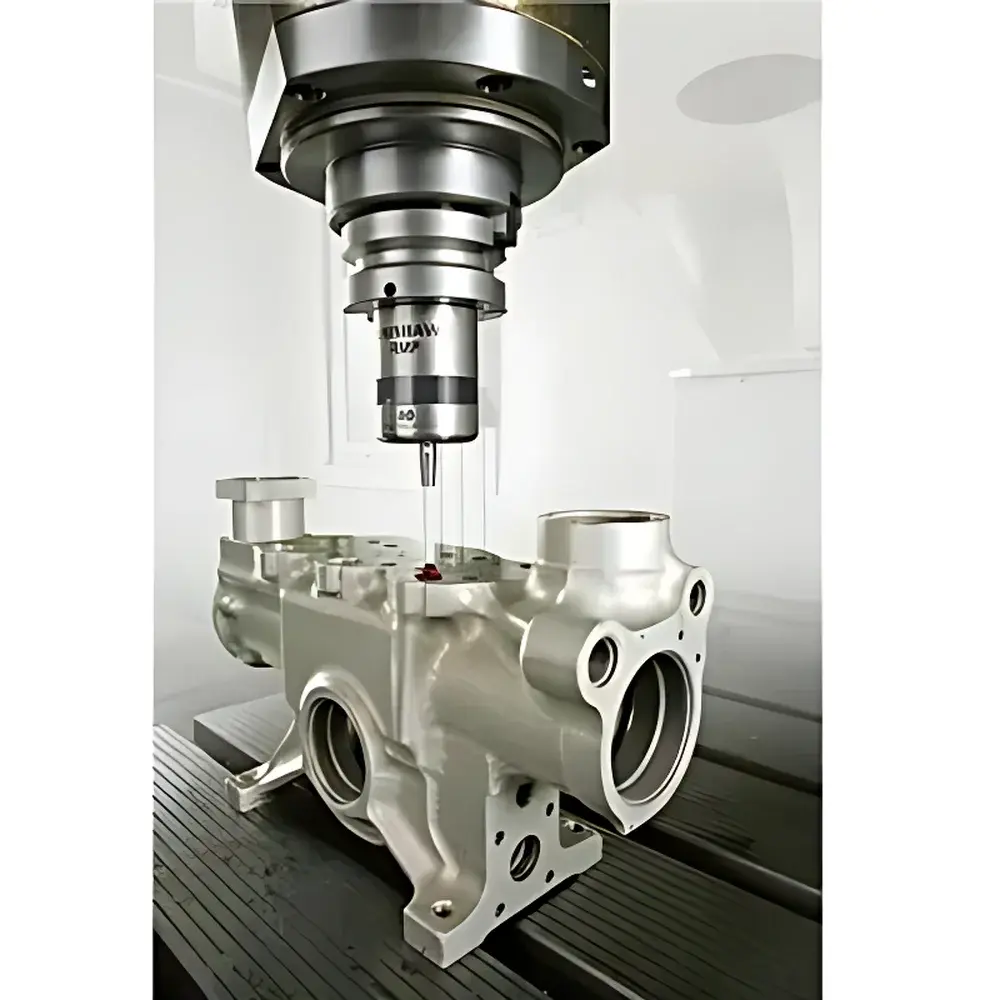
Renishaw RMP600 Compact Radio-Triggered In-Machine Measurement Probe
| Brand | Renishaw |
|---|---|
| Origin | United Kingdom |
| Model | RMP600 |
| Protection Rating | IPX8 |
| Transmission | Radio Frequency (RF) |
| Sensing Technology | RENGAGE™ Strain Gauge |
| Compatibility | CNC Machining Centers, Turning Centers, Mill-Turn Machines |
| Mounting | Spindle or Tool Magazine Interface |
| Environmental Suitability | Coolant-, Chip-, and Vibration-Resistant |
Overview
The Renishaw RMP600 is a compact, high-precision radio-triggered in-machine measurement probe engineered for integration into modern CNC machining centers, multi-tasking mill-turn systems, and precision turning centers. It operates on the principle of mechanical deflection detection via integrated strain gauge transduction—specifically Renishaw’s proprietary RENGAGE™ technology—which converts minute stylus displacement into highly repeatable electrical signals without mechanical switches or optical interrupters. Unlike legacy mechanical or infrared-based probes, the RMP600 employs robust RF communication to transmit trigger events wirelessly to the machine controller, eliminating line-of-sight constraints and enabling reliable operation in fully enclosed, high-chip-load environments. Its design targets metrological-grade dimensional verification directly on the machine tool—reducing part handling, minimizing thermal drift, and supporting closed-loop process control in high-mix, low-volume, and high-accuracy production workflows.
Key Features
- RENGAGE™ strain gauge sensing architecture delivering sub-micrometre repeatability (≤ 0.5 µm MPEL under controlled conditions) across full stylus deflection range
- IPX8-rated hermetic sealing—fully submersible in coolant and resistant to high-pressure washdown, making it suitable for wet machining and heavy-duty turning applications
- RF transmission protocol operating at 2.4 GHz ISM band with adaptive frequency hopping, ensuring immunity to electromagnetic interference from spindle drives, inverters, and arc welding equipment
- Compact, low-inertia housing (Ø33 mm × 72 mm) optimized for installation in constrained spaces—including B-axis turrets and live tooling stations
- Integrated probe cap protection system with self-cleaning geometry and hardened stainless-steel retention—designed to deflect chips and prevent accumulation at the stylus interface
- Support for extended stylus configurations (up to 300 mm length) without compromising signal integrity or triggering stability
Sample Compatibility & Compliance
The RMP600 is qualified for use across ferrous and non-ferrous workpiece materials—including hardened steels (HRC 60+), titanium alloys, Inconel®, and aluminum composites—without requiring surface preparation beyond standard machining finishes. It complies with ISO 10360-5:2019 for probing performance verification and meets the environmental robustness requirements outlined in ISO 230-2:2023 (machine tool testing – positional accuracy). While not a standalone calibration instrument, its output is traceable to national metrology institutes when used with Renishaw’s XK10 alignment system and calibrated reference spheres (certified per ISO 17025). The probe’s RF emissions conform to EN 300 328 v2.2.2 and FCC Part 15 Subpart C, ensuring compatibility in global manufacturing facilities subject to EMC regulatory audits.
Software & Data Management
Probe operation is managed through Renishaw’s MODUS™ metrology software suite (v5.0+), which provides native integration with Siemens SINUMERIK, Heidenhain TNC, Fanuc FOCAS, and Mitsubishi M800/M700 series controls. MODUS supports GD&T evaluation per ASME Y14.5–2018 and ISO 1101:2017, including true position, profile, runout, and concentricity calculations. All measurement routines—including automatic workpiece alignment, bore inspection, and 3D freeform surface sampling—are scriptable via Renishaw’s Inspection Plus language. Audit trails, user access logs, and measurement data export (CSV, STEP AP242, DMIS 4.3) are enabled to satisfy GLP/GMP documentation requirements and FDA 21 CFR Part 11 compliance when deployed in regulated medical device or aerospace component manufacturing.
Applications
- First-article verification and automated setup compensation on multi-axis machining centers
- In-process verification of critical features (e.g., turbine blade root profiles, gear tooth geometry, hydraulic manifold ports)
- Thermal drift monitoring during long-cycle milling operations using repeated datum checks
- Automated tool wear compensation via periodic touch-off measurements on turning centers
- GD&T validation of complex contoured surfaces in die/mold manufacturing prior to EDM finishing
- Statistical process control (SPC) data collection integrated into MES platforms via OPC UA connectivity
FAQ
Is the RMP600 compatible with older CNC controllers lacking native Renishaw protocol support?
Yes—via the RMI-Q interface module, which translates RF signals into standard TTL or relay outputs compatible with legacy PLC-based control architectures.
Can the RMP600 perform scanning or continuous measurement?
No—it is a discrete-point triggered probe; for high-density surface scanning, Renishaw recommends the REVO-2 system with SFP2 sensor.
What is the typical battery life under continuous production use?
With standard alkaline cells, operational life exceeds 12 months at 200 triggers/day; lithium-thionyl chloride options extend this to >24 months.
Does IPX8 rating include resistance to oil mist and emulsified coolants?
Yes—the housing seal system has been validated against ISO 20623-compliant synthetic cutting fluids and mineral oil mists at 0.3 MPa pressure.
How is probe calibration maintained during extended in-machine deployment?
Calibration stability is verified using Renishaw’s QC20-W ballbar system and certified reference standards; no field recalibration is required between scheduled maintenance intervals (typically 12 months).