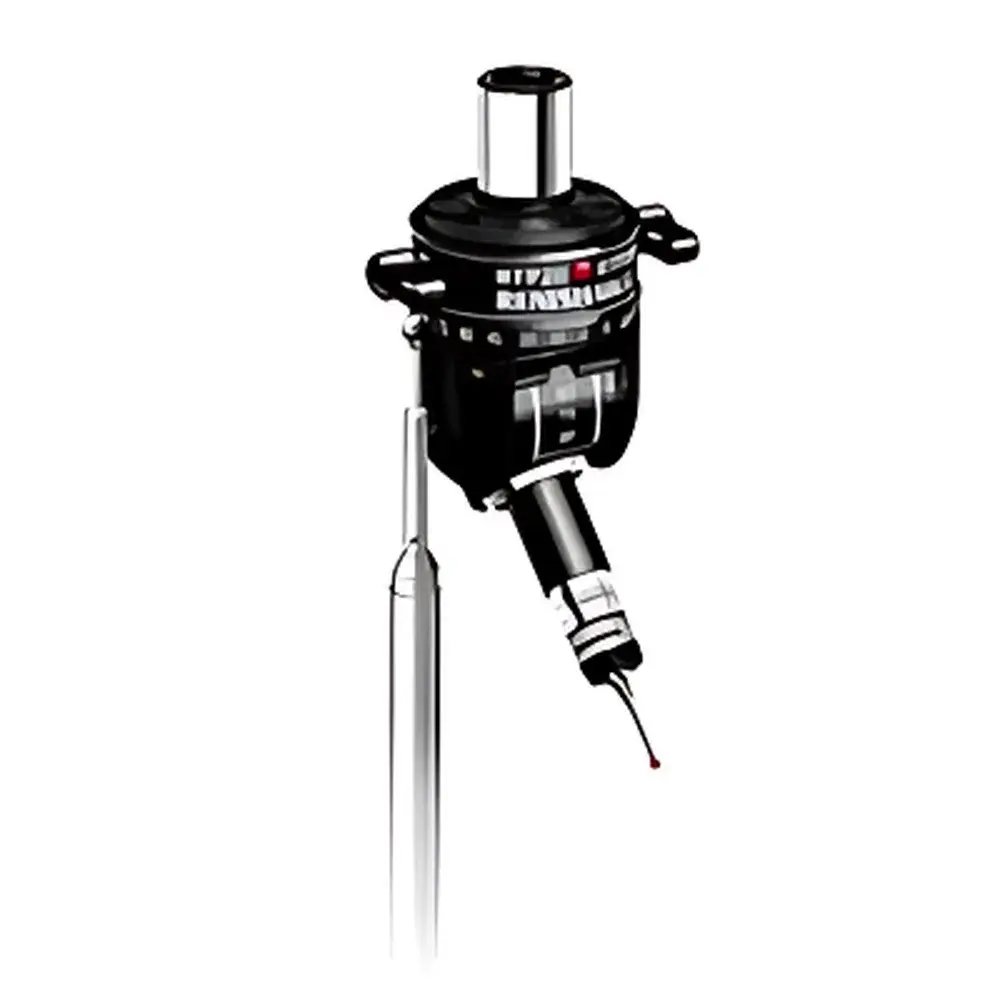
Renishaw RTP20 Economical Semi-Automatic Indexing Probe Head
| Brand | Renishaw |
|---|---|
| Origin | United Kingdom |
| Model | RTP20 |
| Probe Type | Integrated TP20 Touch Trigger Probe |
| Indexing Increment | 15° |
| Compatibility | Fully Supported by Standard CMM Controllers (e.g., Renishaw UCC Series) |
| Module Exchange | Compatible with MCR20 Automatic Module Changer Rack |
| Actuation Method | CMM-Motion-Driven Mechanical Engagement (No Internal Motor or Encoder) |
| Classification | Precision Geometric Measurement Instrument — Coordinate Measuring Machine (CMM) Peripheral |
Overview
The Renishaw RTP20 is a semi-automatic indexing probe head engineered for cost-conscious coordinate measuring machine (CMM) users requiring reliable, repeatable probe orientation changes without the complexity and expense of fully motorized systems. Unlike servo-driven or kinematic probe heads, the RTP20 operates on a passive mechanical indexing principle: it leverages the CMM’s own linear and rotational motion to engage and disengage a precision-machined sleeve mechanism with fixed position pins mounted on the machine table. This eliminates the need for internal motors, encoders, or dedicated drive electronics—reducing both acquisition cost and long-term maintenance overhead. Designed specifically for integration into legacy and modern CMM platforms, the RTP20 delivers deterministic 15° angular increments across a full 360° range, enabling systematic multi-directional probing strategies while maintaining traceable repeatability in accordance with ISO 10360-2 (CMM performance verification) and ISO 15530-3 (probe calibration methodology).
Key Features
- Passive indexing architecture—no internal power supply, motor, or encoder required; relies solely on CMM motion for positioning and locking.
- Integrated TP20 touch-trigger probe module—factory-aligned and pre-calibrated for immediate deployment with minimal setup time.
- 15° incremental indexing with mechanical detent feedback—ensures consistent angular resolution and positional repeatability across all orientations.
- Full compatibility with Renishaw UCC series controllers and other industry-standard CMM control systems (e.g., PC-DMIS, QUINDOS, Calypso) via standard I/O and probe interface protocols.
- Seamless interoperability with the MCR20 modular changer rack—enables automatic exchange of stylus modules, extension bars, and specialty probes without manual intervention.
- Rugged aluminum alloy housing with IP54-rated sealing—designed for stable operation in typical metrology lab environments with controlled temperature and humidity.
Sample Compatibility & Compliance
The RTP20 is intended for use with rigid, geometrically stable workpieces commonly encountered in dimensional inspection workflows—including machined metal components, injection-molded plastics, castings, and sheet-metal assemblies. It supports standard styli up to 50 mm in length and 8 mm in diameter, conforming to ISO 8178-1 (stylus interchangeability) and ISO 10360-5 (probe system performance testing). Its mechanical indexing design ensures compliance with GLP and GMP documentation requirements where audit trails are maintained at the CMM controller level—not within the probe head itself. While the RTP20 does not incorporate active sensors or digital communication interfaces, its behavior is fully deterministic and reproducible, satisfying clause 7.6 of ISO/IEC 17025:2017 regarding measurement equipment verification.
Software & Data Management
The RTP20 requires no proprietary firmware or embedded software. All indexing commands are issued through the host CMM controller using standardized probe head control syntax (e.g., “INDEX TO ANGLE” or “ROTATE TO POSITION”). Calibration data—including probe tip definition, stylus offset vectors, and orientation-specific correction factors—is stored and managed within the CMM’s native metrology software environment. When used with Renishaw’s MODUS™ or third-party platforms supporting ISO 10360-compliant probe characterization, full traceability of indexing events is retained in measurement reports. No FDA 21 CFR Part 11 electronic signature capability is implemented at the probe head level; however, audit trails generated by compliant CMM controllers meet regulatory expectations for data integrity in quality-critical industries.
Applications
- First-article inspection of medium-complexity mechanical parts with multiple datums and orientation-dependent features.
- Production line QC checks where rapid stylus reorientation is needed but full automation is economically unjustified.
- Educational and vocational training labs seeking an entry-level CMM probe system that illustrates fundamental principles of tactile metrology and probe kinematics.
- Reverse engineering workflows involving manual scan path planning across non-planar surfaces with discrete angular sampling.
- Calibration laboratories performing routine verification of CMM volumetric accuracy using multi-angle artifact measurements (e.g., ball bars, step gauges, sphere arrays).
FAQ
Does the RTP20 require external power or a dedicated controller?
No—the RTP20 is entirely passive and draws no electrical power. Positioning and locking are achieved mechanically via CMM motion.
Can the RTP20 be used with non-Renishaw CMM controllers?
Yes—it supports standard TTL-level probe interface signals and is compatible with any CMM controller capable of issuing basic probe head indexing commands.
What is the angular repeatability specification of the RTP20?
Angular repeatability is ≤ ±0.5° under controlled environmental conditions (20 ± 1°C), as verified per ISO 10360-2 Annex D procedures.
Is the integrated TP20 probe replaceable or upgradeable?
Yes—the TP20 module is field-replaceable and may be substituted with other TP20 variants (e.g., TP200, TP20-1) following Renishaw’s mechanical alignment protocol.
Does the RTP20 support continuous rotation or only discrete indexing?
It supports discrete 15° increments only—continuous rotation is not possible due to its mechanical detent-based architecture.