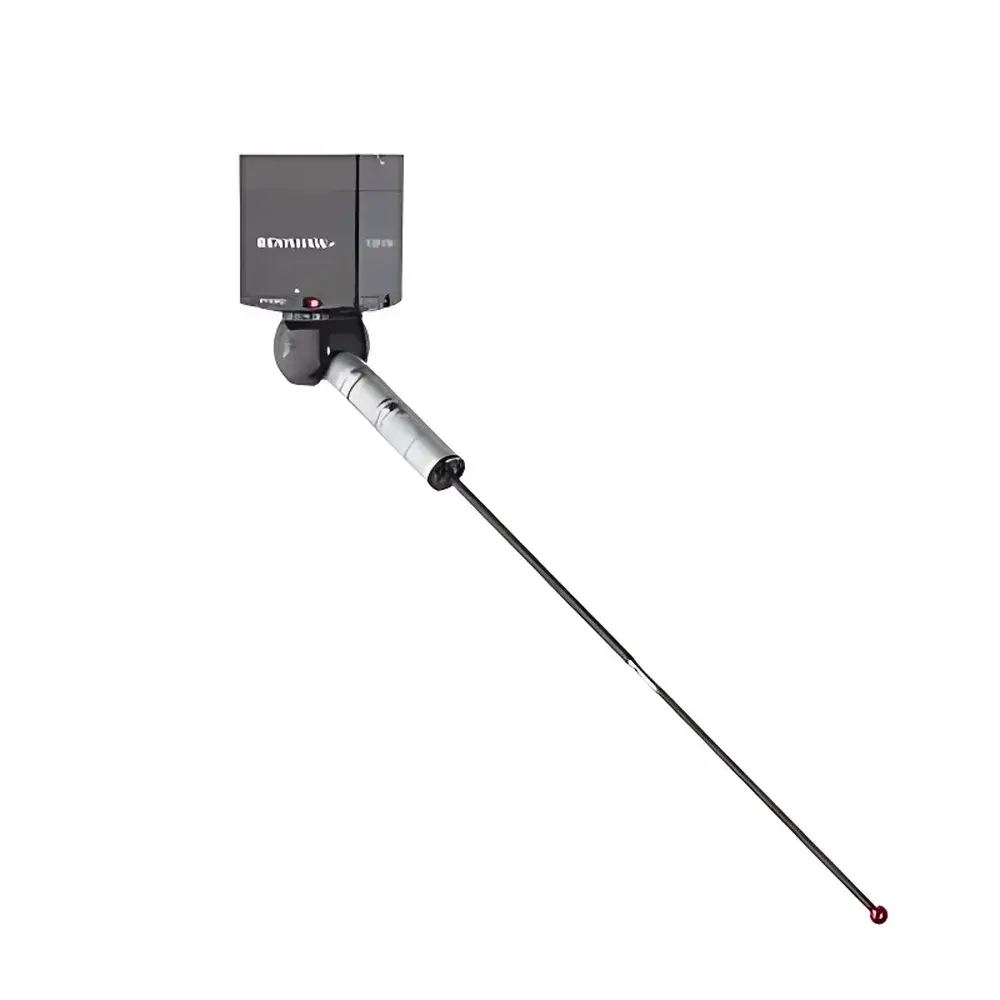
Renishaw SP25M Compact Dual-Mode Scanning and Touch-Trigger Probe System for Coordinate Measuring Machines
| Brand | Renishaw |
|---|---|
| Origin | United Kingdom |
| Model | SP25M |
| Probe Type | Dual-mode (scanning + touch-trigger) |
| Sensor Integration | Integrated capacitive scanning sensor + mechanical trigger sensor |
| Compatible Shank Lengths | 20 mm to 400 mm |
| CMM Interface | Standard M3, M4, or HSK shank options (per OEM integration) |
| Operating Principle | Capacitive displacement sensing (scanning mode) |
Overview
The Renishaw SP25M is a compact, dual-mode probe system engineered specifically for integration into coordinate measuring machines (CMMs) where space constraints, multi-sensor flexibility, and metrological traceability are critical. Unlike conventional single-function probes, the SP25M embeds two independent sensing mechanisms—capacitive scanning and mechanical touch-trigger—within a single, monolithic housing measuring under 25 mm in diameter. Its operation relies on Renscan™ technology, a proprietary high-bandwidth capacitive displacement measurement architecture that enables continuous surface sampling at up to 1,000 points per second with sub-micrometre repeatability. In scanning mode, the probe maintains constant contact force (typically 0.05–0.15 N) via active servo control, minimizing stylus deflection and thermal drift effects. In trigger mode, it functions as a high-stability, low-hysteresis mechanical switch compliant with ISO 10360-2 for probing error assessment. The SP25M is not a standalone instrument but a metrologically validated subsystem designed for OEM integration into bridge-type, gantry, or horizontal-arm CMM platforms operating under ISO 10360-5 and VDI/VDE 2617 Part 5 standards.
Key Features
- Ultra-compact form factor (Ø24.5 mm × 49 mm) enabling access to confined geometries and deep cavities inaccessible to larger probes
- Dual-sensing architecture: simultaneous support for high-density surface scanning (Renscan™) and discrete point acquisition (ISO-compliant trigger mode)
- Wide stylus compatibility: accepts standard M2, M3, and M4 threaded shanks; supports stylus lengths from 20 mm to 400 mm without recalibration
- Integrated temperature compensation: real-time correction of thermal expansion effects using embedded Pt100 sensor (±0.1 °C resolution)
- Dynamic performance: scanning bandwidth up to 200 Hz; trigger response time < 10 µs; angular deviation sensitivity < 0.1 µrad/µm
- Ruggedized ceramic housing with IP64-rated sealing for stable operation in controlled metrology labs and production-floor environments
Sample Compatibility & Compliance
The SP25M is intended for use with rigid, machined components ranging from precision injection-moulded plastics to hardened tool steels and aerospace-grade aluminium alloys. It meets ISO 10360-5 Annex B requirements for scanning probe verification and supports calibration protocols aligned with EURAMET cg-18 and UKAS M3003. When deployed on CMMs certified to ISO 17025, the probe contributes to uncertainty budgets traceable to NPL (UK) or PTB (Germany) primary standards. It is compatible with workpiece materials exhibiting surface roughness Ra ≤ 6.3 µm and hardness up to 65 HRC. No sample preparation is required beyond standard cleaning and temperature stabilization (20 ± 1 °C, per ISO 1.1). The probe does not support soft or highly deformable materials (e.g., elastomers, foams) in scanning mode due to inherent contact-force limitations.
Software & Data Management
The SP25M interfaces exclusively via Renishaw’s UCC (Universal CMM Controller) platform and is fully supported in MODUS™ metrology software v5.0+. All scanning trajectories are defined using parametric CAD-based path planning, with automatic collision avoidance and adaptive feedrate control based on local curvature. Raw point-cloud data is output in ASME B89.4.10-compliant ASCII format (.pts) or native .mod files with full audit trail metadata—including timestamp, environmental sensor logs, probe status flags, and traceable calibration ID. Software features include GLP/GMP-compliant electronic signatures, 21 CFR Part 11 audit logging (user action, parameter change, result export), and version-controlled calibration certificate linking. Data exports support direct import into PolyWorks®, Geomagic Control X®, and Metrolog X4® for cross-platform validation.
Applications
- High-accuracy profile measurement of turbine blade leading edges and compressor airfoils
- GD&T evaluation of position, concentricity, and profile tolerances on automotive powertrain components
- Verification of micro-machined medical device features (e.g., stent struts, catheter ports)
- In-process validation of additive-manufactured parts with complex lattice structures
- First-article inspection of injection-moulded housings requiring full-form capture of draft angles and sink marks
- Reverse engineering of legacy parts lacking CAD models, where dense point clouds enable robust surfacing
FAQ
Is the SP25M compatible with non-Renishaw CMM controllers?
Yes—via UCC-compatible third-party controller interfaces (e.g., Hexagon PC-DMIS, Zeiss CALYPSO) using Renishaw’s open API and I++ DME protocol implementation.
Does the probe require periodic factory recalibration?
Annual verification against traceable artefacts (e.g., sphere stacks, step gauges) is recommended per ISO 10360-5; full recalibration is required only after physical impact or environmental exposure exceeding IP64 limits.
Can scanning data be merged with optical CMM or CT scan datasets?
Yes—MODUS™ supports multi-sensor data fusion workflows, aligning SP25M point clouds to photogrammetry or computed tomography volumes using iterative closest point (ICP) algorithms with RMS residual reporting.
What is the maximum recommended scanning speed for aluminium 6061-T6?
Up to 30 mm/s at 0.5 µm sampling interval; speed must be reduced proportionally for surfaces with Ra > 3.2 µm or high local curvature (>10 mm radius).