Renishaw TP200 Trigger Probe
| Brand | Renishaw |
|---|---|
| Origin | United Kingdom |
| Model | TP200 |
| Probe Type | Modular Trigger (Kinematic) Probe for CMMs |
| Sensor Technology | Micro-strain Gauge |
| Repeatability | < 0.5 µm (3σ, under controlled conditions) |
| Overtravel Force Options | Standard Force (SF) or Low Force (LF) |
| Interface | PI 200 (Proprietary Renishaw CMM Interface) |
| Toolchanging Compatibility | SCR200 Automatic Probe Change Rack |
| Electronics | ASIC-based Signal Conditioning and Debounce Circuitry |
| Operating Life | > 10⁶ triggers (typical, per module) |
Overview
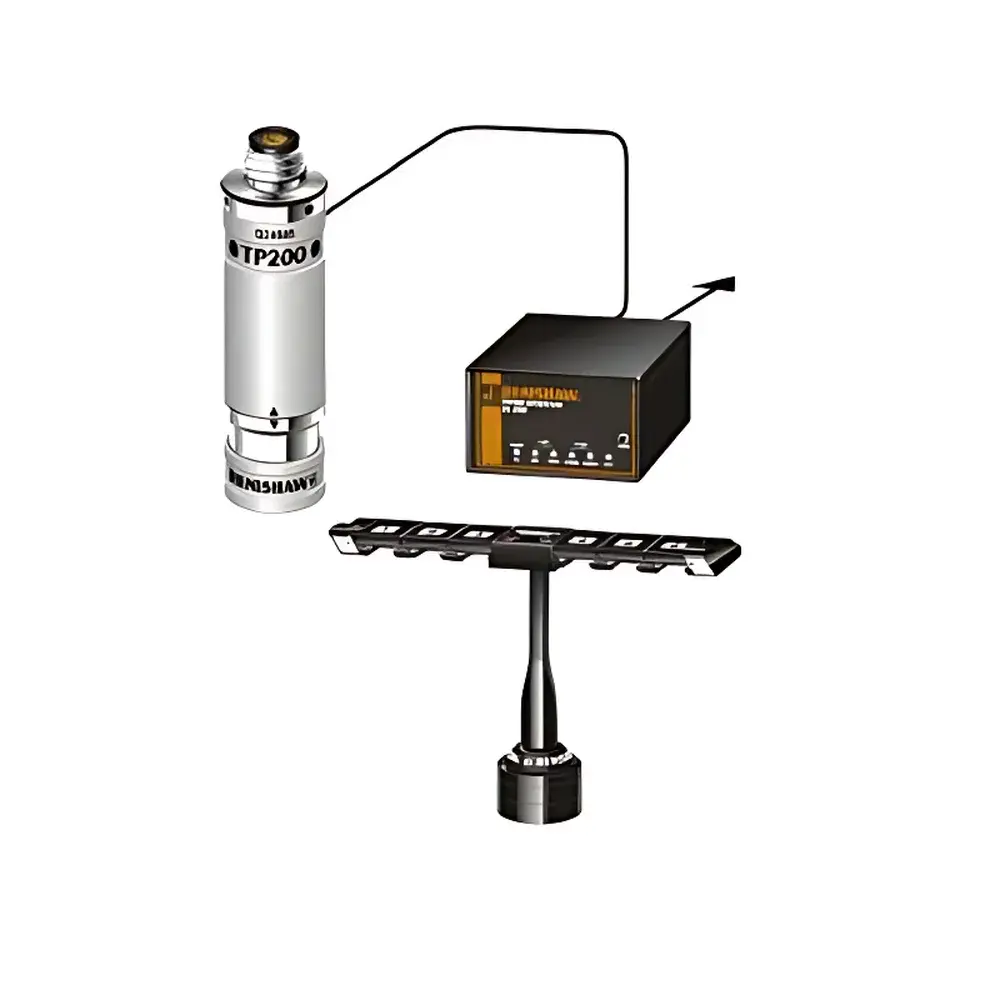
The Renishaw TP200 is a high-precision modular trigger probe engineered for coordinate measuring machines (CMMs) requiring sub-micrometre repeatability, directional isotropy, and long-term stability in demanding metrology environments. Unlike traditional mechanical switch-based probes, the TP200 employs a micro-strain gauge sensing principle—where minute dimensional changes in a precision-engineered flexure element are converted into proportional electrical signals via bonded semiconductor strain gauges. This solid-state transduction mechanism eliminates mechanical hysteresis, friction-induced anisotropy, and wear-related drift, delivering true 3D isotropic performance across all probing directions. The probe’s kinematic mounting interface ensures repeatable mechanical alignment during automatic toolchanging, while its low-mass design minimises dynamic deflection—critical when using extended or custom probe configurations. Designed and manufactured in the UK to ISO 9001-certified processes, the TP200 meets the foundational requirements of ISO 10360-2 (CMM probing performance) and supports traceable calibration in accordance with ISO/IEC 17025-accredited laboratories.
Key Features
- Micro-strain gauge sensor architecture providing isotropic triggering response and < 0.5 µm repeatability (3σ), independent of stylus length or orientation
- Two selectable overtravel force variants: Standard Force (SF) for general-purpose measurement of rigid components; Low Force (LF) for delicate surfaces, thin-walled features, or soft materials such as plastics and composites
- ASIC-integrated electronics enabling precise signal conditioning, digital debouncing, and electromagnetic noise immunity—ensuring robust operation in industrial shop-floor environments
- Modular design comprising interchangeable TP200 probe modules, PI 200 interface (with integrated temperature compensation and serial communication), and SCR200-compatible kinematic couplings
- No mechanical switches or moving contacts—eliminating contact wear, bounce, and maintenance intervals associated with legacy trigger probes
- Full compatibility with Renishaw’s MODUS™ CMM software suite and third-party metrology platforms supporting I++ DME or UCC protocols
Sample Compatibility & Compliance
The TP200 is qualified for use across a broad spectrum of manufactured parts—from aerospace turbine blades and medical implants to automotive powertrain components and precision moulded optics. Its LF variant enables reliable data capture on surfaces with Ra < 0.2 µm finish, while SF maintains geometric fidelity on hardened steel and cast iron up to 62 HRC. The system complies with ISO 10360-5 for probing error evaluation and supports GLP/GMP-aligned workflows through audit-trail-enabled software integration. All probe modules undergo individual thermal drift characterisation at 20 °C ± 0.5 °C and are supplied with traceable calibration certificates compliant with UKAS or equivalent national metrology institute standards.
Software & Data Management
The TP200 operates natively within Renishaw’s MODUS™ metrology software, enabling real-time probe qualification, dynamic compensation for stylus bending, and automated calibration routines per ISO 10360-5 Annex B. When integrated with enterprise MES or QMS platforms, raw trigger events—including timestamp, vector direction, and status flags—are logged with full 21 CFR Part 11-compliant electronic signatures and change history. Data export formats include ASCII (.txt), DMIS 4.3+, and STEP AP242 for downstream GD&T analysis in PolyWorks or Metrolog X4. Firmware updates are delivered via Renishaw’s secure Update Manager, ensuring continued conformance with evolving IEC 61508 functional safety guidelines for embedded probe electronics.
Applications
- High-accuracy form and position verification of GD&T-controlled features (e.g., true position, concentricity, profile of a surface)
- In-process validation of CNC-machined components prior to final heat treatment or surface finishing
- First-article inspection of injection-moulded polymer housings with thin ribs and snap-fit geometries
- Reverse engineering of legacy parts where tactile point-cloud density and vector accuracy dictate model fidelity
- Calibration artefact verification—including step gauges, ring gauges, and sphere plates—under ISO/IEC 17025 scope
- Automated multi-sensor CMM cells combining TP200 with optical line scanners or CT modules for hybrid metrology workflows
FAQ
What distinguishes the TP200 from the earlier TP20 series?
The TP200 replaces mechanical microswitches with solid-state micro-strain gauges, eliminating directional bias and improving long-term repeatability by up to 40%—particularly with stylus lengths exceeding 50 mm.
Can the TP200 be used on articulated arms or portable CMMs?
No—the TP200 is designed exclusively for bridge, gantry, and horizontal-arm CMMs equipped with Renishaw’s PI 200 interface and SCR200-compatible probe racks.
Is firmware update capability available for field-deployed units?
Yes—via Renishaw’s MODUS™ Software or standalone Update Manager, with version history and cryptographic signature verification.
Does the TP200 support analog output or only digital triggering?
It is a digital-only trigger probe; analog displacement sensing requires Renishaw’s PH20 or REVO systems.
How often does the TP200 require recalibration?
Annual recalibration is recommended under ISO 10012; however, routine in-house qualification (e.g., sphere calibration) should be performed before each shift or measurement campaign per ISO 17025 Clause 7.7.