
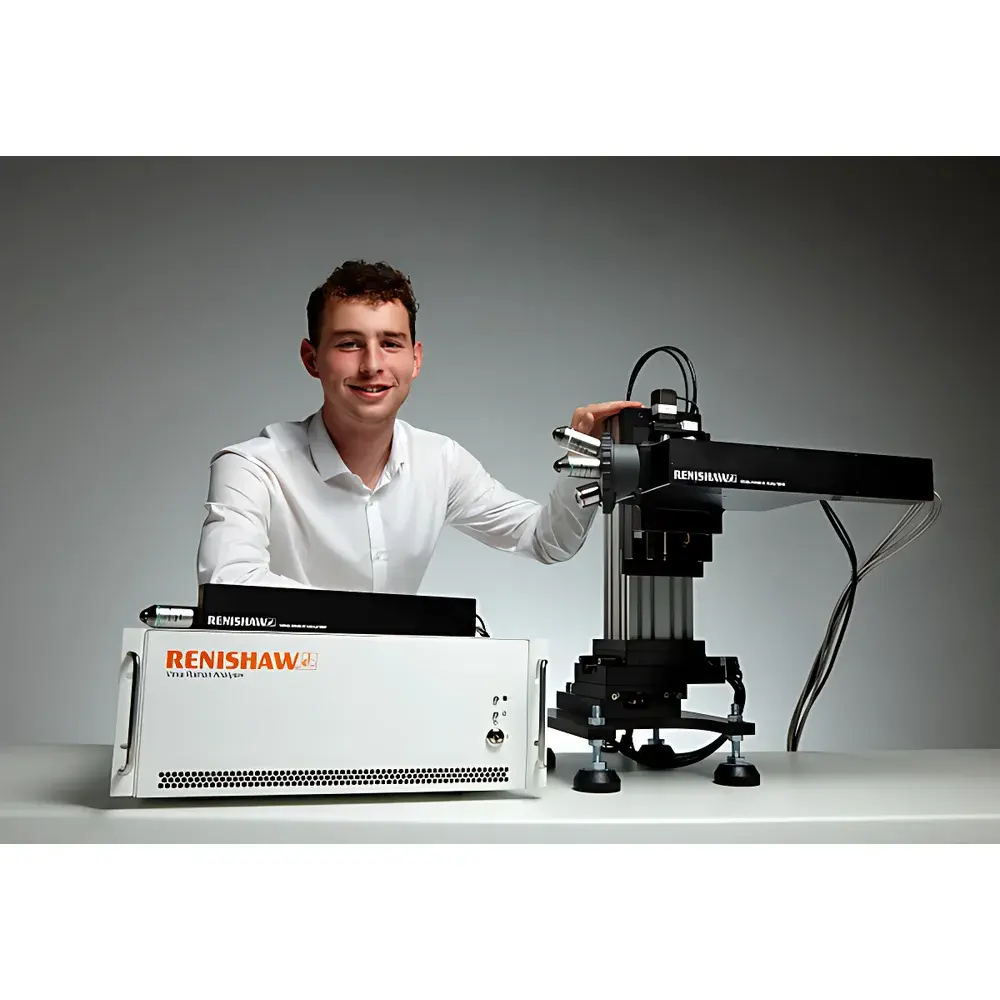
Renishaw Virsa Raman Analyzer
| Brand | Renishaw |
|---|---|
| Origin | United Kingdom |
| Model | Virsa Raman Analyzer |
| Instrument Type | Portable/Handheld Raman Spectrometer |
| Spectral Range | 50–4000 cm⁻¹ |
| Spectral Resolution | <2.5 cm⁻¹ |
| Spatial Resolution | XY <0.5 µm, Z <2 µm |
| Minimum Wavenumber | 50 cm⁻¹ |
| Spectral Reproducibility | <±0.1 cm⁻¹ |
Overview
The Renishaw Virsa Raman Analyzer is a high-performance, portable Raman spectrometer engineered for in situ and non-destructive molecular characterization across industrial, pharmaceutical, and materials science environments. Utilizing confocal Raman spectroscopy—based on inelastic scattering of monochromatic light—the Virsa delivers research-grade spectral fidelity while maintaining field-deployable ergonomics. Its core architecture integrates a thermally stabilized laser excitation source, high-throughput transmission spectrometer, and low-noise CCD detector, enabling robust signal acquisition even under variable ambient conditions. Designed for direct analysis of samples that cannot be relocated—such as large-scale manufactured components, heritage artifacts, or fragile composite structures—the Virsa eliminates the need for destructive sampling or laboratory transport, thereby preserving sample integrity and accelerating decision cycles in quality assurance and failure analysis workflows.
Key Features
- True portability with integrated battery operation and ruggedized enclosure rated to IP54 for use in production floors, cleanrooms, and field sites.
- Multi-wavelength excitation capability (e.g., 532 nm, 633 nm, 785 nm) with automated laser switching—no realignment or sample repositioning required—minimizing fluorescence interference and optimizing signal-to-noise ratio across diverse sample classes.
- Confocal optical design delivering sub-micron spatial resolution: XY <0.5 µm and axial (Z) resolution <2 µm—enabling precise chemical mapping of heterogeneous surfaces, thin-film interfaces, and micro-inclusions.
- Standard 5 m fiber-optic probe (extendable up to 20 m), decoupling the spectrometer unit from the measurement point for safe analysis of hazardous, hot, or inaccessible locations.
- Motorized focus adjustment with optional integrated CMOS camera for real-time visual targeting and precise region-of-interest selection prior to spectral acquisition.
Sample Compatibility & Compliance
The Virsa accommodates a broad range of physical sample forms—including solids, powders, gels, and liquids—via interchangeable probe configurations. Optional immersion probes enable direct analysis of aqueous or solvent-based solutions; high-pressure and temperature-rated probes support process monitoring under non-ambient conditions (e.g., catalytic reactors, polymerization vessels). All hardware and software comply with ISO/IEC 17025 requirements for analytical instrument validation, and spectral data files adhere to ASTM E1840 and ISO 19728 standards for Raman spectral metadata formatting. The system supports GLP/GMP-aligned audit trails when operated with Renishaw’s WiRE 5.x software suite configured for 21 CFR Part 11 compliance (electronic signatures, user access control, immutable data logging).
Software & Data Management
Controlled via Renishaw’s WiRE (Windows-based Raman Environment) software platform, the Virsa offers intuitive workflow-driven operation—from rapid single-spectrum capture to automated hyperspectral imaging and multivariate chemometric analysis (PCA, cluster analysis, spectral unmixing). Raw spectra are stored in vendor-neutral .spa/.spc formats alongside embedded calibration and acquisition metadata. Batch processing, spectral library matching against >10,000 reference compounds (including USP, EP, and in-house libraries), and customizable reporting templates facilitate integration into LIMS and ELN ecosystems. Data export supports CSV, ASCII, and HDF5 formats for third-party analysis tools such as MATLAB, Python (scikit-learn, SciPy), and Thermo Fisher OMNIC.
Applications
- Pharmaceutical: Polymorph identification, API distribution mapping in tablets, counterfeit drug screening, and stability-indicating assay development.
- Materials Science: Carbon nanotube chirality assessment, graphene layer counting, stress/strain mapping in composites, and corrosion product identification on metallic substrates.
- Forensics & Cultural Heritage: Non-invasive pigment analysis in paintings, ink differentiation in questioned documents, and degradation product detection in historical polymers.
- Manufacturing QA/QC: Real-time verification of coating composition, weld zone chemistry, and additive manufacturing powder feedstock homogeneity.
FAQ
Can the Virsa be used for quantitative analysis?
Yes—when coupled with certified reference standards and validated calibration models, the Virsa supports semi-quantitative and quantitative analysis per ICH Q2(R2) guidelines, particularly for uniform solid-phase systems.
Is fiber-optic alignment required after changing wavelengths?
No—the system employs pre-aligned, wavelength-agnostic fiber coupling; laser switching is fully automated without mechanical recalibration.
What maintenance is required for long-term spectral stability?
Annual wavelength and intensity calibration using NIST-traceable polystyrene or silicon standards is recommended; no routine optical realignment is necessary due to monolithic optomechanical construction.
Does the Virsa support remote operation?
Yes—WiRE software enables secure remote desktop access and scheduled unattended measurements via Ethernet or Wi-Fi, compatible with enterprise IT security policies.
Can I integrate the Virsa into an automated production line?
Yes—digital I/O ports and TCP/IP command protocol allow synchronization with PLCs, robotic arms, and MES systems for inline process analytics deployment.




