
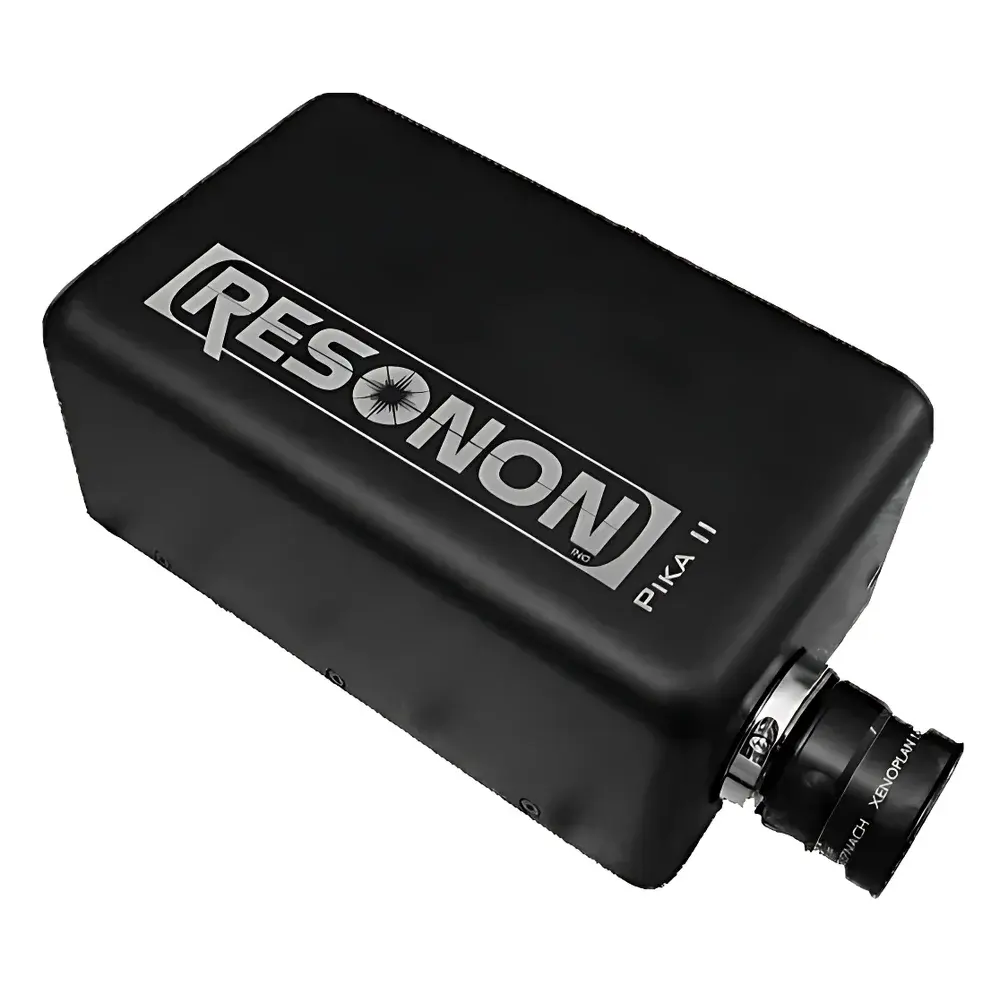
Resonon Pika II VNIR Hyperspectral Imaging System
| Brand | Resonon |
|---|---|
| Origin | USA |
| Model | Pika II |
| Operating Principle | Push-broom |
| Imaging Method | Dispersive |
| Deployment | Ground-based & Airborne |
| Spectral Range | 400–900 nm |
| Spectral Resolution | 2.1 nm |
| Spatial Channels | 640 |
| Spectral Channels | 240 |
| Frame Rate | 145 fps |
| Field of View (TFOV) | 3.9°, 5.5°, 12.0°, 16.0°, 22.5°, 33.0°, or 43.5° (interchangeable optics) |
| Instantaneous Field of View (IFOV) | 0.20, 0.30, 0.65, 0.88, 1.25, 1.9, or 2.5 mrad (optics-dependent) |
| Bit Depth | 12-bit |
| Interface | IEEE 1394b & Gigabit Ethernet |
| Power | 8–30 VDC, <2.5 W |
| Weight | 1.3 kg |
| Dimensions | 124 × 239 × 210 mm |
| Operating Temperature | 0–45 °C |
| Aperture | f/3.0 |
| RMS Spot Radius (avg.) | 7 µm |
| Smile (peak-to-peak) | 5 µm |
| Keystone (peak-to-peak) | 7 µm |
Overview
The Resonon Pika II is a high-performance visible-near-infrared (VNIR) push-broom hyperspectral imaging system engineered for scientific rigor and field-deployable reliability. Based on dispersive prism-grating optical architecture, the Pika II captures contiguous spectral data across 240 narrow bands from 400 to 900 nm at a nominal resolution of 2.1 nm—enabling precise material identification, spectral unmixing, and quantitative reflectance analysis. Its compact, ruggedized aluminum chassis (1.3 kg, 124 × 239 × 210 mm) supports both ground-based tripod mounting and airborne integration on UAVs, light aircraft, and manned platforms. The system’s low-stray-light optical path, high throughput efficiency, and sub-7 µm RMS spot radius ensure minimal spatial-spectral crosstalk—critical for maintaining fidelity in calibrated radiometric workflows. Designed for continuous operation in ambient temperatures from 0 to 45 °C, the Pika II delivers stable performance under variable thermal loads without active cooling.
Key Features
- Push-broom acquisition architecture with synchronized line-scanning—eliminates motion blur and enables real-time georeferenced data capture
- Optically optimized dispersive design minimizing smile (≤5 µm p-p) and keystone (≤7 µm p-p) distortions—ensuring pixel-level spectral registration accuracy
- High signal-to-noise ratio (>600:1 typical at 100 ms integration) achieved through back-illuminated CMOS sensor and low-noise electronics
- Interchangeable lens options supporting seven discrete TFOVs (3.9° to 43.5°) and corresponding IFOVs (0.20–2.5 mrad), enabling flexible ground sampling distance (GSD) configuration
- 12-bit digitization with dual interface support: IEEE 1394b (FireWire) and Gigabit Ethernet—facilitating seamless integration into existing data acquisition frameworks
- Ultra-low power consumption (<2.5 W at 12 VDC) compatible with battery-operated and embedded platforms
- Robust mechanical housing rated for shock (50 g) and vibration (5–500 Hz, 2.5 g RMS), validated per MIL-STD-810G guidelines
Sample Compatibility & Compliance
The Pika II is not sample-contacting; it operates as a passive, non-destructive remote sensing instrument. It is suitable for analyzing heterogeneous surfaces including vegetation canopies, mineral outcrops, agricultural crops, painted surfaces, pharmaceutical tablets, and industrial coatings. Radiometric calibration is traceable to NIST-traceable standards via Resonon’s factory-applied reflectance and irradiance calibration protocols. The system complies with ISO 17025-accredited calibration practices and supports audit-ready documentation required under GLP and GMP environments. While not FDA 21 CFR Part 11–certified out-of-the-box, its raw data export formats (ENVI .hdr/.bin, TIFF, HDF5) and metadata-rich output enable full compliance when integrated into validated laboratory information management systems (LIMS).
Software & Data Management
SpectrononPro—the official cross-platform application—provides full instrument control, real-time preview, radiometric correction, spectral library matching, and ENVI-compatible export. It supports automated dark-current subtraction, flat-field normalization, and geometric correction using built-in camera models. A comprehensive C++ SDK is provided royalty-free, granting developers full access to frame buffers, metadata headers, and hardware-triggered acquisition modes. The API supports multithreaded streaming, ROI selection, and synchronization with external GPS/IMU units—essential for orthorectification and photogrammetric processing pipelines. All software components generate timestamped, hash-verified logs compliant with ALCOA+ principles (Attributable, Legible, Contemporaneous, Original, Accurate, Complete, Consistent, Enduring, Available).
Applications
- Agricultural phenotyping: chlorophyll content mapping, nitrogen stress detection, and disease early-warning via spectral indices (e.g., NDVI, PRI, MCARI)
- Geological surveying: mineralogical classification using diagnostic absorption features near 700 nm (Fe²⁺), 820 nm (Al–OH), and 900 nm (Mg–OH)
- Environmental monitoring: water quality assessment (chlorophyll-a, CDOM, suspended solids) from airborne platforms
- Industrial QA/QC: coating thickness verification, pigment dispersion uniformity, and counterfeit detection in printed electronics and packaging
- Forensic science: document alteration analysis, ink differentiation, and latent trace evidence enhancement
- Pharmaceutical manufacturing: blend homogeneity evaluation and tablet coating thickness quantification via spectral unmixing
FAQ
What spectral calibration standards are used for factory calibration?
Resonon performs spectral calibration using NIST-traceable holmium oxide and didymium filters, supplemented by laser line sources at key wavelengths (e.g., 532 nm, 633 nm). Calibration certificates include uncertainty budgets per ISO/IEC 17025.
Can the Pika II operate synchronously with GNSS/IMU units?
Yes—the C++ SDK exposes hardware trigger inputs and outputs, and SpectrononPro supports time-synchronized logging of position, attitude, and exposure metadata via ASCII or binary serial protocols (e.g., NMEA 0183, SBP).
Is radiometric calibration temperature-stable across the operating range?
Dark current and responsivity drift are compensated in real time using on-board thermistors and embedded correction coefficients derived from thermal soak testing across 0–45 °C.
Does the system support real-time onboard processing?
Raw frame streaming is supported at full 145 fps; spectral indexing, band math, and basic anomaly detection can be implemented externally using the SDK—though no FPGA or GPU acceleration is embedded within the sensor head.
What is the maximum usable altitude for airborne deployment?
Altitude capability depends on lens selection and GSD requirements; with the 43.5° FOV lens, operational ceiling exceeds 1,200 m AGL while maintaining ≤10 cm GSD at 100 m altitude.
Related Products





