
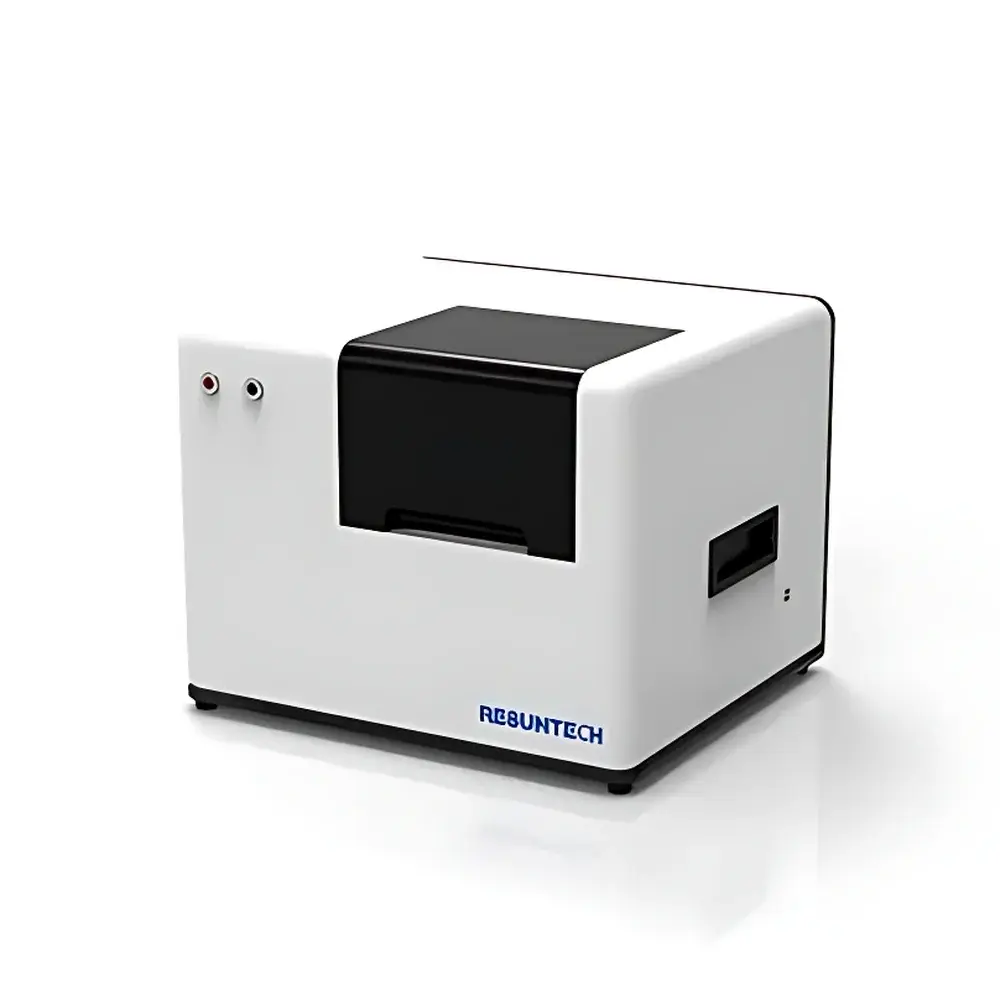
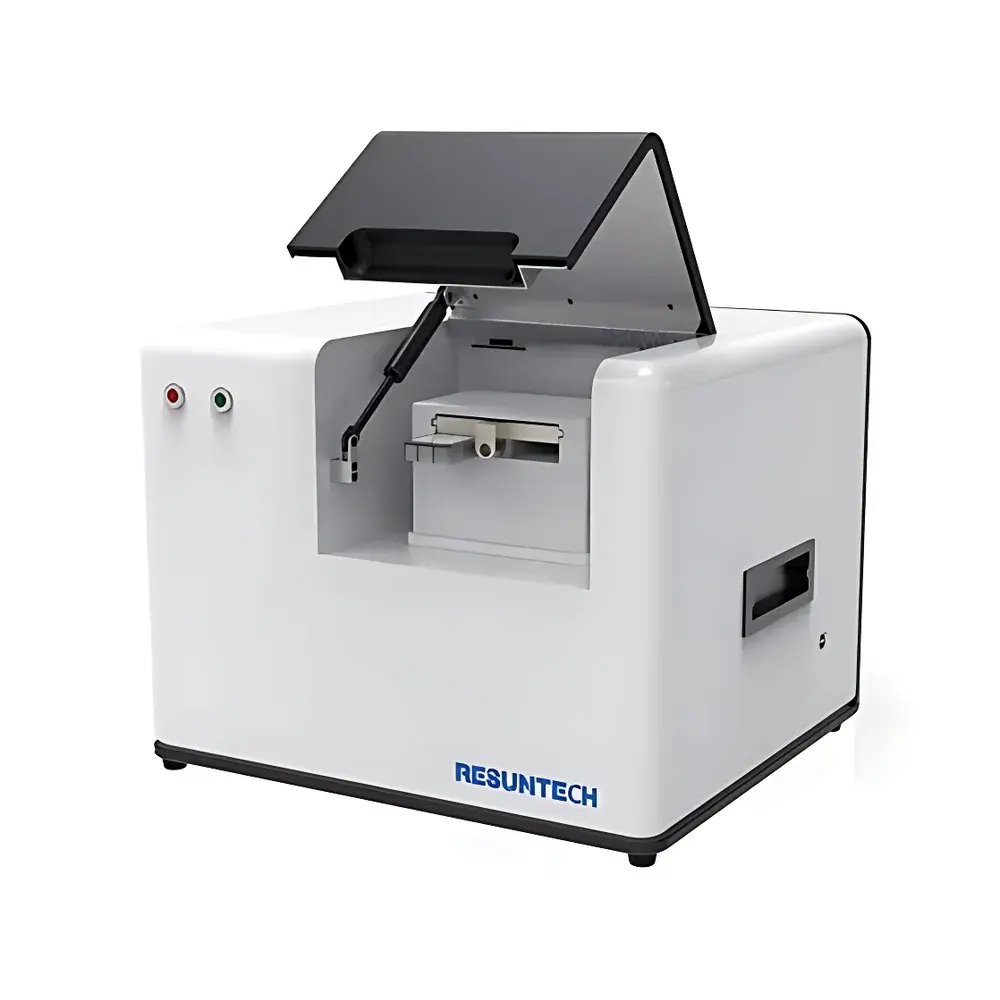
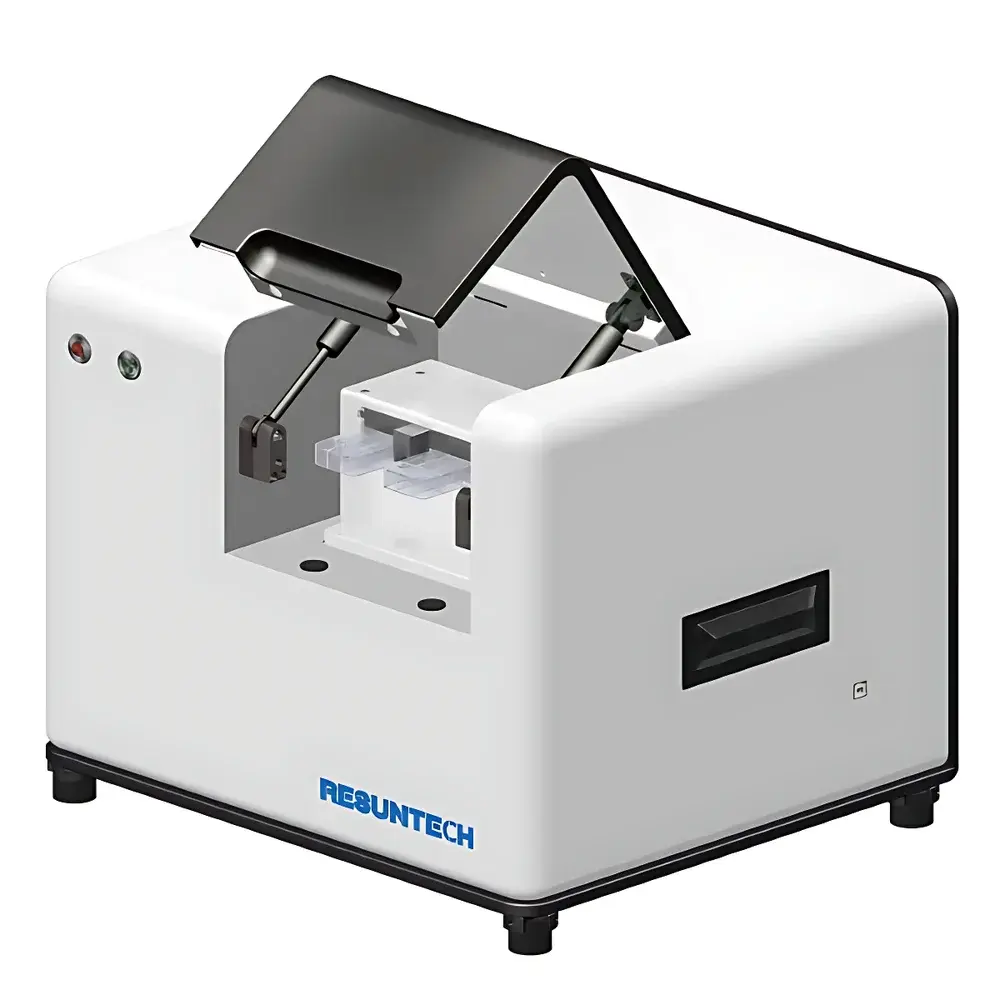
RESUNTECH NanoCoulter G Nanoparticle Analyzer (Size, Concentration & Zeta Potential)
| Brand | RESUNTECH |
|---|---|
| Origin | Shenzhen, China |
| Manufacturer Type | Authorized Distributor |
| Country of Origin | China |
| Model | NanoCoulter G |
| Price Range | USD 84,000–112,000 (FOB) |
| Size Range | 60–2000 nm |
| Size Reproducibility | >90% |
| Temperature Range | 5–40 °C |
| Temperature Control Accuracy | ±5 °C |
| Detection Principle | Resistive Pulse Sensing (RPS) |
| Sample Volume | 30–50 µL |
| Particle Concentration Range | 1×10⁶–1×10¹² particles/mL |
| Zeta Potential Range | −200 to +200 mV |
| Measurement Time | 5–10 min |
| Software Compliance | FDA 21 CFR Part 11, Audit Trail Enabled |
| Dimensions | 27 × 16.5 × 19 cm |
| Weight | 8 kg |
Overview
The RESUNTECH NanoCoulter G Nanoparticle Analyzer is an integrated resistive pulse sensing (RPS)-based platform engineered for high-fidelity, single-particle characterization of nanoscale colloids in liquid suspension. Unlike ensemble-averaging optical techniques such as dynamic light scattering (DLS), RPS measures discrete electrical pulses generated as individual particles translocate through a microfabricated nanopore under controlled electrophoretic or hydrodynamic flow. Each pulse amplitude correlates linearly with particle volume, while pulse duration reflects transit velocity—enabling simultaneous, label-free quantification of hydrodynamic diameter, absolute particle concentration, and zeta potential at the single-particle level. The instrument is purpose-built for applications demanding trace-level detection, high-resolution size distribution, and orthogonal validation against transmission electron microscopy (TEM) or flow cytometry—particularly in extracellular vesicle (EV), lipid nanoparticle (LNP), viral vector, and nanomedicine development workflows.
Key Features
- True single-particle resolution across 60–2000 nm, with demonstrated correlation to TEM data per MISEV2023 guidelines
- No calibration required: pre-programmed detection cartridges auto-configure measurement parameters via QR code scan
- Disposable, non-invasive microfluidic cartridges eliminate cross-contamination risk and eliminate cleaning protocols between runs
- Integrated zeta potential module enabling concurrent measurement of surface charge on each detected particle—not averaged values
- Full-pulse waveform capture and storage: raw current-time traces for every event are retained for retrospective reanalysis, threshold adjustment, or custom gating
- FDA 21 CFR Part 11-compliant software architecture with electronic signatures, role-based access control, and immutable audit trail for GLP/GMP-regulated environments
Sample Compatibility & Compliance
The NanoCoulter G supports aqueous suspensions of biological and synthetic nanoparticles—including exosomes, liposomes, LNPs, adenovirus, vaccinia virus, magnetic nanoparticles, and latex standards—without requirement for labeling, fixation, or dilution beyond standard protocol ranges (30–50 µL native sample; up to 200 µL post-dilution). It operates within ISO 13322-2:2020 compliant RPS methodology and meets ASTM E2490-18 criteria for nanoparticle concentration determination. All firmware and software modules undergo IQ/OQ/PQ validation support documentation per ICH Q5A(R2) and USP <1043> for biopharmaceutical particulate analysis. Instrument design conforms to IEC 61010-1 safety standards for laboratory electrical equipment.
Software & Data Management
The Windows-based NanoCoulter Analysis Suite provides bilingual (English/Chinese) GUI with modular workflow configuration. It delivers real-time visualization of pulse histograms, scatter plots of size vs. zeta potential, and cumulative concentration curves. Raw pulse data are stored in HDF5 format with embedded metadata (operator ID, timestamp, cartridge lot, environmental conditions). Audit trail logs record all user actions—including parameter changes, data exports, report generation, and software updates—with tamper-proof timestamps. Export options include CSV, PDF, and XML formats compatible with LIMS integration. Optional 3Q (IQ/OQ/PQ) documentation packages are available for regulated laboratories requiring full traceability from installation to operational qualification.
Applications
- Extracellular Vesicle Characterization: Quantifies EV size distribution (LOD 50–800 nm) and concentration (5×10⁷–2×10¹¹ particles/mL), supporting MISEV2023-compliant reporting and orthogonal verification of ultracentrifugation, SEC, or immunoaffinity isolation efficiency
- Lipid Nanoparticle Process Development: Resolves multimodal LNP populations invisible to DLS; calculates component-specific concentration within user-defined size gates (e.g., 80–120 nm fraction), and correlates zeta potential heterogeneity with formulation stability
- Viral Vector Quality Control: Enables batch-to-batch comparability of adenovirus or poxvirus preparations by tracking particle count, aggregation state, and surface charge drift during storage or purification
- Nanomagnetic Bead Optimization: Evaluates dispersion efficacy of sonication protocols via direct particle-count-based assessment of monodispersity and residual clustering
- Latex Immunoassay Support: Monitors antibody conjugation-induced aggregation in real time, providing quantitative metrics for coating optimization and quality release testing
FAQ
Does the NanoCoulter G require daily calibration or warm-up time?
No. The system uses factory-characterized, QR-coded disposable cartridges that embed pore geometry, fluidics, and voltage parameters—eliminating manual calibration or thermal stabilization delays.
Can it measure zeta potential without electrophoretic mobility assumptions?
Yes. The integrated electrophoretic module directly measures particle velocity under applied field, computing zeta potential using Henry’s equation with Smoluchowski approximation validated for aqueous systems at pH 4–10.
Is raw pulse data export supported for third-party analysis?
Yes. Full-resolution current-vs.-time waveforms for every detected event are saved in open HDF5 format with documented schema, enabling MATLAB, Python, or custom algorithm integration.
How does it handle highly polydisperse or aggregated samples?
The RPS principle inherently resolves individual particles even in heterogeneous mixtures; however, aggregate dissociation prior to analysis is recommended when physical integrity must be preserved—validated protocols for gentle sonication or buffer exchange are provided.
What regulatory documentation is available for audit readiness?
Standard delivery includes software validation summary, electrical safety certificate, and optional full 3Q package (Installation, Operational, Performance Qualification) aligned with ISO/IEC 17025 and FDA guidance for computerized systems.



