
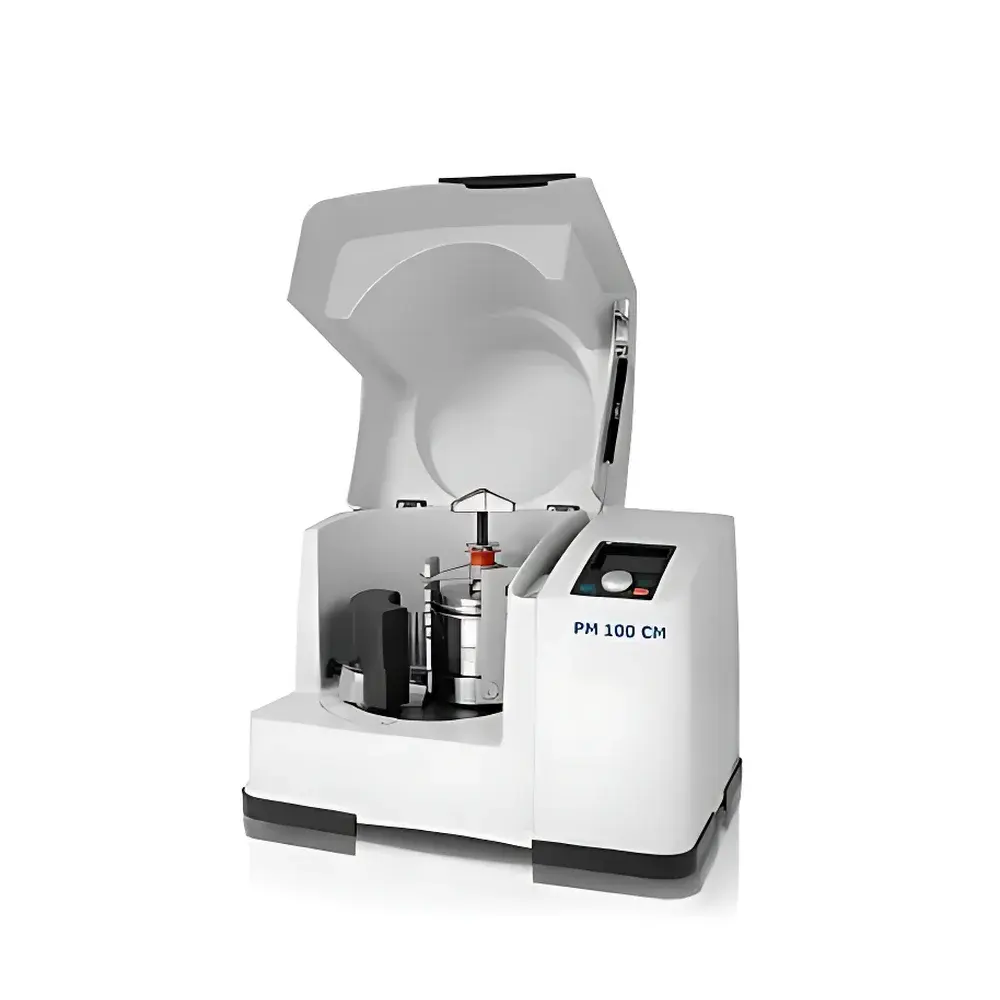
Retsch PM100 CM Centrifugal Planetary Ball Mill
| Brand | Retsch |
|---|---|
| Origin | Germany |
| Model | PM100 CM |
| Instrument Type | Planetary Ball Mill |
| Sample Suitability | Hard, brittle, fibrous, soft materials (dry or wet grinding) |
| Max. Feed Size | < 10 mm |
| Final Particle Size | < 0.1 µm (colloidal grinding) |
| Batch Volume | up to 1 × 220 mL |
| Grinding Mechanism | Impact and friction forces |
| Sun Wheel Speed | 100–650 rpm |
| Effective Sun Wheel Diameter | 141 mm |
| Relative Centrifugal Force (RCF) | 33.3 g |
| Grinding Jar Capacity Options | 12, 25, 50, 80, 125, 250, 500 mL |
| Jar Materials | Stainless steel, hardened steel, tungsten carbide, agate, sintered corundum, silicon nitride, zirconium oxide |
| Drive | 750 W three-phase AC motor with frequency inverter |
| Power Consumption | ~1250 VA |
| Dimensions (W × H × D) | 640 × 480 (780) × 420 mm |
| Net Weight | ~86 kg |
| Protection Class | IP 30 |
| Compliance | CE-marked |
| Patents | DE 20307741 (counterweight), DE 20310654 (FFCS), DE 202008008473 (safety slider) |
| Interface | RS-232 / RS-485 |
| Programmable Modes | 10 stored protocols |
| Time Control | Grind, pause, reverse rotation — all digitally adjustable from 00:00:01 to 99:59:59 |
| Jar Fixation | “Comfort” type with safety locking mechanism |
Overview
The Retsch PM100 CM is a high-energy centrifugal planetary ball mill engineered for reproducible, high-intensity comminution of hard, brittle, fibrous, and soft materials under dry or wet conditions. Operating on the principle of centrifugal planetary motion, the instrument generates exceptionally high relative centrifugal forces (up to 33.3 g) by rotating the sun wheel at speeds between 100 and 650 rpm while simultaneously driving the grinding jar(s) in the opposite direction. This counter-rotational kinematics amplifies impact energy and shear stress, enabling ultra-fine particle size reduction down to sub-100 nm levels—particularly effective in colloidal grinding applications where nanoscale homogeneity is critical. Unlike conventional planetary mills operating in standard mode, the PM100 CM’s dedicated centrifugal configuration minimizes mechanical wear on components and enhances process efficiency, reducing required grinding time without compromising precision or repeatability. Its robust cast-aluminum housing and vibration-damped base ensure operational stability during extended high-speed runs.
Key Features
- Centrifugal-mode operation delivering up to 33.3 g RCF for accelerated particle size reduction
- Dual-direction programmable drive: forward, reverse, and intermittent rotation with independent timing control (00:00:01–99:59:59)
- 10 user-definable grinding protocols stored internally for method reproducibility
- “Comfort”-type jar clamping system with integrated safety lock mechanism compliant with DIN EN 61000-6-2 and IEC 61000-6-4
- Wide range of jar volumes (12–500 mL) and material options—including zirconium oxide, tungsten carbide, and sintered corundum—for contamination-sensitive or abrasive applications
- Digital time control with real-time display of elapsed and remaining runtime
- Frequency-inverter-driven 750 W three-phase AC motor ensuring consistent torque across speed ranges
- RS-232 and RS-485 serial interfaces for integration into automated lab networks or LIMS environments
Sample Compatibility & Compliance
The PM100 CM accommodates diverse sample types including metals, alloys, ceramics, minerals, pharmaceutical actives, polymers, and biological tissues. It supports both dry grinding and wet dispersion using solvents such as ethanol, isopropanol, or aqueous surfactant solutions. The instrument complies with CE directives covering electromagnetic compatibility (EMC), low voltage (LVD), and machinery safety. Its design incorporates patented mechanical safeguards—including an adaptive counterweight system (DE 20307741), FFCS force feedback control (DE 20310654), and a fail-safe sliding safety block (DE 202008008473)—to prevent unbalanced operation and unintended jar ejection. For regulated environments, the device supports audit-ready documentation when paired with Retsch’s optional software packages compliant with FDA 21 CFR Part 11 requirements for electronic records and signatures.
Software & Data Management
While the PM100 CM operates autonomously via its front-panel interface, it is fully compatible with Retsch’s RETSCH Software Suite (optional), which enables remote parameter configuration, real-time monitoring, and secure export of grinding logs in CSV or PDF formats. All executed protocols—including speed profiles, duration settings, reversal sequences, and pause intervals—are timestamped and stored with unique identifiers. The RS-232/RS-485 interface allows bidirectional communication with laboratory information management systems (LIMS) or enterprise resource planning (ERP) platforms. Data integrity is maintained through non-volatile memory and automatic backup upon power loss. The software architecture adheres to GLP/GMP principles, supporting traceability, user access controls, and electronic signature workflows where required.
Applications
The PM100 CM serves critical roles across multiple analytical and preparatory workflows. In materials science, it facilitates mechanochemical synthesis of metal-organic frameworks (MOFs), alloy nanopowders, and solid-state battery cathode precursors. In pharmaceutical development, it enables amorphization of crystalline APIs and preparation of nanosuspensions for bioavailability enhancement. Environmental labs use it for homogenizing soil, sediment, and fly ash samples prior to heavy metal extraction (per EPA Method 3050B). Geological and metallurgical laboratories rely on its ability to pulverize silicates, oxides, and refractory ores to <100 nm for XRD, SEM-EDS, or ICP-MS analysis. Additionally, it supports quality control in ceramics and glass manufacturing by producing standardized reference powders with narrow PSD distributions.
FAQ
What distinguishes the PM100 CM from standard planetary ball mills?
The PM100 CM operates exclusively in centrifugal mode, generating significantly higher RCF than conventional planetary configurations—enabling faster, more energetic grinding with reduced mechanical wear.
Can the PM100 CM perform cryogenic grinding?
Yes—when equipped with stainless steel or tungsten carbide jars and used with liquid nitrogen cooling accessories (sold separately), it supports cryo-milling of thermolabile or ductile materials.
Is the instrument suitable for ISO/IEC 17025-accredited laboratories?
Yes—its programmable parameters, audit-trail-capable software interface, and CE-compliant safety architecture meet foundational requirements for method validation and equipment qualification.
How is jar balancing ensured during high-speed operation?
The patented FFCS (Force Feedback Control System) continuously monitors rotational asymmetry and adjusts motor response to maintain dynamic equilibrium, eliminating manual balancing steps.
What maintenance intervals are recommended for routine operation?
Routine inspection of jar seals, clamping mechanisms, and drive belts is advised every 500 operating hours; full calibration and torque verification should occur annually or per internal SOP.



