Revealer PIV-EDU Educational Particle Image Velocimetry System
| Brand | Revealer |
|---|---|
| Origin | Anhui, China |
| Manufacturer Type | Authorized Distributor |
| Country of Origin | China |
| Model | PIV-EDU Educational PIV System |
| Measurement Capability | 2D Planar Flow Field Visualization and Quantification |
| Operating Frequency | Low-Frequency Synchronized Imaging (Typical Range: 1–15 Hz) |
| Flow Visualization Medium | Water-based Seeded Flow |
| Core Components | Recirculating Water Channel, Cylindrical Obstacle Set, Pulsed Laser Illumination Module (532 nm, Class IV), High-Sensitivity CMOS Camera (12-bit, 1280×1024 resolution, Global Shutter), RFlow2D2C Acquisition & Cross-Correlation Software |
| Compliance | Designed for Academic Use in Accordance with ASTM E2655–21 (Standard Guide for Education in Fluid Mechanics) and ISO/IEC 17025:2017 Principles for Calibration Laboratories |
Overview
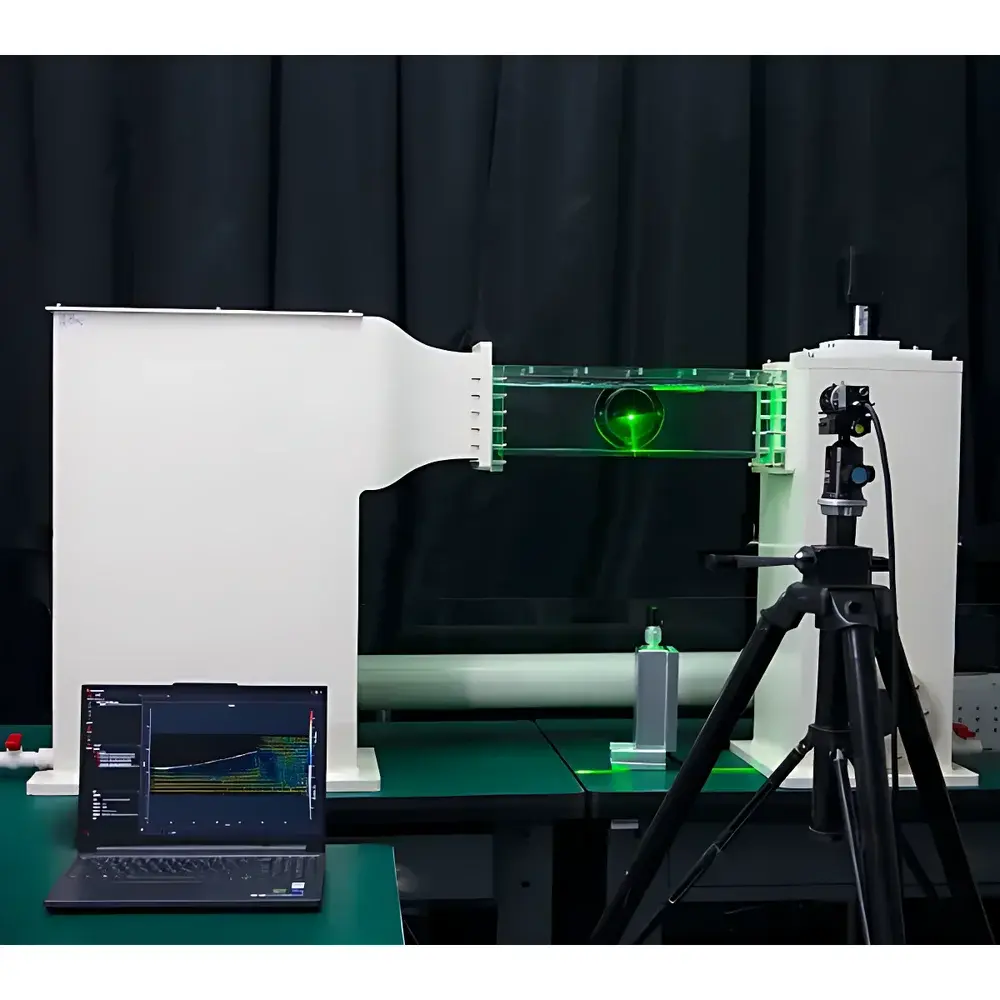
The Revealer PIV-EDU Educational Particle Image Velocimetry System is a purpose-built, turnkey teaching platform engineered for undergraduate fluid mechanics laboratories. It implements the fundamental principle of time-resolved laser sheet illumination combined with double-frame digital image correlation to quantify instantaneous two-dimensional velocity vector fields in transparent, seeded fluid media—primarily water. Unlike research-grade PIV systems optimized for high-speed or volumetric reconstruction, the PIV-EDU prioritizes pedagogical clarity, operational safety, and reproducible classroom-scale experiments. Its architecture follows the classical Cuvelier–Adrian configuration: a low-repetition-rate pulsed green laser (532 nm) generates a thin light sheet orthogonal to the flow direction; suspended tracer particles (e.g., hollow glass spheres or polyamide seeding, ~10–50 µm diameter) scatter light into a high-sensitivity CMOS camera equipped with a macro lens and synchronized global shutter. Velocity vectors are computed via interrogation window-based cross-correlation algorithms embedded in the RFlow2D2C software suite. The system enables direct observation of vorticity generation, boundary layer separation, wake instability, and unsteady flow phenomena—making it ideal for illustrating foundational concepts such as Reynolds number dependence, drag coefficient estimation, and vortex shedding frequency (Strouhal number analysis).
Key Features
- Integrated recirculating water channel with adjustable flow rate (0–0.8 m/s), transparent acrylic test section (300 × 200 mm viewing area), and standardized cylindrical obstruction set for canonical bluff-body experiments.
- Class IV pulsed diode-pumped solid-state (DPSS) laser (532 nm, pulse energy ≥1.5 mJ, pulse width <10 ns) with integrated beam shaping optics and safety interlock circuitry compliant with IEC 60825-1:2014.
- High-dynamic-range CMOS sensor (12-bit ADC, 1280 × 1024 pixels, pixel size 5.2 µm) with programmable exposure and precise dual-frame triggering synchronized to laser pulses within ±100 ns jitter.
- RFlow2D2C software provides real-time acquisition, adaptive interrogation window sizing (from 16 × 16 to 64 × 64 pixels), sub-pixel displacement interpolation, vector validation (median filtering, universal outlier detection), and export of velocity components (u, v), vorticity (ωz), and streamlines in CSV, HDF5, and MATLAB-compatible formats.
- Modular mechanical design supports rapid reconfiguration for canonical experiments—including cylinder wake analysis, airfoil boundary layer visualization, and bio-inspired flapping foil kinematics—without requiring optical realignment.
Sample Compatibility & Compliance
The PIV-EDU operates exclusively in liquid-phase environments using aqueous suspensions of neutrally buoyant tracer particles. It is validated for use with standard educational seeding materials (e.g., Dantec Dynamics Polyamide 12, mean diameter 20 µm, ρ = 1.025 g/cm³) at particle number densities of 10–20 particles per interrogation window. No hazardous solvents or high-pressure gases are required. The system conforms to academic laboratory safety standards under ANSI Z87.1 (laser eyewear), UL 61010-1 (electrical safety), and ISO 13857 (safeguarding distances). While not certified for industrial metrology, its measurement traceability aligns with ASTM E2655–21 guidelines for fluid mechanics education and supports student-led validation against analytical solutions (e.g., potential flow around a cylinder) and published benchmark data (e.g., Williamson & Roshko, 1988 cylinder wake database).
Software & Data Management
RFlow2D2C is a Windows-based application developed specifically for educational PIV workflows. It features an intuitive GUI with experiment templates, live histogram feedback for laser intensity and particle density optimization, and built-in calibration tools using printed checkerboard patterns. All acquired image pairs and processed vector fields are timestamped and stored with full metadata (camera settings, laser pulse delay, flow rate, ambient temperature). The software supports audit-ready data logging and exports raw images in TIFF format with embedded EXIF tags. For institutional compliance, RFlow2D2C includes optional user authentication, session logging, and export history tracking—enabling alignment with GLP-aligned lab record-keeping practices in undergraduate capstone courses.
Applications
- Undergraduate instruction in fluid dynamics: Reynolds number scaling, laminar-to-turbulent transition, vortex shedding, and drag/lift coefficient derivation.
- Validation of computational fluid dynamics (CFD) models: Benchmarking OpenFOAM or ANSYS Fluent simulations against measured velocity fields in canonical geometries.
- Bio-inspired flow studies: Quantifying wake structures behind oscillating foils mimicking fish caudal fins or insect wings, supporting biomechanics and soft robotics curricula.
- Engineering design labs: Evaluating flow uniformity in ducts, assessing mixing efficiency in stirred tanks, and visualizing separation zones in diffuser configurations.
- Senior design projects and thesis research: Enabling students to conduct original experimental investigations with documented uncertainty budgets and statistical repeatability assessment.
FAQ
Is the PIV-EDU suitable for quantitative research beyond teaching?
The system is optimized for pedagogy and qualitative-to-semiquantitative classroom measurements. While velocity magnitudes are physically meaningful within calibrated flow regimes, it lacks NIST-traceable calibration certificates and environmental controls required for publication-grade research.
What training and documentation are provided?
Comprehensive English-language user manuals, lab experiment guides (including step-by-step protocols for cylinder wake and flapping foil experiments), safety checklists, and video tutorials are included. On-site or remote instructor training sessions are available upon request.
Can the system be upgraded to support 3D or stereoscopic PIV?
The current PIV-EDU hardware does not support stereo-PIV due to fixed single-camera geometry and lack of dual-lens calibration capability. However, the RFlow2D2C software architecture permits future integration with add-on modules if institutional requirements evolve.
What maintenance is required?
Routine maintenance includes periodic cleaning of optical windows and water channel surfaces, annual verification of laser pulse energy using a calibrated photodiode sensor, and CMOS sensor dust inspection. No consumables are required beyond standard seeding particles.
Does the system meet FDA or ISO 13485 requirements?
No—the PIV-EDU is not intended for medical device development or regulatory submission. It is classified as an educational instrumentation platform under ISO 9001:2015 quality management principles for academic equipment suppliers.