
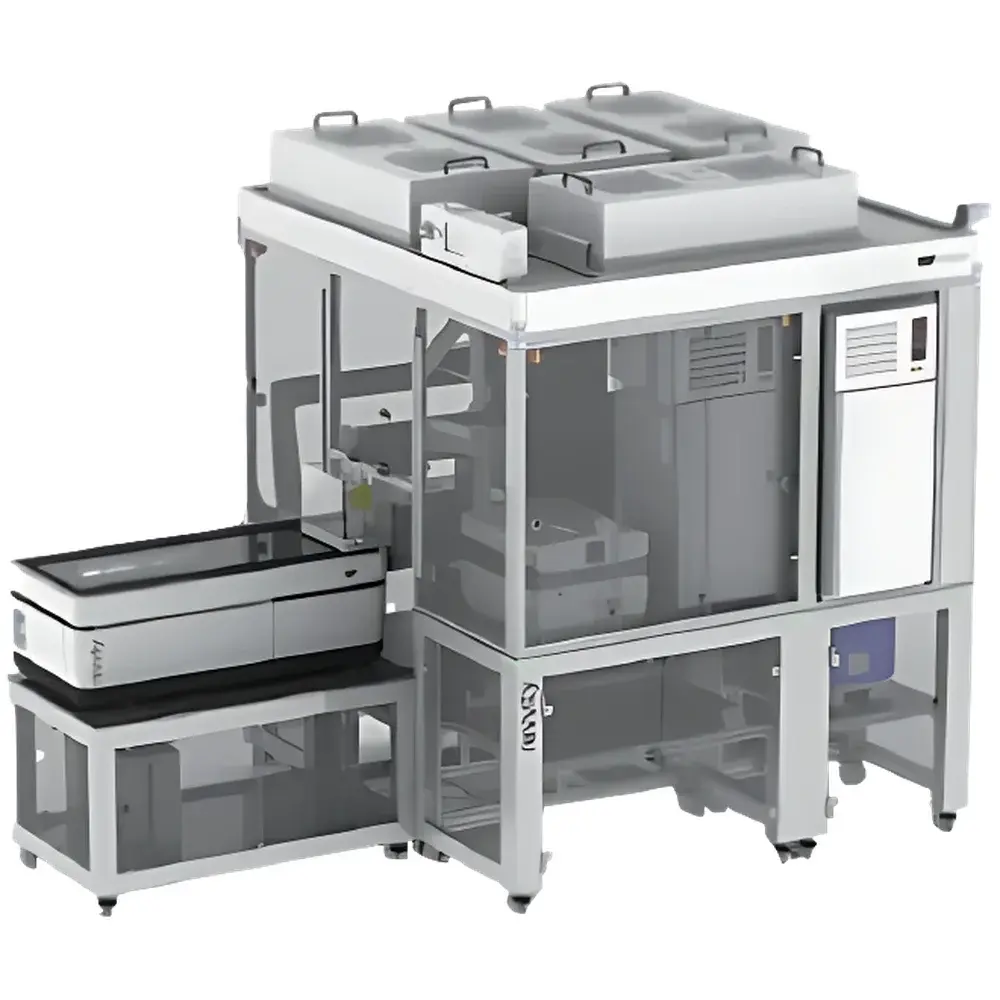
Revvity explorer G3 Integrated Robotic Automation System
| Brand | Revvity |
|---|---|
| Origin | Germany |
| Manufacturer Type | Original Equipment Manufacturer (OEM) |
| Origin Category | Imported |
| Model | explorer G3 |
| Pricing | Available Upon Request |
Overview
The Revvity explorer G3 Integrated Robotic Automation System is a fully modular, high-throughput laboratory automation platform engineered for end-to-end unattended operation in drug discovery and functional genomics workflows. Built upon Couette-flow–based robotic coordination and centralized deterministic scheduling architecture, the system integrates discrete life science instrumentation—including liquid handling, microplate reading, high-content imaging, incubation, centrifugation, and storage—into a unified, software-synchronized ecosystem. Unlike legacy point-to-point automation solutions, the explorer G3 employs a Flex collaborative robotic arm with ISO 9283–compliant repeatability (< ±0.1 mm) and programmable payload capacity (up to 1.5 kg), enabling precise, non-contact plate transport across heterogeneous device footprints. Its core intelligence resides in the proprietary Central Control Scheduler (CCS), which dynamically allocates tasks based on real-time device availability, priority queues, and workflow dependencies—ensuring optimal throughput without manual intervention. Designed for GLP- and GMP-aligned environments, the system supports continuous 7×24 operation under validated conditions and is routinely deployed in primary screening, hit confirmation, dose–response profiling, and phenotypic assay cascades.
Key Features
- 24/7 unattended operation with full hardware fault detection, automatic error recovery, and event-logged diagnostics
- Parallel task orchestration: simultaneous execution of liquid transfer, plate incubation, imaging acquisition, and data export across independent modules
- Modular architecture: each integrated instrument (e.g., JANUS G3, EnVision, Opera Phenix) retains standalone functionality and can be decoupled for offline maintenance or validation without system downtime
- Barcode-driven sample traceability: dual-mode scanning (1D/2D) with LIMS integration via ASTM E1714-compliant HL7 and ANSI X12 interfaces
- Plate logistics management: automated lid handling (sealing, peeling, storage), CO2 incubation (37 °C ±0.3 °C, 5% CO2 ±0.2%), and temperature-controlled storage (4–25 °C)
- Regulatory-ready software stack compliant with FDA 21 CFR Part 11, including electronic signatures, audit trails, and role-based access control
Sample Compatibility & Compliance
The explorer G3 accommodates standard SBS-format microplates (96-, 384-, and 1536-well), adherent and suspension cell cultures, cryovials (2 mL), and assay-ready reagent cartridges. All integrated instruments are CE-marked and meet IEC 61000-6-2/6-4 electromagnetic compatibility standards. The system’s operational protocols align with ISO/IEC 17025 for testing laboratories and support IQ/OQ/PQ documentation packages. For regulated biopharma applications, it satisfies critical elements of USP <1058> Analytical Instrument Qualification and enables full traceability from compound ID to raw image file (DICOM/OME-TIFF) and processed result (CSV/JSON), meeting ALCOA+ data integrity principles.
Software & Data Management
Controlled by Revvity’s Harmony v5.x orchestration suite, the explorer G3 provides a web-accessible interface for workflow design (drag-and-drop protocol builder), real-time monitoring (live camera feeds, status dashboards), and retrospective analysis. Data pipelines support direct export to CDD Vault, Dotmatics, Benchling, and internal ELN systems via RESTful APIs. All instrument-generated metadata—including timestamped plate movements, environmental logs (temperature, humidity, CO2), and sensor-derived calibration records—are archived in a time-stamped, immutable format. Audit trails capture user actions, parameter changes, and system alerts with SHA-256 hashing for forensic verification during regulatory inspections.
Applications
- Primary HTS campaigns against diverse compound libraries (synthetic, natural product, fragment, covalent inhibitor)
- Cell-based phenotypic screening with multi-parametric readouts (morphology, translocation, viability, apoptosis)
- Functional genomics workflows: CRISPR/Cas9 library screening, siRNA knockdown validation, and ORF overexpression assays
- Toxicity profiling using multiplexed endpoints (ATP content, membrane integrity, mitochondrial function)
- Automated assay development and robustness testing per ICH Q5C and Q2(R2) guidelines
FAQ
What types of microplates and labware are supported by the explorer G3?
Standard SBS-compliant plates (96-, 384-, 1536-well), PCR plates, deep-well blocks, cryovials (2 mL), and custom-labeled carriers with machine-readable barcodes.
Can the system integrate third-party instruments not listed in the standard configuration?
Yes—via Revvity’s Open Integration Framework (OIF), which provides SDKs and HL7/REST adapters for validated interoperability with non-Revvity devices meeting IEC 62304 Class B software safety requirements.
Is remote monitoring and troubleshooting supported?
Yes—the system includes secure TLS 1.3–encrypted remote access, live diagnostic telemetry, and predictive maintenance alerts delivered via email or SNMP traps.
How is data integrity ensured during long-duration screening runs?
Through write-once-read-many (WORM) archival, cryptographic checksums per data packet, and synchronized NTP time-stamping across all subsystem clocks to sub-millisecond precision.
Does the explorer G3 support assay miniaturization to 1536-well format?
Yes—JANUS G3 pipetting modules achieve CV < 3% at 1 µL dispense volumes, and Opera Phenix supports autofocus and z-stack acquisition in 1536-well plates with 40× water-immersion objectives.




