
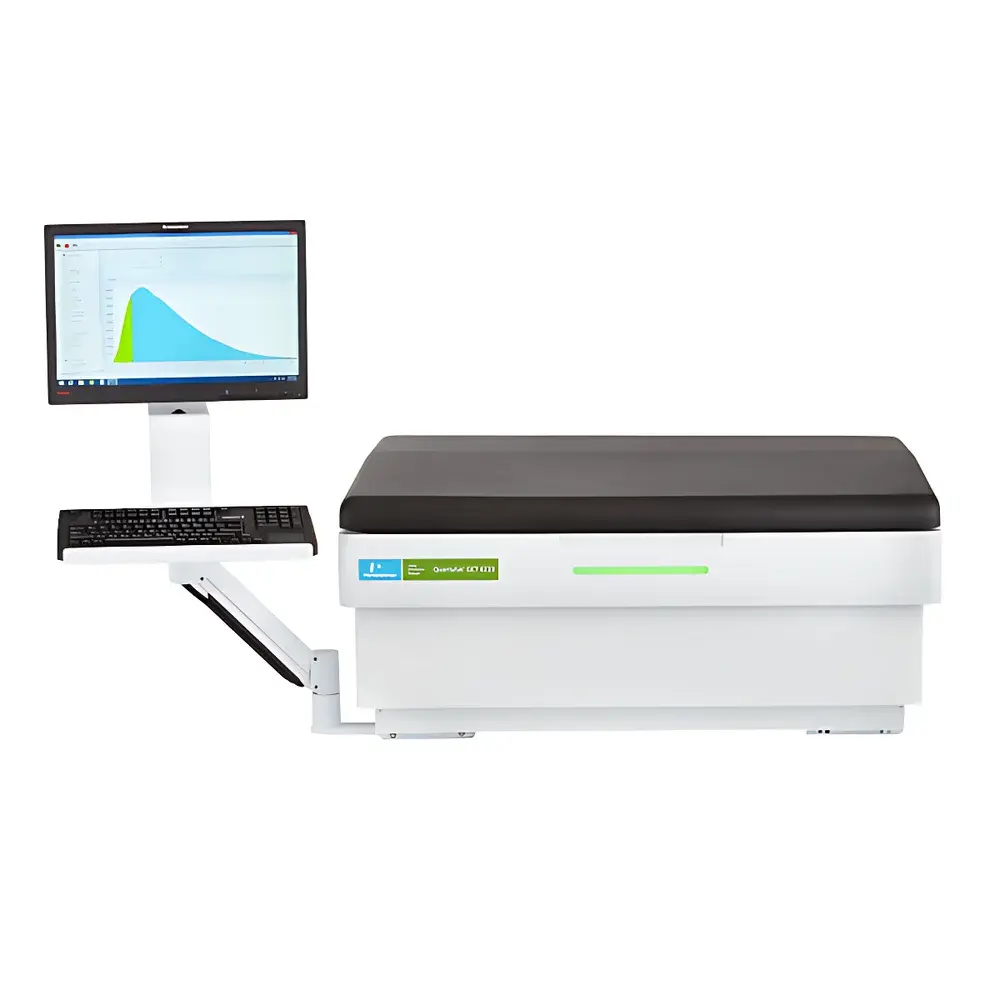
Revvity Tri-Carb Series Liquid Scintillation Spectrometer
| Brand | Revvity |
|---|---|
| Origin | USA |
| Model | Tri-Carb |
| Detection Principle | Dual-photomultiplier tube (PMT) coincidence counting with pulse-shape discrimination (PSD) and time-resolved LSC |
| Sample Capacity | Up to 200 vials (configurable via Varisette autosampler) |
| Operating System | Windows® 10 IoT Enterprise |
| Software | QuantaSmart™ v5.x with SpectraWork2™ analysis module |
| Compliance | FDA 21 CFR Part 11 (optional enhanced security module), ISO/IEC 17025 support, GLP/GMP audit trail capability |
| Temperature Control | Optional Peltier-based thermal regulation (±0.5 °C stability) |
| Alpha/Beta Discrimination | Standard on Tri-Carb 4910+, optional on 4810 |
| Dimensions (W×D×H) | 61 × 66 × 53 cm (Tri-Carb 4910/5110) |
Overview
The Revvity Tri-Carb Series Liquid Scintillation Spectrometers are engineered for high-precision, low-background quantification of alpha- and beta-emitting radionuclides in aqueous and organic scintillation cocktails. Utilizing dual-photomultiplier tube (PMT) coincidence detection, these instruments suppress electronic noise and cosmic background through pulse-shape discrimination (PSD), pulse amplitude comparison (PAC), and time-resolved liquid scintillation counting (TR-LSC). The Tri-Carb platform supports both routine CPM (counts per minute) and absolute DPM (disintegrations per minute) quantification—without requiring quench standards—via integrated spectral deconvolution and color correction algorithms. Designed for regulatory-compliant environments, the system architecture enables trace-level activity measurement down to sub-Bq/L levels in environmental water matrices, pharmaceutical metabolites, and archaeological carbon dating samples.
Key Features
- Dual-PMT coincidence counting with real-time spectrum display and automated spectral storage
- Direct DPM calculation using internal quench calibration curves—eliminating reliance on external quench standards
- Alpha/beta discrimination (ABD) enabled by pulse shape analysis (PSA), standard on Tri-Carb 4910 and higher models
- Varisette autosampler supporting heterogeneous vial formats (20 mL glass, 7 mL plastic, microcentrifuge tubes)
- QuantaSmart™ software with intuitive workflow-driven interface, preconfigured user protocols (15–60 depending on model), and full audit trail logging
- Optional temperature-controlled sample chamber (Peltier-cooled, ±0.5 °C stability) for reproducible counting of thermally sensitive cocktails
- UL/CSA-certified electrical safety and electromagnetic compatibility (EMC) compliance for global laboratory deployment
- Integrated Ethernet (2× Gigabit) and USB 3.0 (4× ports) connectivity for secure network integration and peripheral expansion
Sample Compatibility & Compliance
The Tri-Carb series accommodates a broad range of sample matrices—including aqueous solutions, tissue homogenates, blood plasma, soil extracts, and ethanol-based biological fuels—when prepared in compatible scintillation cocktails (e.g., Ultima Gold™, EcoLume™, or PerkinElmer’s proprietary formulations). All models meet ISO 11929:2019 for determination of characteristic limits and uncertainties in radioactivity measurements. The Quantulus GCT 6220 extends this capability with its patented Guard Compensation Technology (GCT), integrating a bismuth germanate (BGO) scintillation shield that actively detects and subtracts ambient gamma radiation, reducing instrument background by up to two orders of magnitude versus conventional LSC systems. This configuration satisfies ASTM D7283–22 for tritium in drinking water and EPA Method 906.0 for low-level alpha/beta screening in environmental monitoring programs. Full 21 CFR Part 11 compliance—including electronic signatures, role-based access control, and immutable audit trails—is available via the optional Enhanced Security Module.
Software & Data Management
QuantaSmart™ v5.x provides a validated, scalable software environment supporting method development, batch processing, statistical validation, and report generation in accordance with GLP and GMP requirements. Each system logs all acquisition parameters, operator actions, and instrument diagnostics with timestamped, non-erasable entries. SpectraWork2™ enables advanced spectral deconvolution for multi-label assays (up to three isotopes simultaneously), including 3H/14C/36Cl and 3H/14C/45Ca combinations. Data export conforms to ASTM E2500-20 and ISO/IEC 17025:2017 Annex A.2 for raw data integrity; outputs include CSV, PDF, XML, and LIMS-compatible ASCII formats. Remote monitoring and centralized fleet management are supported via optional Revvity Connect™ cloud gateway.
Applications
- Environmental monitoring: 3H in potable water (detection limit <1 Bq/L), 226Ra/228Ra in groundwater, 14C in atmospheric CO2 and bioethanol feedstocks
- Nuclear decommissioning: Low-level waste characterization, surface contamination mapping, and spent fuel pool surveillance
- Pharmaceutical ADME studies: Radiolabeled drug metabolism profiling in plasma, urine, and bile across preclinical and clinical phases
- Archaeological radiocarbon dating: Benzene-based 14C samples exceeding 51,000 years BP with optimized background rejection
- Food safety and forensics: Detection of illicit nuclear materials in agricultural products and beverages; verification of vintage wine authenticity via 14C spike analysis
- Energy research: Tritium tracer studies in fusion reactor coolant loops and geothermal brine reservoir modeling
FAQ
What is the minimum detectable activity (MDA) for 3H in water using the Quantulus GCT 6220?
The MDA for 3H in 10 mL aqueous samples is ≤0.85 Bq/L at 95% confidence (1000-minute count, background ≤0.08 cpm).
Does Tri-Carb support multi-isotope analysis without hardware modification?
Yes—SpectraWork2™ enables simultaneous 3H/14C/36Cl quantification using spectral deconvolution; no additional PMT or detector upgrades required.
Is QuantaSmart™ software validated for regulated laboratories?
Yes—software qualification documentation (IQ/OQ/PQ protocols), change control records, and 21 CFR Part 11 configuration files are provided with the Enhanced Security Module.
Can the Varisette autosampler handle 20 mL glass vials and 1.5 mL microtubes in the same run?
Yes—adaptive gripper design and programmable tray mapping allow mixed-format runs without manual intervention.
How does GCT technology differ from passive lead shielding alone?
GCT combines active BGO gamma vetoing with passive Pb shielding to reject both terrestrial and cosmic-ray-induced background events—achieving net background rates below 0.05 cpm in ultra-low-level configurations.







