
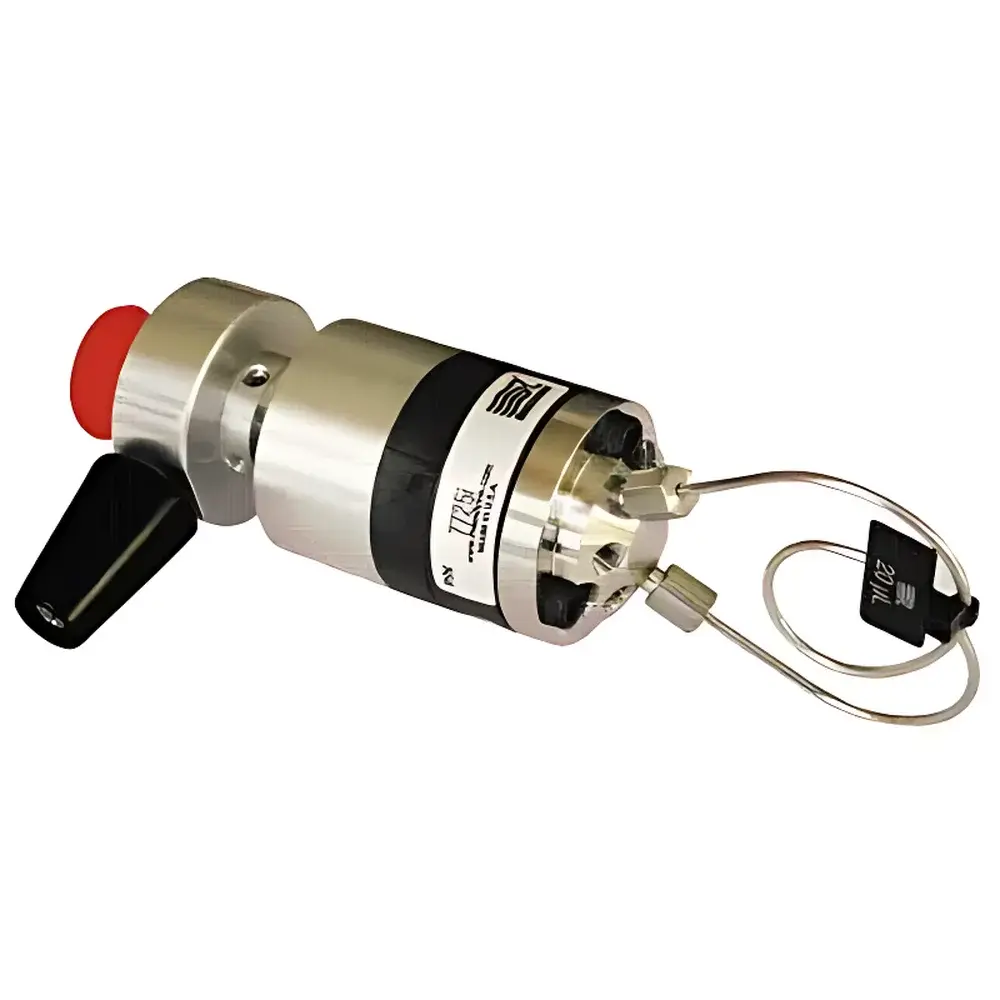
Rheodyne 7725i High-Pressure Manual Injection Valve for HPLC and UHPLC Systems
| Origin | USA |
|---|---|
| Manufacturer Type | Authorized Distributor |
| Origin Category | Imported |
| Model | RHEODYNE 7725i |
| Pricing | Upon Request |
Overview
The Rheodyne 7725i is a precision-engineered, high-pressure manual injection valve designed for integration into analytical and preparative liquid chromatography systems—including HPLC, UHPLC, and LC-MS workflows. Based on the proven dual-rotor, multi-port valve architecture, it operates on the principle of precise rotor positioning within a stationary stator, enabling reproducible sample introduction without flow interruption. Its core functionality relies on Rheodyne’s proprietary Make-Before-Break (MBB) fluidic design—a patented sealing mechanism that ensures continuous mobile phase delivery during the sample load/inject transition. This eliminates pressure spikes, baseline disturbances, and column overpressure risks commonly associated with break-before-make valves, thereby preserving column integrity and chromatographic resolution. Rated for continuous operation up to 34 MPa (5,000 psi) and capable of short-term excursions to 48 MPa (7,000 psi), the 7725i meets the mechanical and thermal demands of modern high-efficiency separations under elevated backpressures.
Key Features
- Make-Before-Break (MBB) fluid path technology—ensures uninterrupted mobile phase flow during switching, minimizing system perturbation and enhancing retention time stability.
- Manual actuation with tactile feedback handle and rear-mounted pressure adjustment knob for intuitive, repeatable sealing force control across diverse solvent viscosities and operating pressures.
- Extended angular range for tubing port orientation—supports flexible manifold layout in crowded instrument racks or stacked modular configurations.
- Integrated electrical trigger output (standard on “i”-suffix models)—provides TTL-compatible pulse signal synchronized with injection event for external timing coordination (e.g., detector start, fraction collector activation, or data acquisition triggering).
- Modular quantitative loop compatibility—accepts standard stainless steel loops (1–5 µL) and optional factory-installed 2 µL ultra-micro loops with matched fittings and zero-dead-volume connectors.
- Chemically resistant wetted materials—including 316 stainless steel rotor seal surface, PEEK stator body, and fluoropolymer seals—ensuring long-term compatibility with aggressive mobile phases (e.g., high-pH buffers, TFA, DMSO, THF).
Sample Compatibility & Compliance
The 7725i supports aqueous, organic, and mixed-solvent mobile phases commonly used in reversed-phase, ion-exchange, size-exclusion, and hydrophilic interaction chromatography. Its robust construction complies with industry-standard mechanical safety margins defined in ASTM F2699 (Standard Specification for High-Pressure Liquid Chromatography Valves) and aligns with ICH Q5C stability-indicating method requirements for consistent injection volume accuracy. While the valve itself is not a regulated device under FDA 21 CFR Part 11, its repeatable performance and traceable trigger output support audit-ready workflows in GLP and GMP environments when integrated with compliant data systems. Documentation packages—including material certifications, pressure test reports, and dimensional drawings—are available upon request for qualification protocols (IQ/OQ/PQ).
Software & Data Management
As a hardware-level component, the 7725i does not incorporate embedded firmware or onboard software. However, its TTL trigger output enables seamless synchronization with third-party chromatography data systems (CDS), such as Thermo Chromeleon, Waters Empower, Agilent OpenLab CDS, and Shimadzu LabSolutions. Trigger events are logged with timestamp precision matching system clock resolution, supporting full audit trail generation when paired with CDS platforms configured for 21 CFR Part 11 compliance (electronic signatures, user access controls, and immutable event history). Optional mounting brackets and DIN-rail adapters facilitate integration into automated rack-based sampling modules or custom-built LC platforms requiring deterministic valve sequencing.
Applications
- Analytical-scale method development and validation where injection precision ≤0.5% RSD is required for peak area and retention time reproducibility.
- Preparative LC fraction collection systems requiring precise, low-dispersion injection into high-flow columns (≥10 mL/min).
- Multi-dimensional LC (LC×LC) interfaces where uninterrupted flow and minimal dwell volume (<1.5 µL internal volume) reduce cross-contamination and band broadening.
- Biochromatography applications using biocompatible variants (e.g., titanium rotor, PEEK stator, and inert seals) for monoclonal antibody or oligonucleotide purification.
- Method transfer between laboratories—leveraging standardized geometry and pressure rating to ensure consistent hydraulic behavior across instrument platforms.
FAQ
What is the difference between the 7725 and 7725i models?
The “i” suffix denotes integrated TTL trigger output capability; otherwise, mechanical and fluidic specifications are identical.
Can the 7725i be used with corrosive solvents like concentrated acids or halogenated organics?
Yes—when equipped with optional Hastelloy-C276 rotor seals and PTFE/FFKM stator seals, it maintains integrity with 10% HCl, 5% HNO₃, chloroform, and dichloromethane at ≤34 MPa.
Is calibration required before installation?
No routine calibration is specified; however, users must verify loop volume accuracy using gravimetric or spectrophotometric methods per USP or ISO 17025 guidelines during system qualification.
Does Rheodyne provide replacement parts and service documentation?
Yes—complete OEM spare kits (rotor/stator assemblies, seal sets, loop carriers) and illustrated service manuals are available through authorized distributors with traceable lot documentation.
How does the MBB design affect dwell volume and gradient delay?
MBB eliminates transient flow stoppage but does not reduce dwell volume; total system dwell remains governed by post-valve tubing length and detector cell volume—not valve architecture.




