
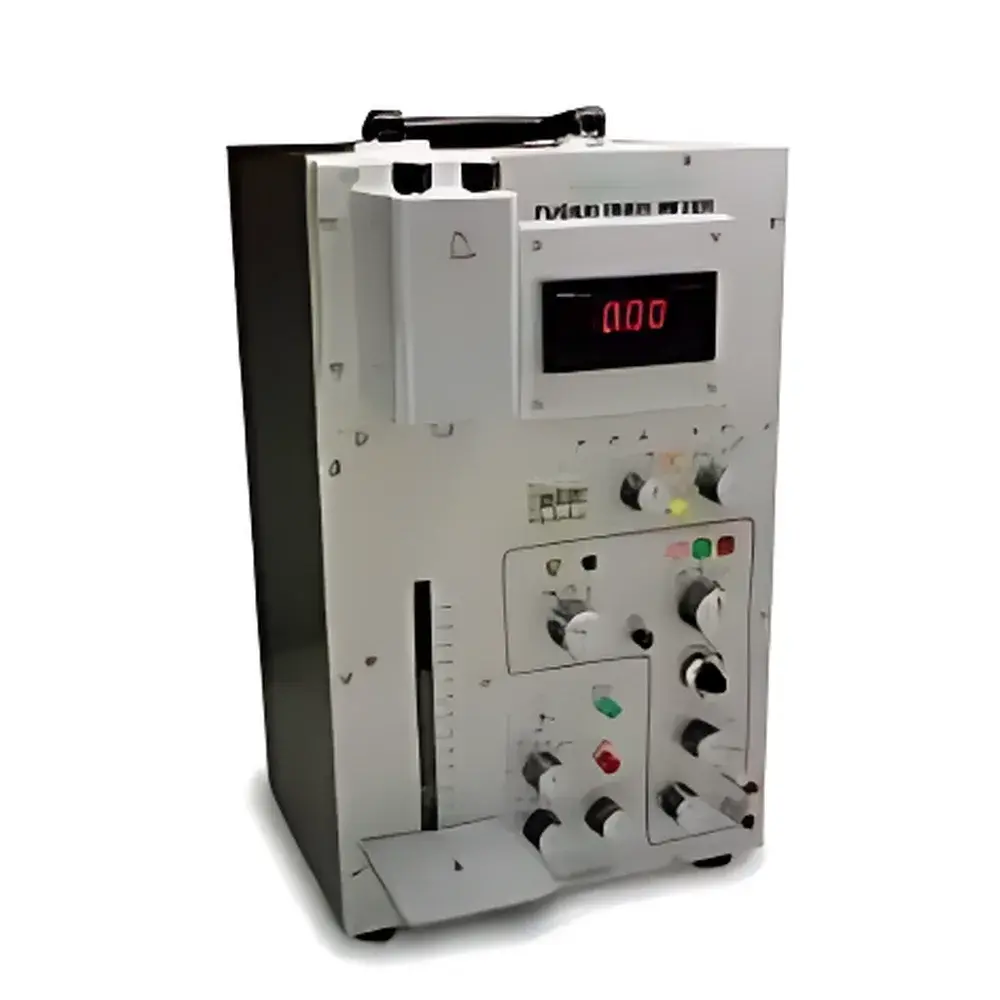
RHEOTECH FUDOH RTC-3002D Universal Texture Analyzer
| Brand | RHEOTECH |
|---|---|
| Origin | Japan |
| Model | FUDOH RTC-3002D |
| Load Capacity | ±200 N |
| Stroke Range | 0.1–99.9 mm (0.1 mm resolution) |
| Test Speed Options | 2, 5, 6, 10, 20, 30 cm/min or 5, 6, 10, 20, 30, 60 cm/min |
| Display | Triple 3-digit LED (force, displacement, time) |
| Auto-zero Function | Yes |
| Power Supply | 220–250 V AC, 50/60 Hz |
| Dimensions | 260 W × 430 H × 280 D mm |
| Weight | 15 kg |
| Compliance | Designed for ISO 11357, ASTM F3165, USP <1043>, and GLP-compliant texture analysis workflows |
Overview
The RHEOTECH FUDOH RTC-3002D is a high-precision universal texture analyzer engineered for reproducible mechanical property characterization of soft solids and semi-solids. Based on controlled-force compression/tension methodology with electromagnetic clutch-driven vertical actuation, it delivers real-time force-displacement data acquisition at sampling intervals ≤5 ms (200 Hz equivalent), enabling accurate capture of transient events such as fracture onset, yield point, and stress relaxation kinetics. Its modular architecture supports standardized test protocols across food science, pharmaceutical formulation, cosmetic rheology, and biomedical material evaluation—where quantification of hardness, adhesiveness, cohesiveness, chewiness, springiness, and fracturability is essential for QC release, product development, and regulatory documentation.
Key Features
- Electromagnetic clutch mechanism ensures instantaneous free-fall and precise load application control during both upward and downward probe movement.
- Programmable stroke range from 0.1 to 99.9 mm in 0.1 mm increments—ideal for low-deformation testing (e.g., gel stiffness, tablet coating integrity) and large-strain applications (e.g., meat tenderness, dough extensibility).
- Dual-range digital LED display showing real-time force (±200 N), displacement (mm), and elapsed time (s) with three-digit resolution and automatic zeroing prior to each test cycle.
- Six selectable crosshead speeds (2–60 cm/min) optimized for compliance with ASTM F3165 (food texture profiling) and ISO 11357-3 (thermoplastic deformation behavior).
- Peak-hold and event-triggered stop functions allow autonomous termination upon reaching user-defined force thresholds, displacement limits, or time durations—critical for stress-relaxation, creep, and break-point assays.
- Reversible motorized actuation enables fully automated cyclic compression–tension sequences, supporting chewing simulation, repeated compression fatigue, and adhesion peel tests.
- Lightweight benchtop footprint (15 kg; 260 × 430 × 280 mm) facilitates deployment in production labs, pilot-scale facilities, and field-mobile QA environments without dedicated anchoring.
Sample Compatibility & Compliance
The RTC-3002D accommodates specimens ranging from viscous gels (e.g., pectin hydrogels, carrageenan matrices) to heterogeneous particulates (e.g., cereal flakes, cheese cubes, coated tablets). Over 100 interchangeable probes—including spherical, cylindrical, conical, wire-cut, and Warner–Bratzler blades—are available to conform to method-specific geometries defined in AOAC 985.21, USP , and ISO 11357-6. All firmware and hardware configurations support audit-trail generation per FDA 21 CFR Part 11 requirements when paired with validated RHEO WIN software. Instrument calibration traceability follows ISO/IEC 17025 guidelines using NIST-traceable deadweight standards.
Software & Data Management
When interfaced via analog A/D output to the RHEO WIN software platform (Windows-compatible), the RTC-3002D enables full parametric test scripting, real-time graphing, multi-curve overlay, statistical batch reporting (mean ± SD, CV%), and export to CSV, Excel, or PDF formats. The software embeds built-in calculation modules for derived parameters including Young’s modulus (from initial linear slope), work of shear (area under curve), relaxation ratio (% force decay at fixed strain), and chew index (hardness × cohesiveness × elasticity). All raw data files are timestamped, user-ID tagged, and stored with immutable metadata—ensuring full compliance with GLP and GMP documentation standards.
Applications
This instrument is routinely deployed for:
- Food texture profiling: quantifying hardness of baked goods, fracturability of biscuits, gumminess of confectionery, and compressive yield of dairy spreads.
- Pharmaceutical solid dosage analysis: measuring tablet friability, capsule shell rupture force, and transdermal patch tack strength.
- Cosmetic product evaluation: assessing viscosity hysteresis of creams, extrudability of toothpastes, and film-forming resilience of hair sprays.
- Agricultural post-harvest quality control: determining firmness decay in fruits, crispness retention in vegetables, and starch retrogradation kinetics in rice products.
- Biomedical material testing: evaluating tensile strength of hydrogel wound dressings, compression recovery of soft tissue scaffolds, and adhesion energy of bioadhesive films.
FAQ
What types of mechanical tests can the RTC-3002D perform?
It supports standardized texture analysis methods including compression, tension, puncture, shear, extrusion, adhesion, stress relaxation, creep, and cyclic loading—each programmable with independent speed, distance, force, and dwell parameters.
Is the instrument suitable for regulated environments?
Yes. With RHEO WIN software validation packages and configurable electronic signatures, it meets FDA 21 CFR Part 11, EU Annex 11, and ISO 13485 requirements for use in pharmaceutical and medical device manufacturing QA/QC labs.
How is calibration maintained?
Calibration is performed using certified reference loads traceable to national metrology institutes. Daily verification with check weights and annual third-party certification are recommended per ISO/IEC 17025.
Can test data be integrated into LIMS systems?
Yes. ASCII-based data export and ODBC connectivity enable seamless integration with major laboratory information management systems (LIMS) and enterprise quality management systems (QMS).
What safety features are included?
The system includes emergency stop button, overload protection circuitry, mechanical end-stop limit switches, and software-enforced force/displacement boundaries to prevent probe collision or specimen over-compression.



