
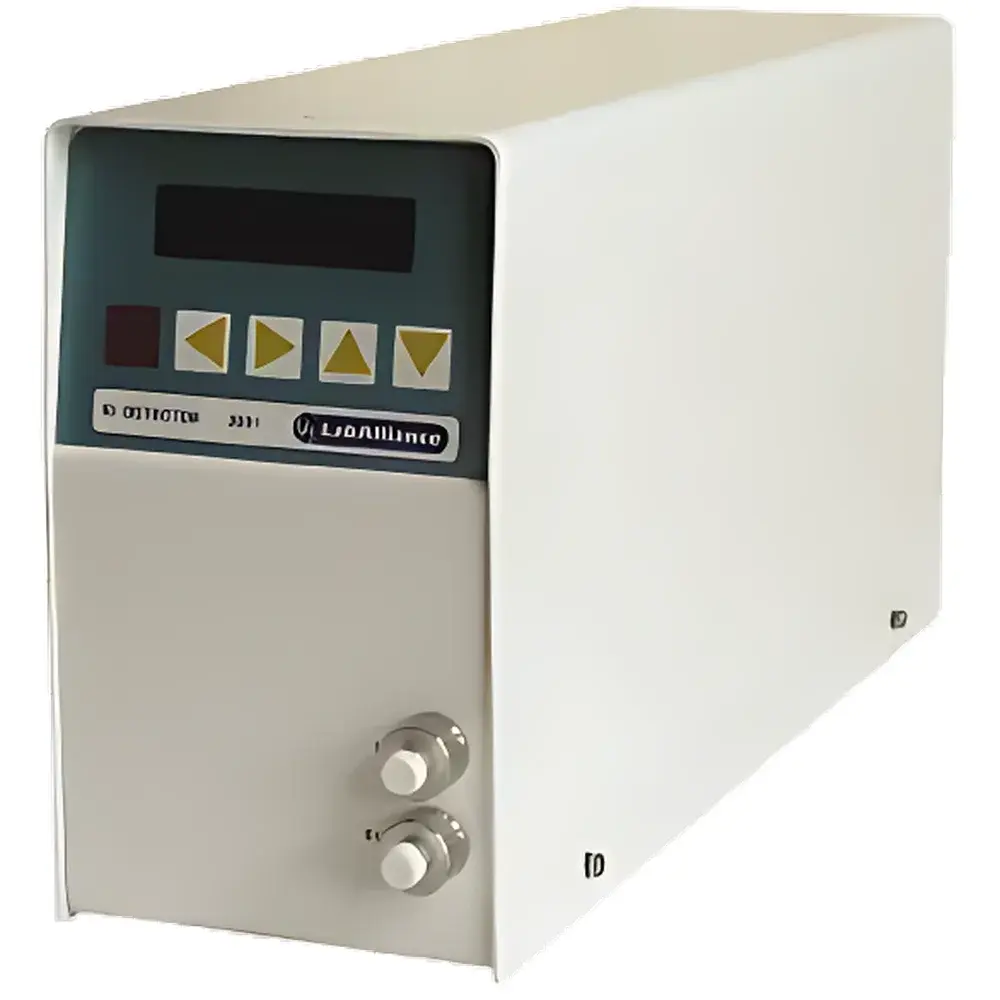
RI2001 Differential Refractometer
| Origin | USA |
|---|---|
| Manufacturer Type | Authorized Distributor |
| Origin Category | Imported Instrument |
| Model | RI2001 |
| Price Range | USD 7,000–14,000 |
| Detector Type | Differential Refractometer (RID) |
| Wavelength Range | 160–1100 nm |
| Measurement Principle | Dual-Beam Optical Null Method |
| Light Source | Deuterium Lamp |
| Temperature Compensation | Automatic Real-Time |
| Data Output | Analog (±1 V, ±5 V, ±10 V) + Digital (RS-232/USB) |
| A/D Resolution | 16-bit |
| Zero Calibration | Motorized Auto-Zero with Solvent Flush Sequence |
| Reference Cell | Self-Cleaning Flow-Through Design |
| Thermal Stability | Integrated Isothermal Enclosure with Active Temperature Control (±0.01 °C) |
Overview
The RI2001 Differential Refractometer is a high-stability, dual-beam optical detector engineered for universal detection in liquid chromatography systems—including HPLC, GPC/SEC, and preparative LC—where analytes lack strong chromophores or ionizable functional groups. Unlike UV-Vis or fluorescence detectors, the RI2001 operates on the principle of differential refractive index measurement: it compares the refractive index of an eluting sample stream against a matched reference solvent stream using a precision-machined, thermally isolated optical cell pair. This null-balance method enables quantitative detection of virtually all solutes—including sugars, polymers, lipids, organic acids, and small-molecule pharmaceuticals—regardless of spectral absorbance. Its compact form factor (28 × 15 × 12 cm) integrates seamlessly into standard LC racks, while its rigid aluminum chassis and vibration-damped optical platform ensure mechanical stability under continuous operation. The instrument complies with ISO 9001 manufacturing controls and is designed to meet GLP documentation requirements for regulated laboratories.
Key Features
- Dual-beam optical architecture with real-time null-point tracking, minimizing baseline drift during extended gradient runs
- Integrated isothermal enclosure with Peltier-assisted temperature regulation (±0.01 °C), eliminating thermal lensing effects in the flow cell
- Self-cleaning reference flow cell featuring laminar solvent flush cycles triggered automatically before and after each analysis
- Motor-driven auto-zero mechanism synchronized with solvent delivery—no manual alignment or calibration screws required
- Simultaneous analog output (±1 V / ±5 V / ±10 V selectable) and digital communication via RS-232 and USB 2.0 interfaces
- 16-bit A/D conversion with 0.1 µRIU resolution and <0.5 µRIU baseline noise (typical, 1 s time constant)
- Deuterium lamp source ensures broad-spectrum stability across 160–1100 nm, supporting compatibility with UV-transparent mobile phases
Sample Compatibility & Compliance
The RI2001 supports aqueous and organic mobile phases including water, methanol, acetonitrile, THF, chloroform, and DMF—provided refractive index contrast between sample and solvent exceeds 1 × 10⁻⁵ RIU. It is compatible with stainless steel, PEEK, and fused silica capillary tubing (ID ≥ 0.12 mm). Flow rate range: 0.1–10 mL/min; maximum backpressure tolerance: 10 MPa. The detector meets ASTM D1259 (Standard Test Method for Refractive Index of Plastics), ISO 1628-1 (Determination of Viscosity Number of Polymers), and USP (Refractometric Assay of Solutions). Its firmware includes audit-trail logging per FDA 21 CFR Part 11 requirements when used with compliant chromatography data systems (CDS).
Software & Data Management
The RI2001 communicates natively with industry-standard CDS platforms—including Empower, Chromeleon, OpenLab CDS, and LabSolutions—via ASCII-based command protocol. Raw signal data are timestamped and streamed at up to 20 Hz. Internal memory stores up to 72 hours of continuous baseline history for diagnostic review. All auto-zero events, temperature logs, and solvent flush cycles are recorded with operator ID and timestamp. Optional SDK allows integration into custom Python- or LabVIEW-based acquisition environments. No proprietary software installation is required for basic operation; configuration is performed via front-panel keypad or remote terminal commands.
Applications
- Gel Permeation Chromatography (GPC/SEC) of synthetic polymers, biopolymers, and dendrimers
- Carbohydrate profiling in food, beverage, and fermentation QC labs
- Quantitative analysis of non-UV-absorbing excipients in pharmaceutical formulations
- Monitoring of hydrolysis or esterification reactions in process analytical technology (PAT) workflows
- Calibration-free concentration determination in preparative LC fraction collection
- Stability-indicating assays for degradation products lacking chromophores
FAQ
What is the minimum detectable refractive index change?
The RI2001 achieves a typical noise floor of 0.5 µRIU at 1 s time constant, corresponding to ~10 ng of sucrose on-column under standard HPLC conditions.
Can the RI2001 be used with gradient elution?
Yes—its dual-beam design and real-time reference compensation enable stable baseline performance during shallow organic gradients (e.g., 0–20% ACN/H₂O), though steep gradients (>1%/min) may require post-run baseline correction.
Is the detector compatible with UHPLC systems?
It supports flow rates up to 10 mL/min and backpressures to 10 MPa, but dwell volume (1.8 µL) limits optimal use to conventional HPLC and GPC; for sub-2-µm particle columns, a low-volume flow cell option is recommended.
Does the RI2001 support 21 CFR Part 11 compliance?
When operated with validated CDS software and configured with user authentication, electronic signatures, and immutable audit trails, the system satisfies Part 11 technical controls for electronic records and signatures.
How often does the reference cell require maintenance?
The self-cleaning cycle eliminates routine manual cleaning; annual verification of lamp intensity and optical alignment is recommended per ISO/IEC 17025 calibration schedules.






