
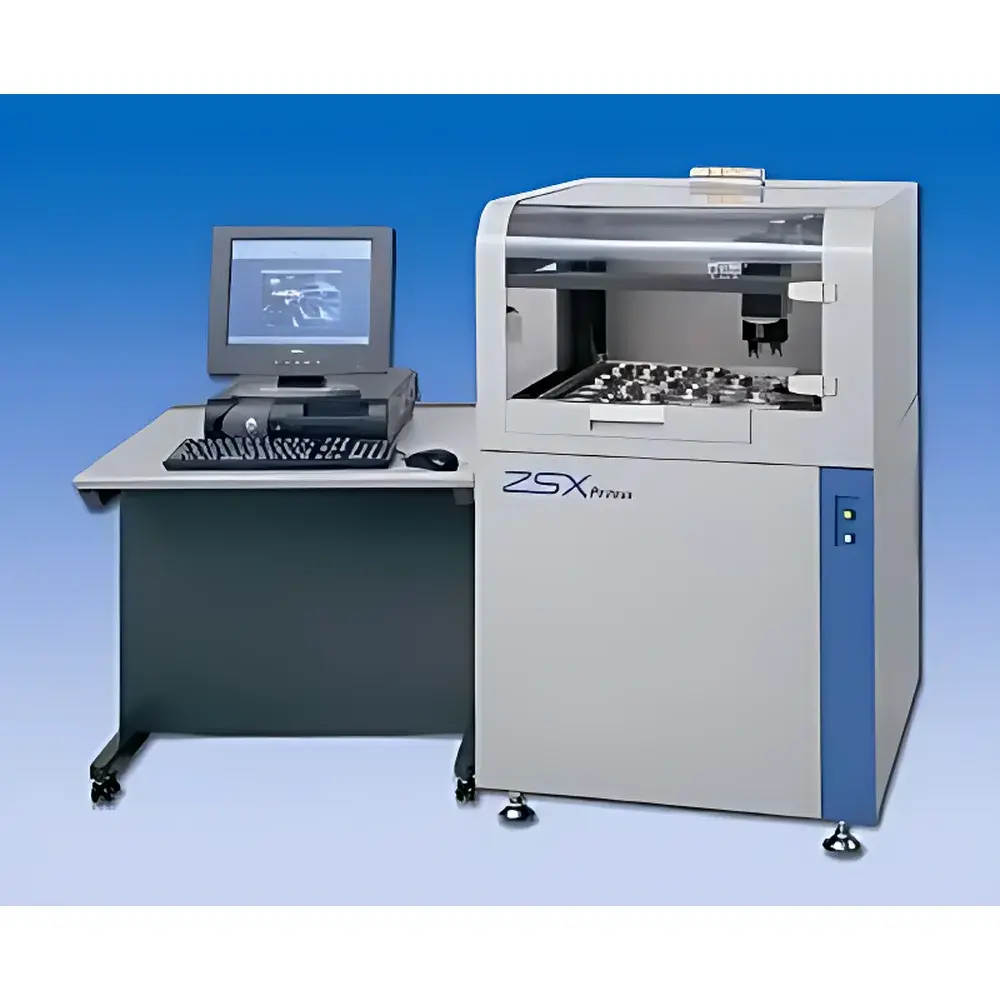
Rigaku Primus Wavelength Dispersive X-Ray Fluorescence Spectrometer (WDXRF)
| Origin | Japan |
|---|---|
| Manufacturer Type | Authorized Distributor |
| Origin Category | Imported Instrument |
| Model | Primus |
| Pricing | Upon Request |
Overview
The Rigaku Primus is a high-performance wavelength dispersive X-ray fluorescence spectrometer engineered for precision elemental analysis across the full periodic table—from beryllium (Be, Z=4) to uranium (U, Z=92). Utilizing Bragg diffraction of characteristic X-rays from crystalline analyzers, the Primus achieves superior spectral resolution and detection sensitivity—particularly for light elements (Na–F) and ultra-light elements (C, N, O)—through optimized optical path design, high-power X-ray excitation, and dual-vacuum architecture. Its down-illumination geometry enables stable, contamination-resistant analysis of solid blocks, pressed pellets, fused beads, and thin films without sample inversion or complex mounting. Designed for routine QC/QA, R&D, and regulatory-compliant laboratories, the Primus meets foundational requirements for ISO/IEC 17025 accreditation and supports traceable calibration per ASTM E1361 and JIS Z 8813.
Key Features
- High-power X-ray source: End-window Rh-target tube rated at 4 kW (60 kV / 150 mA), with optional 3 kW configuration; voltage stability ±0.005% against ±10% input fluctuation
- Dual-vacuum chamber system with independent vacuum pumps—enabling simultaneous analysis of light elements (under vacuum) and heavier elements (in air or He atmosphere)
- Automated 12-/24-/36-/48-position sample changer with programmable sample rotation (30 rpm) and precise positioning accuracy
- Multi-crystal spectrometer: 10-position automatic crystal changer supporting standard crystals (LiF(200), Ge, PET, RX25) and optional extended-range analyzers (LiF(220), TAP, RX series up to RX80)
- Variable collimation: Motorized divergence slits (standard/high-resolution/ultra-light-element modes), receiving slits (SC/F-PC), and six auto-switching field-limiting apertures (0.5–35 mm diameter)
- Advanced primary beam filtration: Four selectable filters (Al, Ti, Cu, Zr) for optimized excitation and background suppression
- Integrated helium purge with partitioned gas flow control for carbon/oxygen/nitrogen analysis in atmospheric mode
- Thermostatically stabilized optics: Constant 36.5 °C environment for long-term angular reproducibility and peak position stability
Sample Compatibility & Compliance
The Primus accommodates flat, homogeneous samples up to 51 mm × 30 mm (H), with maximum analytical area of 35 mm diameter. Optional accessories include powder sample holders with vacuum isolation to prevent pump oil contamination, thin-film holders, and micro-spot mapping stages (minimum analysis spot: 500 µm; mapping resolution: 100 µm). All hardware and software comply with IEC 61000-6-3 (EMC) and IEC 61000-6-4 (emission) standards. Data acquisition and reporting support audit trails required under FDA 21 CFR Part 11 and GLP/GMP environments when configured with user access controls and electronic signature modules.
Software & Data Management
Controlled by Rigaku’s SQX software suite, the Primus provides integrated qualitative and quantitative workflows. Qualitative analysis includes automatic peak identification with background subtraction, smoothing algorithms, and interference correction. Quantitative methods support calibration curve fitting (JIS Z 8813 compliant), matrix correction (fundamental parameters, empirical alpha coefficients), and standardless analysis using FP-based modeling. Additional capabilities include EZ Scan for rapid survey screening, application templates for cement, metals, polymers, and geological matrices, automated beam diameter selection, peak deconvolution, precision testing protocols (RSD ≤ 0.5% for major elements), and secure email-based report delivery. All data files are stored in vendor-neutral formats (CSV, XML) and support export to LIMS via ODBC.
Applications
The Primus serves diverse sectors requiring certified elemental composition data: metallurgical QC (alloy grade verification, inclusion analysis), cement and raw material certification (LOI, SiO₂, Al₂O₃, Fe₂O₃), environmental monitoring (soil heavy metal screening per EPA Method 6200), catalyst characterization (Pt/Pd/Rh loading), glass and ceramic formulation, and geological exploration (multi-element lithogeochemistry). Its high-count-rate SC detector (1,000 kcps linearity) and F-PC channel enable simultaneous light/heavy element measurement in single runs—reducing turnaround time for multi-component certification.
FAQ
What vacuum configurations does the Primus support for light element analysis?
The instrument features a dual-chamber vacuum system: one chamber for the goniometer and analyzer crystals (maintained at high vacuum), and a second chamber for the sample stage—allowing independent control for He-purged or high-vacuum operation.
Can the Primus perform micro-area analysis or elemental mapping?
Yes—optional micro-beam attachments enable spot analysis down to 500 µm and raster mapping at 100 µm step resolution, with automated stage positioning and spectral accumulation per pixel.
Is remote diagnostics supported?
The system includes embedded remote maintenance tools with secure TLS-encrypted connectivity, enabling real-time troubleshooting, firmware updates, and performance diagnostics by Rigaku Field Service Engineers.
What calibration standards are recommended for routine use?
Rigaku offers certified multi-element reference materials traceable to NIST and BAM, including SRM 278, CRM 587, and industry-specific sets for steel, aluminum, and cement matrices.
How is detector aging compensated during long-term operation?
The hardware implements automatic pulse-height adjustment (PAS), scheduled filament cleaning cycles, and real-time gain stabilization—ensuring consistent energy discrimination over thousands of hours of operation.




