
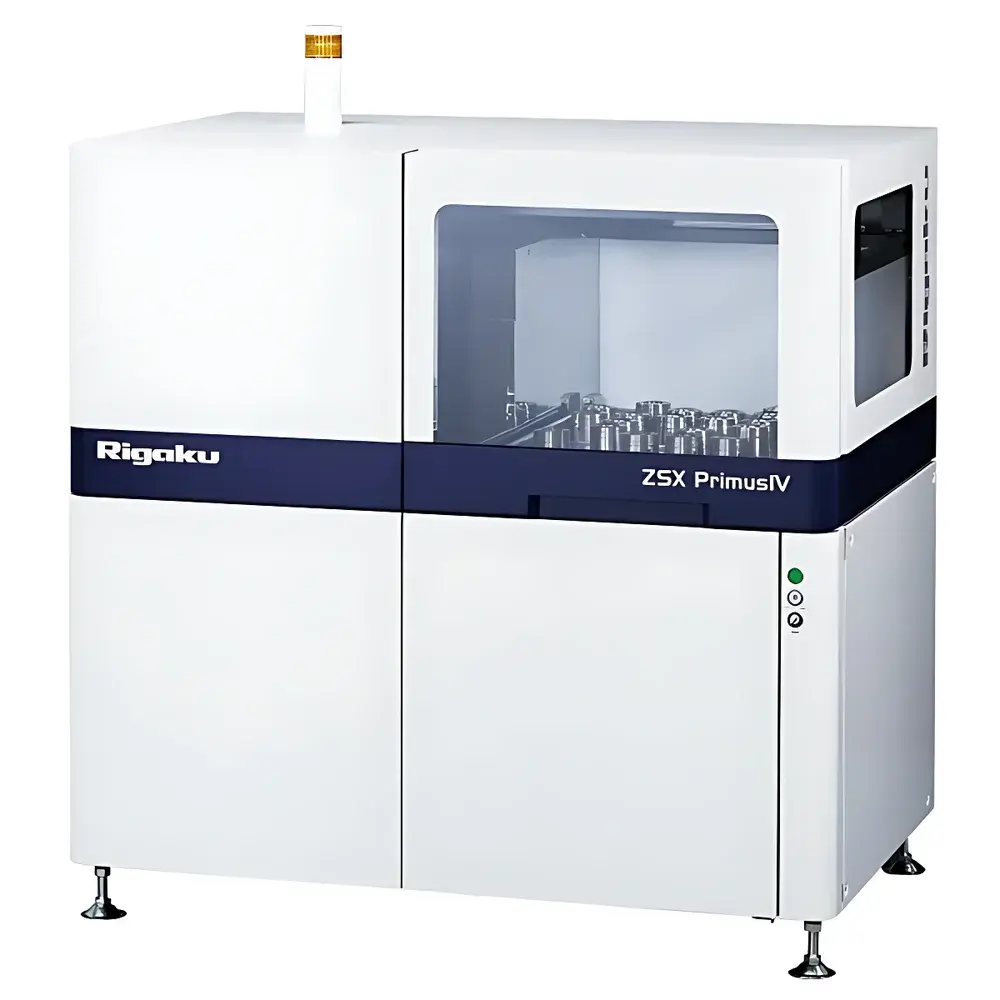
Rigaku ZSX Primus IV Wavelength Dispersive X-Ray Fluorescence Spectrometer
| Origin | Japan |
|---|---|
| Manufacturer Type | Authorized Distributor |
| Origin Category | Imported Instrument |
| Model | ZSX Primus IV |
| Price Range | USD 210,000 – 280,000 (FOB Yokohama) |
| Instrument Type | Scanning WDXRF |
| X-ray Tube Power | 4 kW |
| Elemental Coverage | Beryllium (Be, Z=4) to Curium (Cm, Z=96) |
Overview
The Rigaku ZSX Primus IV is a high-performance, top-illumination wavelength dispersive X-ray fluorescence (WDXRF) spectrometer engineered for precision elemental analysis across the full periodic table—from ultra-light elements (Be, Z=4) to transuranic actinides (Cm, Z=96). Unlike energy dispersive (EDXRF) systems, the ZSX Primus IV employs Bragg diffraction from precisely aligned analyzing crystals to resolve characteristic X-ray lines with exceptional spectral resolution and peak-to-background ratios. Its top-illumination geometry enables direct, non-destructive analysis of solid blocks, pressed pellets, fused beads, and thin films without sample reorientation—minimizing geometry-related intensity drift and enhancing long-term reproducibility. The instrument integrates a high-stability 4 kW sealed-tube X-ray source with a thin beryllium window and optimized anode material (typically Rh or Cr), specifically tuned to maximize photon flux in the soft X-ray region (<1 keV) critical for light-element excitation (e.g., C, N, O, F, Na, Mg). Dual vacuum chambers with independent pumping systems reduce evacuation time by up to 60% compared to single-chamber designs, while dust-trap accessories prevent particulate ingress into turbomolecular pumps—extending maintenance intervals and operational uptime.
Key Features
- Top-illumination optical configuration for stable, geometry-invariant sample positioning and improved light-element sensitivity
- High-power (4 kW) X-ray tube with thin Be window and selectable anode materials (Rh/Cr) optimized for low-Z excitation
- Advanced synthetic multilayer and natural crystal optics—including new high-efficiency crystals for enhanced detection of C Kα (277 eV) and B Kα (183 eV)
- Dual-vacuum architecture with separate roughing and high-vacuum stages, enabling rapid chamber conditioning (<90 s for light-element mode)
- Dust-resistant vacuum interface with integrated particle trap, protecting turbomolecular pumps during powder analysis
- Micro-spot analysis capability (down to 1 mm diameter) using optional collimator kits for heterogeneous or limited-sample applications
- PAS (Precision Alignment System): fully automated optical alignment and crystal calibration routine executed at startup or on demand
- Integrated tube filament cleaning protocol to restore emission stability after extended operation or contamination events
Sample Compatibility & Compliance
The ZSX Primus IV accommodates a broad range of sample forms—including metals, alloys, geological powders, ceramics, polymers, catalysts, and thin-film coatings—without requiring conductive coating for insulating materials. Its robust vacuum and helium-purge pathways support quantitative analysis of elements from Be to Cm under optimal detection conditions: Be–F analyzed under high vacuum (<5 Pa), Na–U under He purge or vacuum, and heavy actinides (e.g., Am, Cm) under standard vacuum. The system complies with IEC 61000-6-3 (EMC emissions), IEC 61000-6-2 (immunity), and meets mechanical safety requirements per ISO 13857. Software workflows support audit-ready data handling aligned with GLP and GMP environments, including user access control, electronic signatures, and full audit trail logging per FDA 21 CFR Part 11 when deployed with validated Rigaku SQX software configurations.
Software & Data Management
Controlled by the Rigaku SQX platform, the ZSX Primus IV delivers intuitive, wizard-driven operation via EZ Scan mode—guiding users through parameter selection, calibration setup, and measurement execution without prior spectroscopy expertise. Predefined application templates encapsulate complete analytical methods: from sample preparation protocols (e.g., fusion ratio, flux type, pressing force) to excitation conditions (tube voltage/current, crystal/filter selection, counting time), background correction algorithms, and matrix correction models (including fundamental parameters, FP). The built-in FP quantification engine enables accurate multi-element analysis without certified reference standards—leveraging atomic physics databases and empirical corrections derived from decades of WDXRF method development. Real-time workflow visualization via “Process Bar” displays active steps (vacuum pump-down, crystal alignment, measurement, data reduction), ensuring procedural transparency and traceability. All raw spectra, processed results, and metadata are stored in vendor-neutral .rxf format, exportable to CSV, SPC, or ASTM E135-compliant XML for LIMS integration.
Applications
The ZSX Primus IV serves as a primary analytical tool in metallurgical QC labs (ASTM E1086, ISO 17072), geochemical exploration (ISO 12740), cement and refractory composition verification (ASTM C114), RoHS/WEEE screening (IEC 62321-5), nuclear fuel cycle characterization (IAEA SSG-21), and advanced materials R&D. Its light-element performance supports carbon-content mapping in steel grades, boron doping in semiconductors, oxygen stoichiometry in battery cathodes (e.g., NMC, LFP), and fluorine quantification in pharmaceutical intermediates. The micro-analysis option facilitates inclusion analysis in turbine blade superalloys, contaminant identification in semiconductor wafers, and stratified layer profiling in multilayer packaging films.
FAQ
What vacuum level is required for beryllium (Be) and carbon (C) analysis?
Ultra-high vacuum (<1 Pa) is maintained in the spectrometer chamber; the sample chamber operates at ~3–5 Pa during Be–F analysis to minimize air absorption of soft X-rays.
Can the ZSX Primus IV perform analysis without certified standards?
Yes—the integrated Fundamental Parameters (FP) algorithm enables semi-quantitative and quantitative analysis using only pure-element sensitivity coefficients and physical constants, validated against NIST SRMs and industry reference materials.
Is helium purge supported for intermediate-Z elements?
Yes—optional He gas flow module replaces air in the sample chamber path, significantly improving detection limits for Na–Cl (0.1–3 keV) while maintaining compatibility with vacuum-mode light-element analysis.
How often is PAS alignment required?
PAS executes automatically at power-on and after major environmental shifts (e.g., >2°C temperature change); manual invocation is recommended after crystal replacement or transport.
Does the system support regulatory compliance for pharmaceutical QA?
When configured with validated SQX software, 21 CFR Part 11-compliant audit trails, role-based permissions, and electronic signature modules are available—supporting GMP-aligned elemental impurity testing per ICH Q3D.
Related Products





