
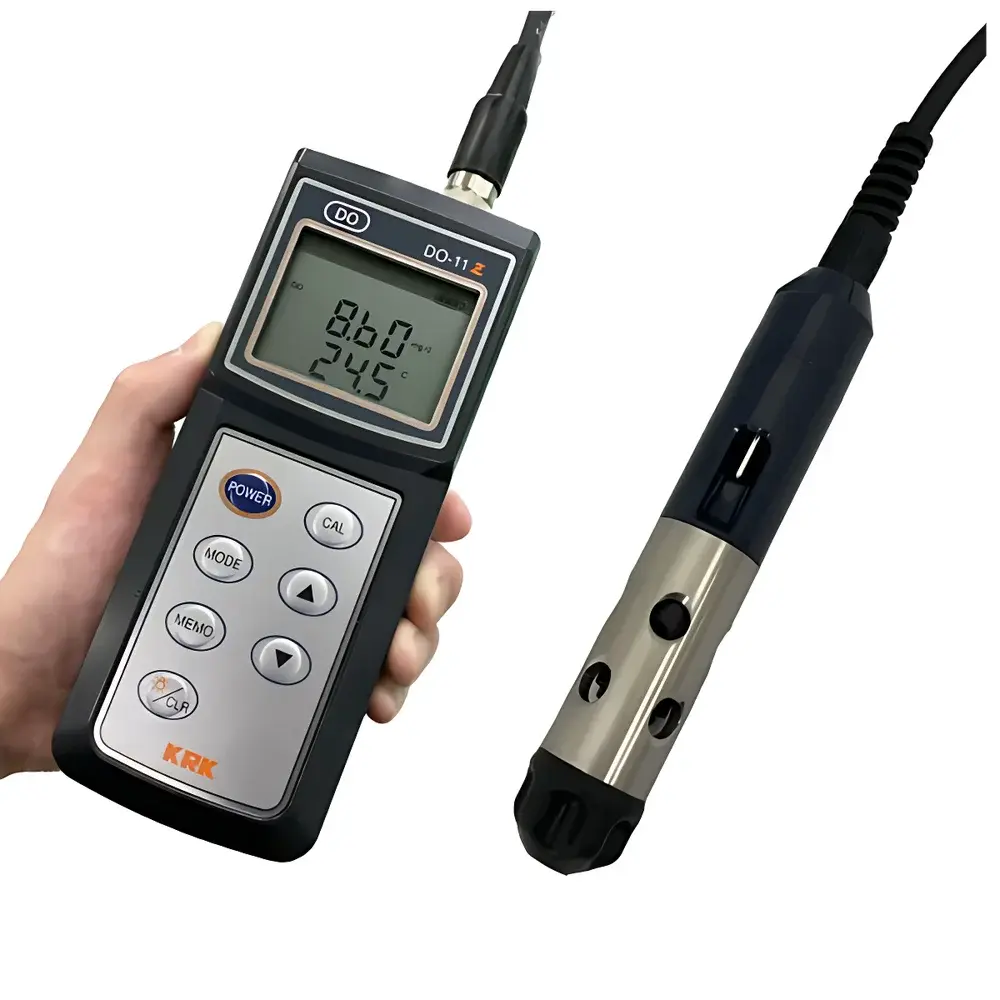
Rikari DO-11Z Portable Dissolved Oxygen Meter
| Brand | Rikari |
|---|---|
| Origin | Japan |
| Model | DO-11Z |
| Instrument Type | Portable |
| Measurement Principle | Galvanic Cell Electrochemical Probe |
| Measurement Range | 0–20 mg/L |
| Accuracy | ±2% of reading |
| Repeatability | ±2% of reading |
| Detection Limit | 0.01 mg/L |
| Sensor Type | Cylindrical OXNIT Galvanic Probe with Replaceable Membrane |
| Enclosure Rating | IP67 |
| Display Resolution | Adjustable between 0.01 mg/L and 0.1 mg/L |
Overview
The Rikari DO-11Z is a field-deployable, galvanic cell-based dissolved oxygen (DO) meter engineered for reliable, maintenance-efficient measurement in diverse aqueous environments. Unlike polarographic sensors requiring external polarization voltage, the DO-11Z employs a self-powered galvanic cell principle—where oxygen diffusion across a gas-permeable membrane drives spontaneous electrochemical reduction at the cathode (typically gold or platinum), generating a current proportional to dissolved oxygen concentration. This architecture eliminates warm-up time, reduces calibration frequency, and enhances operational stability in fluctuating temperature or low-oxygen conditions. Designed for routine monitoring in wastewater treatment plants, aquaculture systems, surface water bodies, and decentralized sanitation infrastructure, the DO-11Z delivers trace-level sensitivity (0.01 mg/L detection limit) and consistent performance across its full 0–20 mg/L range—covering both hypoxic and supersaturated conditions commonly encountered in biological treatment processes and eutrophic ecosystems.
Key Features
- Cylindrical OXNIT sensor design with minimized cathode surface area, reducing residual current and extending operational lifetime beyond typical galvanic probes
- Interchangeable membrane assembly enabling on-site replacement without sensor recalibration or specialized tools
- IP67-rated housing ensures dust-tightness and submersion resistance up to 1 m for 30 minutes—validated for use in wet wells, stormwater outfalls, and outdoor sampling campaigns
- Adjustable display resolution: user-selectable between 0.01 mg/L (two decimal places) and 0.1 mg/L (one decimal place), optimizing readability under varying ambient lighting and data logging requirements
- Built-in temperature compensation via integrated NTC thermistor (±0.2 °C accuracy), automatically correcting DO readings per Winkler-derived solubility algorithms compliant with ISO 5814 and ASTM D888
- Low-power consumption design supporting >100 hours of continuous operation on standard AA alkaline batteries
Sample Compatibility & Compliance
The DO-11Z is validated for direct immersion measurement in municipal and industrial wastewater streams, septic tank effluents, agricultural runoff, aquaculture recirculation systems, rivers, lakes, and reservoirs. Its galvanic probe exhibits minimal interference from common ions (Cl⁻, NO₃⁻, SO₄²⁻), sulfide, and organic fouling—making it suitable for high-solids or biofilm-prone matrices where optical DO sensors may experience signal drift. The instrument conforms to key regulatory frameworks governing environmental monitoring: measurement methodology aligns with ISO 5814:2012 (Water quality — Determination of dissolved oxygen — Electrochemical probe method); data integrity supports GLP-compliant workflows through timestamped, non-erasable internal storage; and hardware design meets IEC 61000-6-2/6-3 for electromagnetic compatibility in industrial field settings.
Software & Data Management
Data output is provided via RS-232 serial interface (optional USB adapter available), enabling direct transfer to laboratory information management systems (LIMS) or spreadsheet-based QA/QC review. While the DO-11Z does not incorporate onboard graphical software, its ASCII-formatted output includes DO concentration (mg/L), temperature (°C), date/time stamp, and unit identification—structured for automated parsing and integration into validated environmental data pipelines. All stored measurements retain audit trail attributes required under EPA Method 360.1 and EU Water Framework Directive reporting protocols. Firmware updates are performed via terminal command sequence, ensuring version control traceability during regulatory audits.
Applications
- Real-time monitoring of aerobic zones in activated sludge and MBR systems to optimize blower energy consumption
- Compliance verification of discharge permits (e.g., NPDES, EU Urban Wastewater Treatment Directive) at final effluent points
- Diagnosis of oxygen depletion events in fish ponds and hatcheries to prevent hypoxia-related mortality
- Baseline assessment and trend analysis in lake stratification studies and watershed health evaluations
- Performance validation of decentralized wastewater treatment units including septic tanks and constructed wetlands
- Field verification of laboratory DO measurements prior to sample preservation for BOD₅ analysis (ISO 5815-1)
FAQ
Does the DO-11Z require zero-point calibration in nitrogen-saturated water?
No. As a galvanic cell sensor, the DO-11Z operates with inherent zero stability and does not require frequent zero calibration. A single air-saturation calibration at known barometric pressure and temperature is sufficient for routine use.
Can the OXNIT sensor be used in seawater or high-chloride environments?
Yes—the cylindrical membrane design and optimized electrolyte formulation provide stable performance in chloride concentrations up to 35,000 mg/L, with no observed drift over 72-hour continuous immersion.
Is the instrument compatible with GLP or ISO/IEC 17025-accredited laboratories?
Yes. Its documented measurement uncertainty (±2% of reading), traceable calibration protocol, and immutable data logging support compliance with ISO/IEC 17025:2017 Clause 7.7 (Uncertainty of measurement) and FDA 21 CFR Part 11 when paired with validated data transfer software.
How often should the membrane and electrolyte be replaced?
Under normal field use, the replaceable membrane assembly is rated for 6 months or 500 immersion cycles—whichever occurs first. Electrolyte replenishment is not required; the sealed OXNIT cartridge contains pre-filled, long-life electrolyte.
Related Products







