
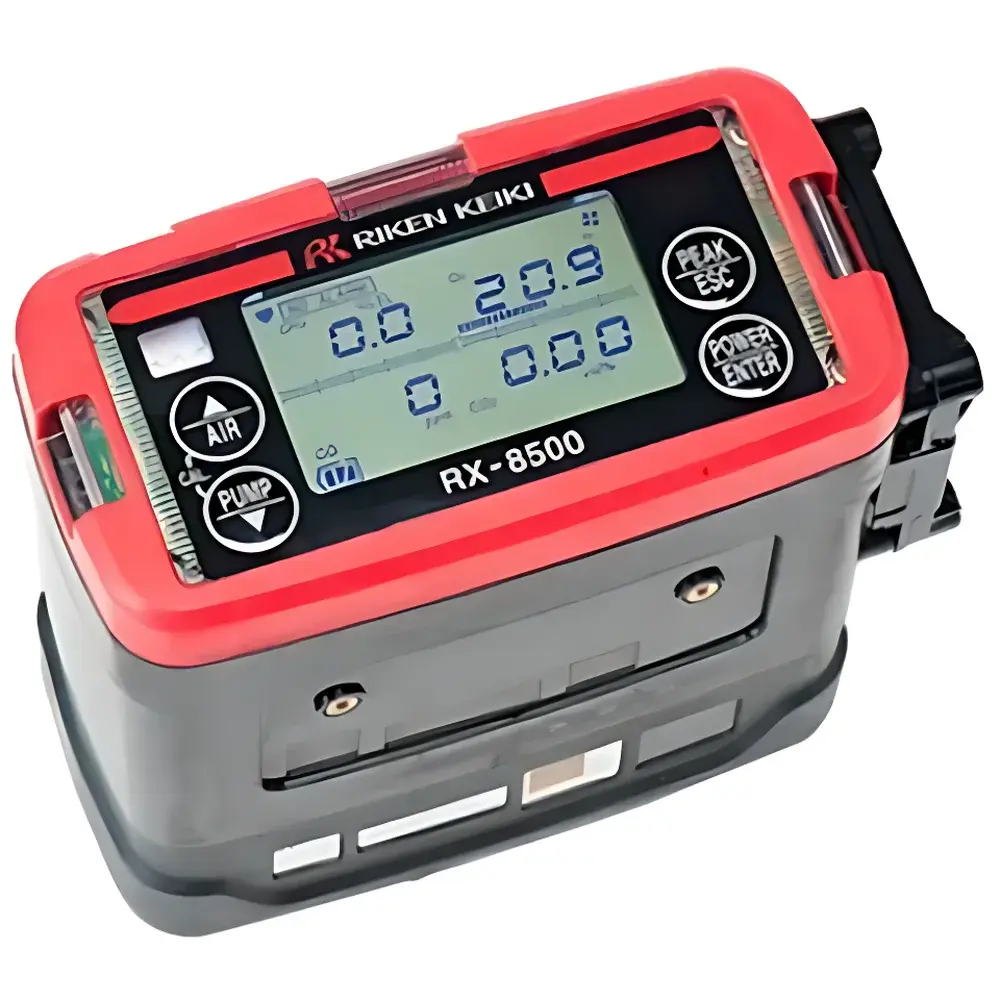
RIKEN KEIKI RX-8500 Multicomponent Portable Gas Detector for Methane, Oxygen, Carbon Monoxide, and Carbon Dioxide
| Brand | RIKEN KEIKI |
|---|---|
| Origin | Japan |
| Model | RX-8500 |
| Type | Portable Multicomponent Gas Detector |
| Detection Principles | NDIR (CH₄, CO₂), Galvanic Cell (O₂), Electrochemical (CO) |
| Response Time | ≤15 s |
| Detection Ranges | CH₄: 0–100% LEL / 5–100 vol% (auto-ranging) |
| O₂ | 0–25 vol% |
| CO | 0–1000 ppm |
| CO₂ | 0–20 vol% |
| Sampling Method | Pump-aspirated |
| Power Supply | Rechargeable Li-ion battery (≈15 h) or 3×AA alkaline batteries (≈8 h) |
| Dimensions | 154(W) × 81(H) × 163(D) mm (excl. protrusions) |
| Weight | ≈1.2 kg (Li-ion), ≈1.1 kg (AA) |
| Operating Environment | −20 to +50 °C, ≤95% RH (non-condensing) |
| Intrinsic Safety Rating | Ex ia II CT4X |
| Certifications | TIIS, ATEX, CE, SOLAS-compliant |
Overview
The RIKEN KEIKI RX-8500 is a certified intrinsically safe, portable multicomponent gas detector engineered for simultaneous, real-time quantification of methane (CH₄), oxygen (O₂), carbon monoxide (CO), and carbon dioxide (CO₂) in demanding industrial, maritime, and confined-space environments. Its hybrid sensing architecture integrates three distinct, industry-validated detection principles: non-dispersive infrared (NDIR) spectroscopy for CH₄ and CO₂, electrochemical galvanic cell technology for O₂, and potentiostatic electrolytic (amperometric) sensing for CO. This configuration ensures high selectivity, minimal cross-sensitivity, and stable baseline performance across wide concentration ranges — particularly critical when monitoring flammable gas mixtures in inert or nitrogen-rich atmospheres. Designed in strict compliance with SOLAS Regulation II-2/10 amendments and certified to Ex ia II CT4X for use in Zone 0 hazardous areas, the RX-8500 meets the most stringent operational safety requirements for offshore platforms, LNG terminals, shipboard engine rooms, and underground utility vaults.
Key Features
- Intrinsically safe design certified to Ex ia II CT4X, enabling continuous operation in Zone 0 explosive atmospheres without risk of ignition.
- Hybrid multi-sensor platform: dual NDIR channels (CH₄ and CO₂), galvanic O₂ sensor, and electrochemical CO sensor — each independently calibrated and temperature-compensated.
- Auto-ranging CH₄ measurement (0–100% LEL and 5–100 vol%) eliminates manual range switching and supports both combustibility assessment and inerting verification.
- Pump-aspirated sampling system with adjustable flow rate (typically 300–500 mL/min), ensuring representative sample delivery even under low-diffusion conditions or behind barriers.
- Robust mechanical construction: IP67-rated enclosure, shock-absorbing rubber overmold, and corrosion-resistant stainless-steel sampling inlet compatible with marine and chemical plant environments.
- Integrated audible (85 dB @ 30 cm), visual (dual-color LED status indicators), and vibratory alarms with configurable thresholds per gas channel and fault condition (e.g., sensor failure, low battery, pump blockage).
Sample Compatibility & Compliance
The RX-8500 is validated for direct measurement of ambient air, nitrogen-purged enclosures, and inert gas blankets containing up to 99.9% N₂ or Ar. Its NDIR sensors maintain accuracy in low-oxygen environments where catalytic bead detectors fail, making it suitable for tank entry pre-checks and post-purge verification per OSHA 1910.146 and IMO MSC.1/Circ.1475 guidelines. All sensors comply with IEC 60079-29-1 (gas detectors) and EN 45544-1 (electrochemical sensors). The device carries TIIS certification (Japan), ATEX Directive 2014/34/EU (Category 1G), CE marking under the EU Measuring Instruments Directive (MID) and Electromagnetic Compatibility (EMC) Directive, and conforms to SOLAS Chapter II-2 requirements for fixed and portable gas detection on passenger and cargo vessels.
Software & Data Management
Data logging is supported via internal memory (up to 10,000 timestamped records, including gas concentrations, alarm events, battery voltage, and pump status). Logged data can be exported in CSV format via USB-C interface using RIKEN KEIKI’s proprietary PC software (RX-Link), which supports traceable calibration history, user-access-level management, and audit-ready reports compliant with ISO/IEC 17025 documentation standards. The firmware includes GLP/GMP-aligned features such as operator ID login, electronic signature prompts for calibration actions, and immutable event logs meeting FDA 21 CFR Part 11 requirements for regulated industries.
Applications
- Confined space entry monitoring per OSHA 1910.146 and ANSI Z117.1 — verifying O₂ sufficiency (>19.5 vol%), absence of CO (<35 ppm TWA), and CH₄/CO₂ accumulation prior to worker entry.
- LNG and LPG facility leak surveys, including cryogenic storage tanks, vapor recovery units, and loading arms where NDIR-based CH₄ detection outperforms catalytic sensors.
- Maritime safety compliance: routine engine room, bilge, and cargo hold inspections onboard SOLAS-certified vessels to detect hydrocarbon leaks, CO buildup from incomplete combustion, and CO₂ displacement in enclosed spaces.
- Municipal infrastructure maintenance: sewer line inspection, manhole entry, and biogas plant monitoring where simultaneous CH₄ (explosion hazard), CO (toxicity), O₂ (asphyxiation risk), and CO₂ (displacement hazard) assessment is mandatory.
- Industrial process safety: verification of purge effectiveness during shutdown/startup sequences in petrochemical plants and pharmaceutical clean utilities.
FAQ
What certifications does the RX-8500 hold for international maritime use?
It complies with SOLAS Regulation II-2/10, carries TIIS approval for Japanese-flagged vessels, and is ATEX-certified for use in European Union waters and offshore installations.
Can the RX-8500 operate reliably in sub-zero temperatures?
Yes — its operating range extends to −20 °C, with lithium-ion battery performance maintained via integrated thermal regulation; however, alkaline battery runtime decreases significantly below 0 °C.
How is sensor cross-interference mitigated in multigas measurement?
NDIR channels are spectrally isolated using optical bandpass filters centered at 3.3 µm (CH₄) and 4.26 µm (CO₂); the O₂ galvanic cell is inherently selective; CO detection employs a dedicated electrolyte membrane and catalytic filter to suppress H₂S and NO₂ interference.
Is field calibration possible without a PC?
Yes — zero and span calibration can be performed using push-button navigation and certified span gases; all calibration parameters are digitally signed and logged with date/time stamp and operator ID.
What maintenance intervals are recommended for routine operation?
Sensor verification with certified test gas is required before each day’s use (bump test); full calibration every 30 days or after exposure to extreme concentrations, sensor poisons (e.g., silicones, H₂S >50 ppm), or physical shock.
Related Products







