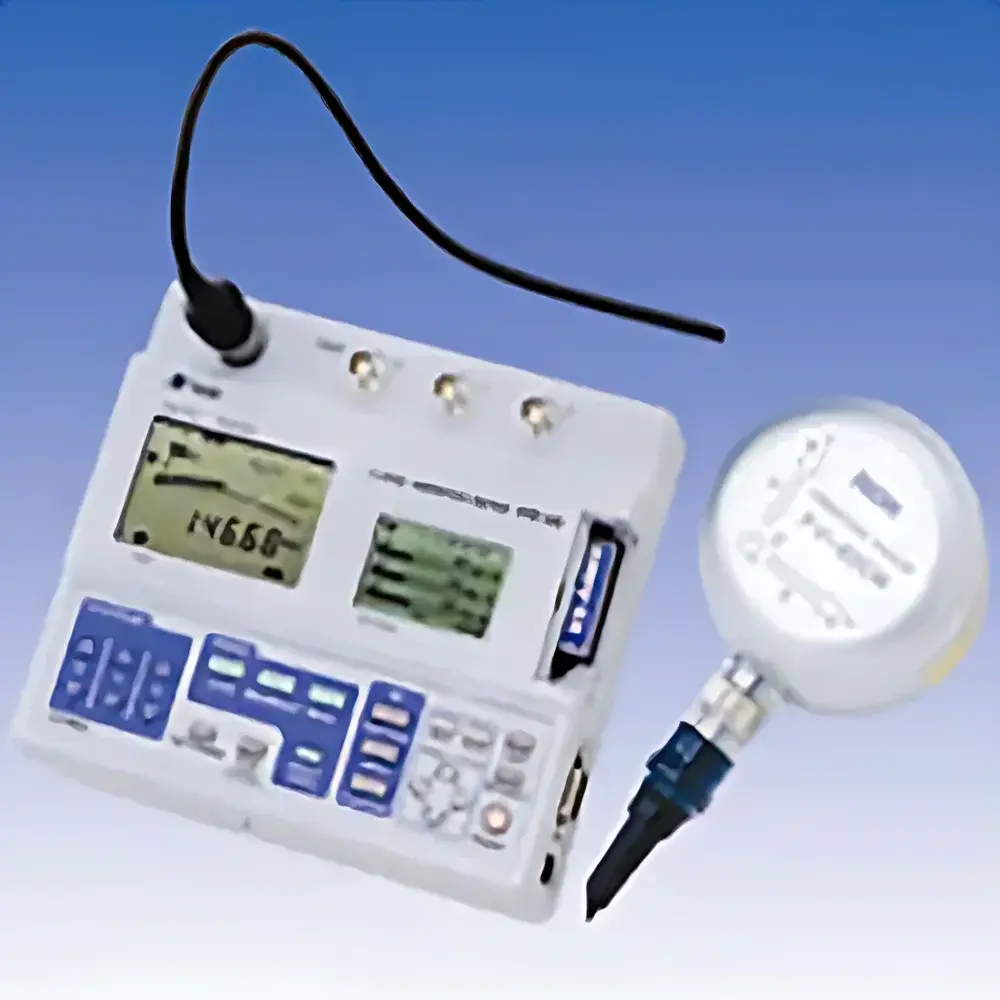
RION VM-54 Triaxial Low-Frequency Vibration Meter
| Brand | RION (Japan) |
|---|---|
| Origin | Japan |
| Model | VM-54 |
| Weight | ~1 kg |
| Frequency Range | 1–80 Hz |
| Measurement Axes | X, Y, Z (simultaneous) |
| Output Options | 3-channel analog AC output |
| Data Storage | CF card (CSV format) |
| Compliance | ISO 6954:2000, ISO 2631-2 (Wm weighting) |
| Measurement Modes | Acceleration (m/s²) or Velocity (mm/s) |
| Sensor Compatibility | PV-83C (triaxial) or PV-57 (uniaxial) |
| Operating Temperature | −10 to +50 °C |
| Relative Humidity | ≤90% RH |
| Power Supply | 4 × IEC R14 (C-size) alkaline batteries (16 h continuous operation) |
| Dimensions | 200 × 56 × 175 mm |
| Display | Dual LCD (primary + secondary) |
| Data Capacity | Up to 50,000 records (with VX-54WS card) |
| Optional Analysis Modules | VX-54WS (ship vibration), VX-54WB (human vibration), VX-54WH (power tool vibration), VX-54FT (FFT spectral analysis) |
| Environmental Protection | Water-resistant carrying case |
Overview
The RION VM-54 Triaxial Low-Frequency Vibration Meter is a portable, field-deployable instrumentation system engineered for precise, simultaneous measurement of vibration acceleration and velocity across three orthogonal axes (X, Y, Z). Designed in accordance with international human exposure and structural vibration assessment standards—including ISO 6954:2000 for shipboard vibration and ISO 2631-2 for mechanical vibration evaluation—the VM-54 employs a robust triaxial piezoelectric sensor architecture (e.g., PV-83C) to capture low-frequency dynamic motion in the 1–80 Hz band. This frequency range is critical for assessing low-speed machinery, marine hull response, building service equipment, and civil infrastructure under operational loads. The instrument operates on a dual-LCD interface with real-time parameter display and supports both acceleration (m/s²) and velocity (mm/s) units—enabling direct correlation with regulatory pass/fail thresholds defined in maritime classification society guidelines (e.g., DNV GL, LR, ABS) and occupational health frameworks.
Key Features
- Triaxial synchronous acquisition: Simultaneous measurement of acceleration or velocity across X, Y, and Z axes without sequential axis switching—ensuring phase-coherent time-series data.
- Configurable dynamic range: Six selectable full-scale ranges for acceleration (0.3 to 10,000 m/s²) and velocity (10 to 3,000 mm/s), optimized for both high-amplitude industrial sources and low-level ambient vibration monitoring.
- Integrated Wm frequency weighting per ISO 2631-2: Applies standardized human-body transmissibility filters for biologically relevant vibration evaluation in seated or standing postures.
- Real-time statistical computation: On-device calculation of Leq (equivalent continuous level), Lmax, and Lmin over user-defined intervals (10 s, 1 min, 2 min, or 10 min).
- 3-channel analog AC output: Enables parallel connection to external data loggers, oscilloscopes, or SCADA systems for synchronized multi-instrument recording.
- Expandable functionality via plug-in analysis cards: Modular firmware cards (VX-54FT, VX-54WS, etc.) extend capabilities without hardware modification—supporting FFT spectral analysis, vessel-specific reporting templates, and ISO 5349-compliant hand-arm vibration assessment.
Sample Compatibility & Compliance
The VM-54 is validated for use with RION’s certified triaxial accelerometers (PV-83C) and uniaxial transducers (PV-57), ensuring traceable metrological performance aligned with JIS C 1510 and IEC 61260-1 Class 2 requirements. Its measurement uncertainty profile satisfies ISO/IEC 17025–accredited laboratory validation protocols when used with calibrated sensors. Regulatory compliance includes ISO 6954:2000 (vibration on ships), ISO 2631-1/-2 (human exposure), and ISO 5349-1 (hand-transmitted vibration). For GMP or GLP environments, data integrity is maintained through timestamped CSV export to CF cards—with optional VX-54WS enabling audit-ready record retention (including operator ID, location tag, and calibration status metadata).
Software & Data Management
All measurement data are stored in industry-standard CSV format on removable CompactFlash cards, facilitating seamless import into MATLAB, Python (pandas), Excel, or vibration analysis platforms such as ME’scope or LMS Test.Lab. The VX-54WS software card enables on-device storage of up to 50,000 discrete records with automatic time-stamping and channel labeling. Optional VX-54FT card provides real-time 1024-point FFT analysis with Hanning windowing, spectral averaging, and peak-hold functions—ideal for identifying dominant resonant frequencies during commissioning or troubleshooting. No proprietary drivers or OS dependencies are required; data transfer occurs via standard USB-CF readers compatible with Windows, macOS, and Linux.
Applications
- Marine engineering: Hull vibration surveys per IMO MSC.374(93) and classification society rules (e.g., Lloyd’s Register NR232, DNV-RP-C203).
- Industrial plant monitoring: Assessment of rotating equipment (pumps, compressors, gearboxes) and structural foundations in factories and power generation facilities.
- Construction site vibration control: Compliance verification against BS 5228-2 and DIN 4150-3 for nearby sensitive structures during piling or demolition.
- Occupational health & safety: Quantification of whole-body vibration (WBV) in vehicle cabins and hand-arm vibration (HAV) from powered tools per EU Directive 2002/44/EC.
- Research & development: Field validation of finite element models (FEM) and modal analysis of lightweight structures under operational boundary conditions.
FAQ
What standards does the VM-54 support for ship vibration assessment?
The instrument complies with ISO 6954:2000 and supports Wm frequency weighting per ISO 2631-2, making it suitable for statutory vibration surveys required by major classification societies.
Can the VM-54 perform real-time FFT analysis without external computers?
Yes—when equipped with the optional VX-54FT analysis card, the device executes live 1024-line FFT with adjustable resolution bandwidth and spectral averaging directly on the unit.
Is calibration traceability provided with the system?
RION supplies factory calibration certificates traceable to NMIJ (National Metrology Institute of Japan); periodic recalibration is recommended annually per ISO 16063-21 and accredited laboratory practice.
How is data security ensured during field deployment?
CF card write-protection switches and timestamped, non-erasable records prevent unauthorized modification; optional VX-54WS implements file-locking logic compliant with FDA 21 CFR Part 11 electronic record requirements.
What is the battery life under continuous logging mode?
Using four alkaline IEC R14 (C-size) cells, the VM-54 operates continuously for up to 16 hours at 25 °C with LCD backlight disabled and sampling at 100 Hz.