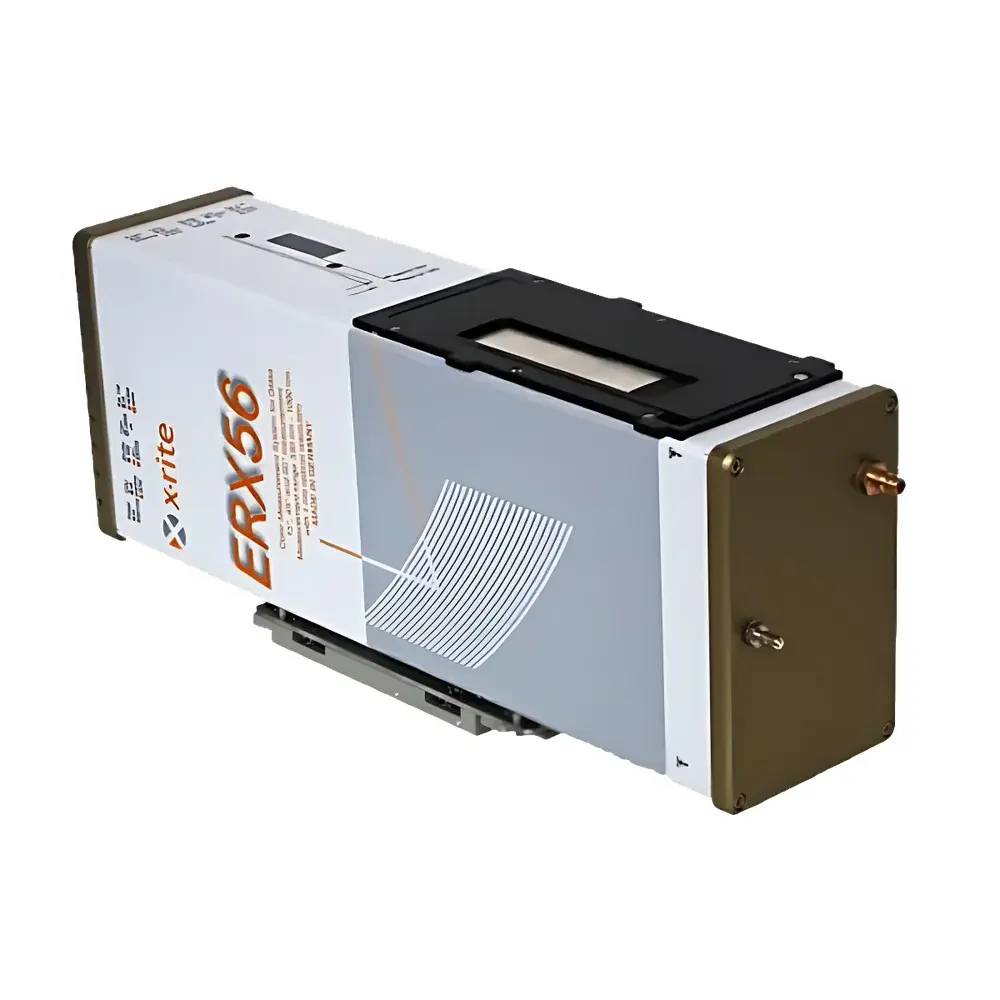
X-Rite ERX56 In-Line Non-Contact Multi-Angle Spectrophotometer
| Brand | X-Rite |
|---|---|
| Origin | USA |
| Model | ERX56 |
| Measurement Geometry | ±15°, ±45°, ±60° (bidirectional reflectance) |
| Spectral Range | 330–730 nm |
| Spectral Interval | 1 nm |
| Measurement Repeatability (White Tile) | ΔL*, Δa*, Δb* < 0.03 |
| Working Distance | 10 mm |
| Measurement Method | Flash-based pulsed xenon illumination |
| Calibration Frequency | External calibration recommended every 28 days |
| Optical Architecture | True dual-beam with auto-wavelength validation |
Overview
The X-Rite ERX56 In-Line Non-Contact Multi-Angle Spectrophotometer is an industrial-grade spectrophotometric sensor engineered for real-time, non-destructive color and appearance monitoring of optically challenging, non-diffusing substrates—particularly low-emissivity (Low-E) coated architectural glass, solar control glazing, and other specular or semi-specular functional thin-film products. Unlike conventional integrating sphere-based instruments designed for matte or diffusely scattering surfaces, the ERX56 employs a fixed-angle bidirectional reflectance geometry (±15°, ±45°, ±60°) to capture angular-dependent spectral reflectance data critical for evaluating goniochromatic behavior—i.e., hue and lightness shifts under varying viewing angles. Its pulsed xenon flash illumination ensures stable, repeatable excitation without thermal load on temperature-sensitive substrates, while its true dual-beam optical path compensates for lamp drift and environmental fluctuations in real time. The instrument operates across a calibrated spectral range of 330–730 nm at 1 nm resolution, enabling high-fidelity characterization of near-UV through visible wavelengths—essential for quantifying coating performance in solar heat gain coefficient (SHGC) and visible light transmittance (VLT) compliance testing.
Key Features
- Triple-angle simultaneous measurement capability: ±15° (equivalent to CIE d/8° sphere geometry for diffuse reference correlation), ±45°, and ±60°—enabling full angular color mapping per measurement cycle
- Non-contact operation at fixed 10 mm working distance—ideal for integration into continuous glass tempering, coating, or laminating lines without mechanical interference
- True dual-beam optical architecture with real-time reference channel monitoring and automated wavelength validation—ensuring long-term photometric stability and traceable accuracy
- Flash-based xenon illumination system eliminates sample heating and supports high-speed production line synchronization (measurement time < 100 ms per angle set)
- Robust industrial enclosure rated IP65 for operation in humid, dusty, or temperature-variable manufacturing environments
- Factory-calibrated spectral response traceable to NIST standards; external recalibration interval extended to 28 days under controlled factory conditions
Sample Compatibility & Compliance
The ERX56 is specifically validated for measurement of non-scattering, highly reflective, and multi-layered optical substrates—including sputter-coated Low-E glass (e.g., silver-based dielectric stacks), electrochromic glazing, anti-reflective (AR) coated optics, and metallized polymer films. Its angular geometry aligns with ASTM E2539 (Standard Practice for Goniospectrophotometric Measurement of Specular Surfaces) and supports compliance verification against ISO 13655 (Graphic technology — Spectral measurement and colorimetric computation for graphic arts images) and EN 410 (Glass in building — Determination of luminous and solar characteristics). Data output conforms to CIE 15:2018 spectral tristimulus values and supports calculation of key architectural metrics including solar reflectance (ρsolar), UV reflectance (ρUV), and color difference (ΔE00) per CIE DE2000. Instrument firmware and associated software support audit trails and electronic signatures required for GLP/GMP-aligned quality systems.
Software & Data Management
The ERX56 integrates natively with X-Rite’s ESWin QC software platform—a Windows-based application designed for statistical process control (SPC) in regulated manufacturing. ESWin QC provides real-time dashboard visualization of angular color deviation trends, SPC charting (X-bar/R, Cpk/Ppk), automatic alarm thresholds for out-of-spec angular shifts, and export of spectral data in ASCII, CSV, and CGATS.21 formats for third-party analytics or MES integration. All measurement sessions include embedded metadata (timestamp, operator ID, job number, calibration status), and the system supports 21 CFR Part 11-compliant user access controls, electronic signatures, and immutable audit logs when deployed in FDA-regulated environments. Optional API modules enable direct OPC UA or Modbus TCP communication with PLCs and SCADA systems for closed-loop feedback control of coating deposition parameters.
Applications
- Real-time monitoring of silver-layer thickness uniformity and oxidation state in magnetron-sputtered Low-E glass production
- Goniochromatic verification of solar control coatings during float glass inline coating processes
- Batch-to-batch consistency validation for automotive glazing with IR-reflective or privacy-tint functional layers
- Quality gate inspection for architectural curtain wall units prior to shipment—reducing field rejection due to angular metamerism
- R&D characterization of novel nanocomposite coatings where spectral angular response correlates with nanostructure orientation
- Supporting ISO 15099 thermal modeling inputs via measured spectral reflectance at multiple incidence angles
FAQ
What angular geometries does the ERX56 support—and why are they standardized?
The ERX56 measures at ±15°, ±45°, and ±60° relative to surface normal. These angles are selected to align with industry benchmarks: ±15° approximates diffuse-integrated response for baseline color correlation; ±45° captures primary viewing-angle perception in façade applications; ±60° reveals edge effects and coating interference fringes critical for thin-film quality assessment.
Can the ERX56 be integrated into existing PLC-controlled production lines?
Yes—the instrument supports analog 4–20 mA outputs for L*a*b* channels and digital communication via Ethernet/IP, Modbus TCP, or optional OPC UA drivers. Hardware I/O terminals allow direct interlock with line stop/start signals and safety relays.
Is spectral data from the ERX56 compliant with ISO/IEC 17025 accredited laboratories?
When operated within documented calibration intervals, environmental controls, and with traceable NIST-traceable standards, raw spectral reflectance data meets ISO/IEC 17025 requirements for measurement uncertainty reporting. Full accreditation requires site-specific validation per ILAC-G8:2019.
Does the ERX56 require periodic internal recalibration?
No internal recalibration is user-performed. The instrument uses factory-installed, thermally stabilized reference channels and auto-wavelength validation at each measurement cycle. Only external calibration using certified ceramic tiles is required every 28 days under typical factory conditions.
How does the ERX56 handle measurement variability caused by glass substrate curvature or waviness?
The 10 mm working distance and narrow depth-of-field optical design minimize focus-related error. For curved substrates exceeding ±0.5 mm/m deviation, optional motorized Z-axis focus compensation can be added to maintain optimal signal-to-noise ratio across the measurement field.