
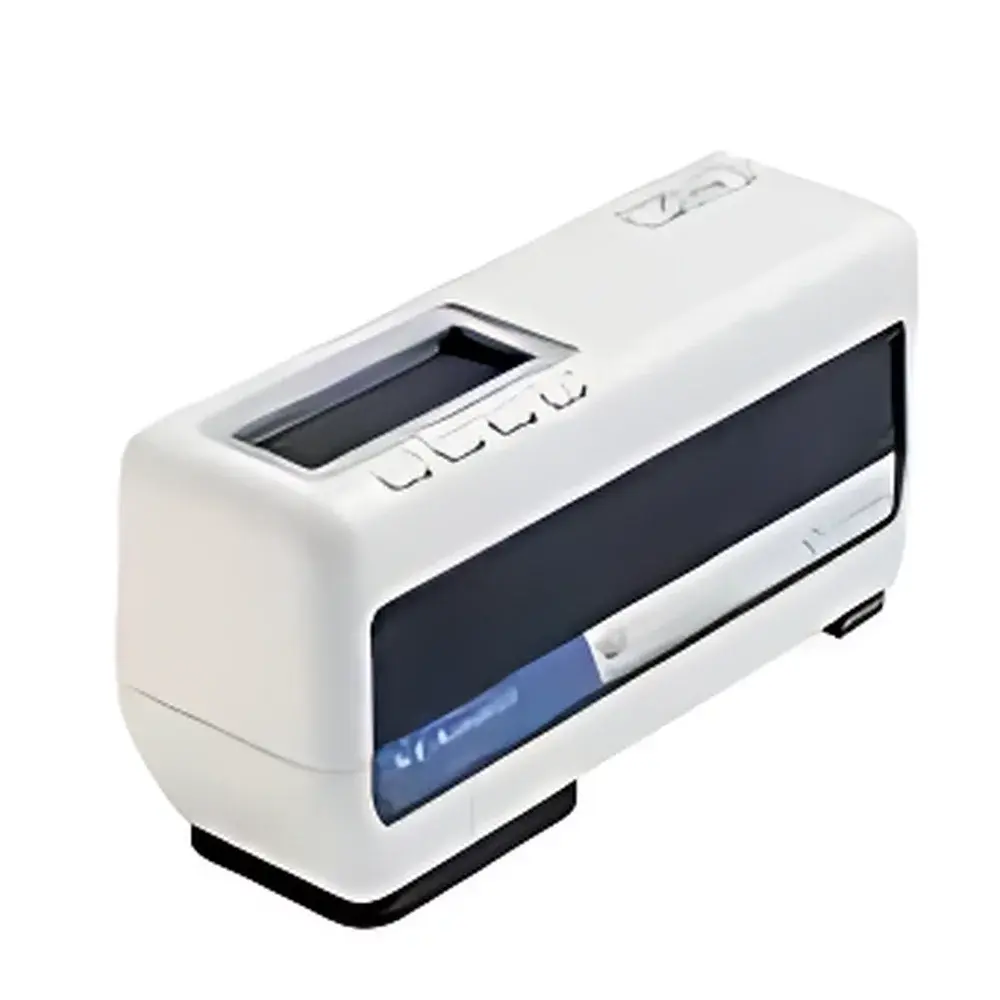
X-Rite MA68 II Multi-Angle Spectrophotometer
| Brand | X-Rite |
|---|---|
| Origin | USA |
| Model | MA68 II |
| Type | Automatic Portable Multi-Angle Spectrophotometer |
| Measurement Geometry | 45° illumination / 15°, 25°, 45°, 75°, 110° viewing angles (measured from specular reflection direction) |
| Angular Accuracy | ±0.15° |
| Aperture | 12 mm (0.5 in) |
| Color Spaces | CIELAB, LCH, ΔL*Δa*Δb*, ΔL*ΔC*ΔH*, ΔFlopIndex, FlopIndex, ΔE*ab, ΔE*cmc(2:1) |
| Illuminants | C, D65, D50, A, F2, F7, F11, F12 |
| Observer Angles | CIE 2° & 10° standard observer |
| Spectral Range | 400–700 nm |
| Spectral Interval | 28 bands (10 nm resolution from 400–640 nm |
| Detector | Blue-enhanced silicon photodiode |
| Reflectance Range | 0–400% |
| Repeatability | ≤0.08 ΔE*ab (short-term, white tile) |
| Measurement Time | ~2 seconds per full 5-angle acquisition |
| Data Interface | RS-232 (bidirectional, 300–19200 baud) |
| Display | 4-line × 20-character dot-matrix LCD |
| Power | Removable NiMH battery pack (6 × AA, 7.2 VDC, 1100 mAh) or AC adapter (90–130 VAC, 50–60 Hz, max 20 W) |
| Battery Life | ~1000 measurements per full charge (5-angle simultaneous mode) |
| Operating Temperature | 10–40 °C, ≤85% RH (non-condensing) |
| Storage Temperature | −20–50 °C |
| Dimensions | 22.5 × 7.6 × 11.6 cm (L×W×H) |
| Weight | 1.4 kg |
| Compliance | Meets CIE No. 15:2018, ISO/CIE 11664 series, ASTM D2244, ASTM E308, ISO 12647-2, ISO 13655, and supports GLP/GMP data integrity requirements via optional software audit trails |
Overview
The X-Rite MA68 II Multi-Angle Spectrophotometer is an industrial-grade, portable spectrophotometric instrument engineered for precise measurement of spatially varying color effects—particularly those exhibited by effect pigments such as metallic flakes, pearlescent particles, and goniochromatic coatings. It operates on a fixed 45° illumination geometry with five discrete viewing angles (15°, 25°, 45°, 75°, and 110°), all referenced from the specular reflection direction. This geometry conforms to ASTM D2244 and ISO 13655 standards for multi-angle color evaluation and enables quantification of both directional reflectance behavior and visual metamerism. The system employs a pulsed tungsten-halogen lamp (≈4000 K CCT) coupled with a blue-enhanced silicon photodiode array and 28-band spectral sampling across 400–700 nm. Its high-speed, simultaneous five-angle acquisition—enabled by Dynamic Rotation Sampling (DRS)—eliminates sequential angular scanning artifacts and ensures temporal coherence across all measured spectra.
Key Features
- Simultaneous five-angle spectral acquisition (15°, 25°, 45°, 75°, 110°) using patented DRS optical path rotation—no motorized goniometer required.
- High repeatability: ≤0.08 ΔE*ab short-term repeatability on certified white tile under controlled conditions.
- Compact, handheld form factor (1.4 kg) with ergonomic design optimized for production-floor use and mobile lab deployment.
- Integrated 4-line × 20-character LCD display with real-time pass/fail feedback and on-device statistical summaries (e.g., mean ΔE, standard deviation).
- Removable, field-replaceable NiMH battery pack supporting >1000 five-angle measurements per charge—ideal for remote or line-side quality verification.
- RS-232 interface compliant with industry-standard protocols (300–19200 baud), enabling direct integration into MES, LIMS, and SPC platforms without proprietary drivers.
- Full spectral output (400–700 nm at 10/20 nm intervals) available per angle, supporting advanced post-acquisition analysis including flop index modeling, sparkle metrics, and custom gloss-weighted color difference algorithms.
Sample Compatibility & Compliance
The MA68 II accommodates flat, curved, and moderately textured substrates—including painted automotive body panels, plastic bumpers, alloy wheels, mirror housings, and trim components—within its 12 mm aperture. Its optical design minimizes edge effects and shadowing on contoured surfaces through optimized beam collimation and diffuse light rejection. The instrument complies with CIE Publication No. 15:2018 (Colorimetry), ISO/CIE 11664-4 (CIELAB), ISO 13655 (Spectral measurement of graphic technology), and ASTM D2244 (Standard Practice for Calculating Color Tolerances). When used with validated software modules (e.g., X-Rite Color iQC or Datacolor MATCHTEXTURE), it supports FDA 21 CFR Part 11-compliant electronic records and signatures, including audit trail generation, user access control, and data immutability for GLP/GMP-regulated environments.
Software & Data Management
Data export is supported via ASCII-formatted RS-232 transmission, delivering complete spectral reflectance curves (400–700 nm), CIELAB coordinates, FlopIndex values, and inter-angle ΔE calculations per measurement event. The device stores up to 200 standards and 890 sample records onboard. For enterprise-level traceability, X-Rite’s Color iQC software provides centralized database management, SPC charting (X-bar/R, Cp/Cpk), automated reporting (PDF/CSV), and version-controlled standard libraries. Optional Metallix-QA software extends analytical capability with spatial mapping of color variation across large parts—enabling correlation between geometric orientation and perceived color shift. All software modules maintain full calibration traceability to NIST-traceable reference standards and support periodic verification per ISO/IEC 17025 requirements.
Applications
- Automotive OEM and Tier-1 paint shop QC: validation of batch-to-batch consistency for metallic basecoats, pearl-effect clearcoats, and chromatic effect finishes.
- Wheel and trim component manufacturing: monitoring aluminum flake orientation, particle size distribution influence, and curing-induced color drift.
- R&D of effect pigment systems: empirical correlation of spectral angular response with pigment aspect ratio, coating film thickness, and binder refractive index.
- Aftermarket refinish formulation: matching legacy vehicle finishes where angular dependency dominates visual acceptability.
- Plastic part color approval: evaluating molded-in color stability across injection-molded PP, ABS, and PC substrates with varying surface topography.
FAQ
What is the angular accuracy specification of the MA68 II?
The angular positioning accuracy is ±0.15° across all five viewing angles, verified during factory calibration using precision optical goniometers traceable to NIST standards.
Does the MA68 II support CIE 10° observer data output?
Yes—the instrument internally computes both CIE 2° and 10° observer functions from raw spectral data and allows user-selectable output in either observer mode.
Can the MA68 II measure transparent or translucent films?
No—it is designed exclusively for opaque or near-opaque reflective samples. Transmittance or haze measurement requires dedicated instrumentation such as an integrating sphere spectrophotometer.
Is firmware upgrade capability available in-field?
Yes—firmware updates are delivered via RS-232 using X-Rite-provided utilities and require no hardware modification or service center intervention.
How is calibration maintained over time?
The instrument includes a removable ceramic white calibration tile (certified per ISO 13655) and supports daily verification routines; full recalibration is recommended annually or after 100,000 measurements, whichever occurs first.





