
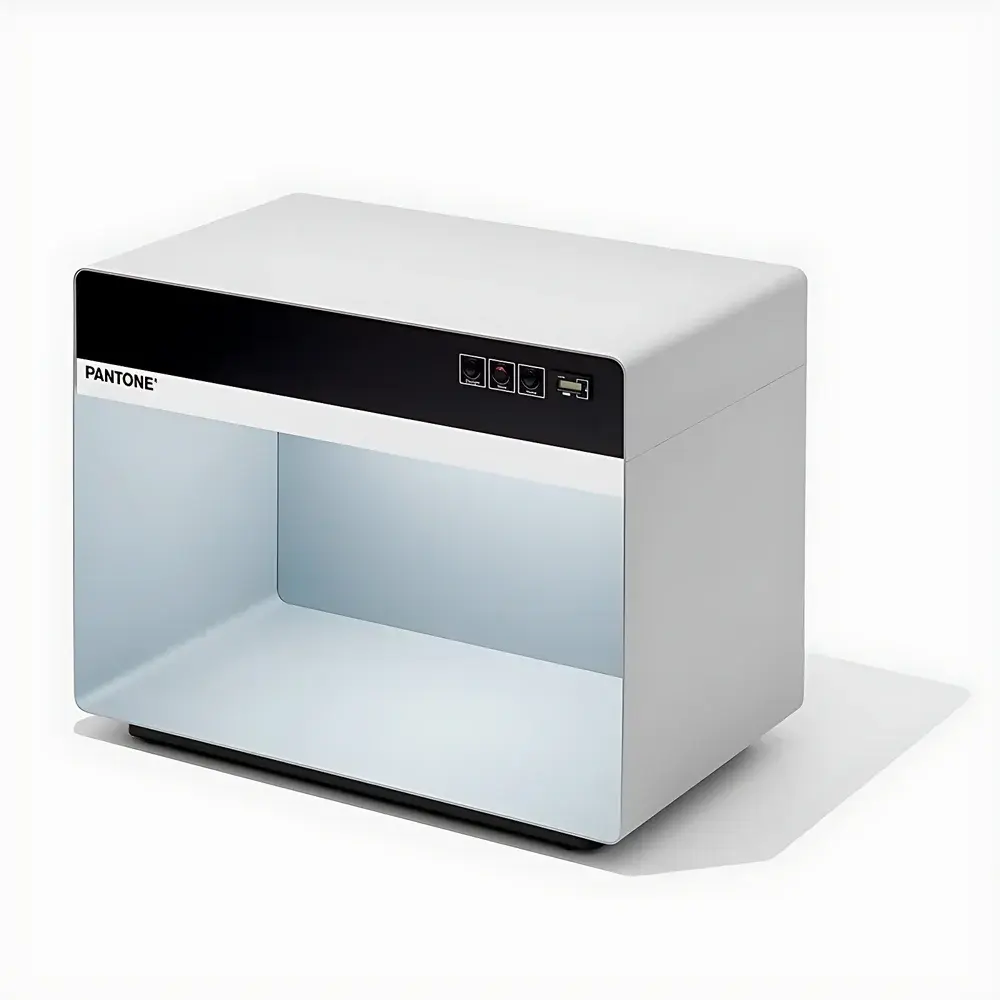
X-Rite Pantone 3 Standard Light Booth
| Brand | X-Rite |
|---|---|
| Origin | USA |
| Model | PANTONE 3 |
| Light Sources | D50 (with CWF), D65 (with TL84), CIE Illuminant A |
| Lamp Life | 2000 hours |
| Preheat Time | 3 min (fluorescent) |
| Power Consumption | ≤50 W |
| Operating Temperature | 0–40 °C |
| Storage Temperature | 0–40 °C |
| Humidity Range | 0–95% RH (non-condensing) |
| Viewing Chamber Dimensions | 68.5 × 39.5 × 35 cm |
| External Dimensions | 69 × 50 × 42 cm |
| Weight | 23.5 kg (unit), 27.5 kg (shipping) |
| Construction | Powder-coated aluminum |
| Metamerism Index | C-grade per CIE TR 51.2-1999 |
| Compliance | ISO 3664, ASTM D1729, ASTM E308, AATCC TM19, BSI BS 950-1 |
| Warranty | 1–2 years |
Overview
The X-Rite Pantone 3 Standard Light Booth is an entry-level, precision-engineered color evaluation system designed for consistent visual assessment under controlled illumination conditions. It operates on the fundamental principle of standardized illuminant simulation—reproducing spectral power distributions (SPDs) that match internationally defined reference illuminants including D50 (for graphic arts and printing), D65 (for general industrial color evaluation), and CIE Illuminant A (representing incandescent tungsten lighting). Unlike broadband or uncalibrated light sources, the Pantone 3 employs spectrally optimized fluorescent lamps with stable output and minimal drift over time, ensuring high reproducibility in observer-based color matching tasks. Its architecture conforms to the geometric and photometric requirements outlined in ISO 3664:2009 for viewing conditions in graphic technology and photography, as well as ASTM D1729 for color evaluation in industrial applications. The booth’s rigid aluminum chassis and powder-coated finish provide mechanical stability and resistance to environmental degradation, supporting long-term calibration integrity in both laboratory and production-floor environments.
Key Features
- Triple-illuminant configuration: D50 (with CWF phosphor blend), D65 (with TL84 phosphor blend), and CIE Illuminant A—each independently selectable via front-panel toggle switches
- Preheat-optimized fluorescent lamp system with 3-minute stabilization time, meeting ISO 3664 minimum warm-up requirements
- C-grade metamerism index per CIE Technical Report 51.2-1999, indicating acceptable spectral fidelity for routine color comparison tasks
- Viewing chamber dimensions (68.5 × 39.5 × 35 cm) engineered to support standard sample placement per ISO 3664 field-of-view specifications
- Integrated lamp-hour counter enabling predictive maintenance scheduling and traceable lamp replacement cycles
- Universal voltage compatibility (100–230 V AC, 50/60 Hz) with ETL-recognized safety certification for North America and global markets
- Modular lamp design allowing user-level replacement without specialized tools; optional pre-certified lamps available with NIST-traceable calibration documentation
Sample Compatibility & Compliance
The Pantone 3 accommodates a wide range of physical samples—including printed substrates, coated foils, textiles, plastic parts, painted panels, and packaging prototypes—within its ergonomically designed viewing chamber. Its illumination geometry adheres to ISO 3664:2009 requirements for surround luminance, background reflectance (Munsell N7 neutral gray), and viewing angle (0°/45° or diffuse/0° configurations supported via optional accessories). The system meets critical compliance benchmarks for visual color assessment workflows, including ASTM D1729 (Standard Practice for Visual Appraisal of Colors), ASTM E308 (Standard Practice for Computing the Colors of Objects by Using the CIE System), AATCC TM19 (Color Measurement Instrumentation), and BSI BS 950-1 (Specification for Colour Matching Cabinets). While it does not include internal temperature or humidity sensors, its specified operating range (0–40 °C, 0–95% RH non-condensing) aligns with GLP-aligned environmental monitoring protocols commonly applied in QC laboratories.
Software & Data Management
The Pantone 3 operates as a standalone hardware platform with no embedded microprocessor or digital interface. As such, it does not feature firmware updates, network connectivity, or software-driven calibration routines. However, its design supports integration into broader color management ecosystems: lamp replacement records, usage logs, and environmental condition data can be manually documented to satisfy audit requirements under ISO/IEC 17025 or FDA 21 CFR Part 11 when used within validated quality systems. Pre-certified lamp kits include calibration certificates traceable to NIST standards, facilitating documentation for internal audits or third-party assessments. For laboratories requiring electronic recordkeeping, X-Rite’s Color iMatch or SpectraMagic software suites may be deployed alongside the Pantone 3 to correlate visual assessments with instrumental measurements from compatible spectrophotometers.
Applications
- Graphic arts prepress and pressroom verification under D50 illumination per ISO 3664 and GRACoL specifications
- Textile and apparel color approval under D65 and TL84 lighting, supporting AATCC and ISO 105-J03 compliance
- Industrial product color consistency checks across lighting environments—e.g., evaluating how automotive trim appears under showroom (D65) vs. home (Illuminant A) lighting
- Packaging development workflows where metamerism detection between retail shelf (TL84) and outdoor daylight (D65) is critical
- Quality control in ink, pigment, and coating manufacturing where batch-to-batch visual match validation is required
- Educational settings for teaching color theory, illuminant effects, and observer variability in visual assessment
FAQ
Does the Pantone 3 require periodic recalibration?
No—the unit contains no optical sensors or electronics requiring recalibration. However, lamps must be replaced every 2,000 hours of operation to maintain spectral fidelity and metamerism performance per ISO 3664 recommendations.
Can I use third-party lamps in the Pantone 3?
X-Rite does not validate or support non-OEM lamps. Use of uncertified lamps voids warranty coverage and may compromise conformance to ISO, ASTM, or AATCC visual assessment criteria.
Is the Pantone 3 suitable for GMP-regulated environments?
Yes—when operated within documented environmental controls and paired with traceable lamp replacement logs and pre-certified lamp documentation, it supports GMP-aligned visual inspection processes per ICH Q5E and ISO 13485 Annex C requirements.
What is the difference between D50 and D65 illumination in practice?
D50 (5003 K) simulates average daylight at mid-morning/mid-afternoon and is mandated for print and publishing; D65 (6504 K) represents noon daylight and is preferred for industrial materials, textiles, and plastics where higher blue content reveals subtle chromatic differences.
How does the C-grade metamerism rating affect my color decisions?
A C-grade rating per CIE TR 51.2-1999 indicates moderate spectral match quality—sufficient for pass/fail evaluation and relative comparison but not recommended for absolute color specification in high-tolerance applications where A- or B-grade booths are specified.




