
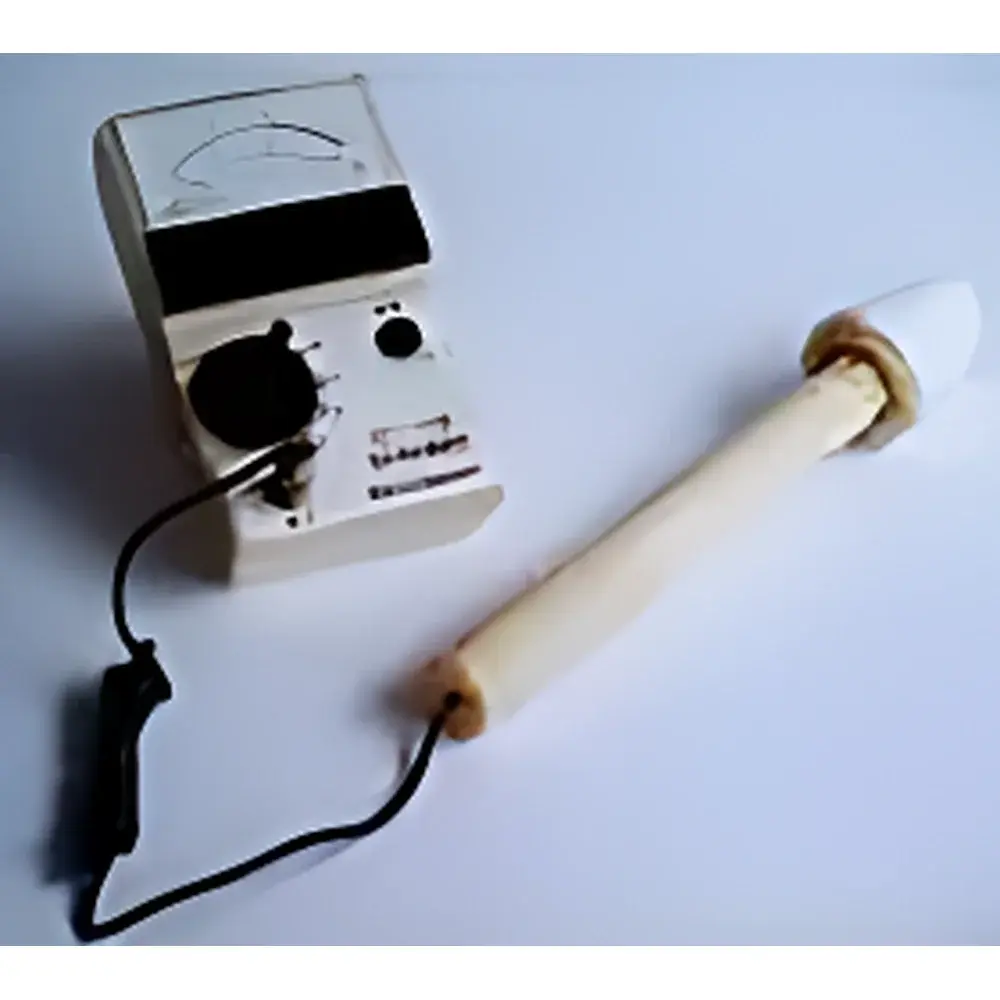
RJ-3 High-Frequency Near-Field Electric Field Meter
| Origin | Zhejiang, China |
|---|---|
| Manufacturer Type | Distributor |
| Origin Category | Domestic |
| Model | RJ-3 |
| Price | USD 700 (approx.) |
| Instrument Type | Field Strength Meter / Dosimetry Rate Meter |
| Frequency Range | 20–200 MHz |
| Measurement Range | 0–450 V/m (3-range switchable: 0–30 V/m, 30–150 V/m, 50–450 V/m) |
| Overall Measurement Uncertainty | ≤ ±30% |
| Operating Temperature | −10 °C to +40 °C |
| Relative Humidity | ≤ 80% RH |
| Power Supply | Two 6 V F22 alkaline stacked batteries |
| Form Factor | Portable |
| Instrument Dimensions | 170 mm × 100 mm × 45 mm |
| Packaging Dimensions | 450 mm × 370 mm × 150 mm |
| Weight | ~3 kg |
Overview
The RJ-3 High-Frequency Near-Field Electric Field Meter is a portable, broadband field strength measurement instrument engineered for quantitative assessment of electric field intensity in the near-field region of high-frequency electromagnetic sources. It operates on the principle of calibrated dipole antenna coupling and broadband RF detection, optimized for frequencies between 20 MHz and 200 MHz — a critical band encompassing industrial RF heating equipment (e.g., induction welders, dielectric sealers), medical diathermy units, FM broadcast transmitters, and VHF television transmission infrastructure. Unlike far-field survey meters designed for plane-wave conditions, the RJ-3 is specifically configured for reactive near-field environments where E-field dominance, non-uniform spatial distribution, and strong field gradients prevail. Its tri-range analog/digital hybrid readout enables rapid qualitative screening and semi-quantitative compliance evaluation under variable exposure scenarios typical in occupational safety and environmental EMF monitoring.
Key Features
- Three-step manual range switching (0–30 V/m, 30–150 V/m, 50–450 V/m) for optimized signal-to-noise ratio across diverse field intensities
- Calibrated isotropic response within specified frequency band; dipole sensor geometry ensures directional sensitivity appropriate for near-field mapping
- Compact, ruggedized handheld enclosure with ergonomic grip and integrated battery compartment for extended field deployment
- Low-power operation using two standard 6 V F22 alkaline stacked batteries, supporting >20 hours of continuous use at room temperature
- Real-time analog needle display supplemented by digital segment readout for immediate visual interpretation and data logging readiness
- Designed for ambient operation from −10 °C to +40 °C and relative humidity up to 80%, meeting IP54-level ingress protection against dust and splashing water
Sample Compatibility & Compliance
The RJ-3 is intended for use in non-ionizing radiation (NIR) assessment contexts governed by national and international exposure guidelines, including ICNIRP (2020) and IEEE C95.1-2019 limits for occupational and general public E-field exposure. While not certified to IEC 61786-1:2013 or IEC 62233:2008 as a Class 1 reference instrument, its documented uncertainty (≤ ±30%) aligns with screening-level requirements per GB/T 18204.1–2013 (China) and similar national standards for preliminary EMF surveys. It is routinely deployed in workplace evaluations involving RF sealers, plasma generators, and broadcast auxiliary equipment where traceable calibration against NIST-traceable field probes (e.g., Narda EHP-50F) is performed prior to each measurement campaign. The instrument does not support real-time spectral analysis or frequency-selective demodulation; it functions strictly as a broadband RMS-equivalent E-field integrator.
Software & Data Management
The RJ-3 operates as a standalone analog-digital hybrid meter without embedded microprocessor-based data storage or wireless telemetry. However, its analog output (0–1 V DC proportional to field strength) and discrete range selection signals are compatible with external DAQ systems (e.g., National Instruments USB-6009, Keysight 34972A) for time-stamped logging and post-processing. Optional accessories include a tripod mount adapter and calibrated field probe extension cable (1.5 m, low-loss RG-174). Calibration certificates issued by accredited Chinese metrology institutes (e.g., Zhejiang Institute of Metrology) include traceability to national primary standards and are valid for 12 months under normal usage conditions. Full audit trails, electronic signatures, and FDA 21 CFR Part 11 compliance are not supported natively but may be implemented via third-party validated LIMS integration workflows.
Applications
- Occupational health and safety assessments around RF plastic welders, textile sealers, and induction brazing stations
- Pre-compliance verification of FM/TV transmitter site perimeter fields prior to regulatory reporting
- EMF baseline surveys in educational laboratories utilizing RF generators and plasma discharge apparatus
- Field validation of shielding effectiveness for RF-enclosed rooms and medical diathermy treatment suites
- Supporting GLP-aligned documentation for internal environmental health programs in manufacturing facilities
- Tactical EMF reconnaissance in military maintenance depots operating high-power communications gear
FAQ
Is the RJ-3 suitable for measuring fields from 5G base stations or Wi-Fi routers?
No. Its 20–200 MHz operational bandwidth excludes modern telecommunications bands (e.g., 700 MHz LTE, 2.4/5 GHz Wi-Fi, 3.5 GHz 5G NR). It is not applicable for microwave or millimeter-wave exposure assessment.
Does the instrument require periodic recalibration?
Yes. Annual recalibration against traceable field standards is recommended per ISO/IEC 17025 guidance and manufacturer specifications to maintain stated uncertainty performance.
Can the RJ-3 distinguish between electric and magnetic field components?
No. It measures only the electric field component (E-field) using a calibrated dipole sensor. Magnetic field (H-field) measurement requires a separate loop-type probe and instrument.
Is the RJ-3 compliant with EU CE marking requirements?
It is not CE-marked, as it is manufactured and distributed for domestic use under Chinese regulatory frameworks (e.g., CCC exemption for non-safety-critical measurement devices). Export configurations require third-party conformity assessment.
What is the minimum detectable field strength in the lowest range?
Based on analog scale resolution and noise floor characterization, the practical lower limit is approximately 1.5 V/m in the 0–30 V/m range, assuming stable battery voltage and ambient thermal equilibrium.
Related Products







