
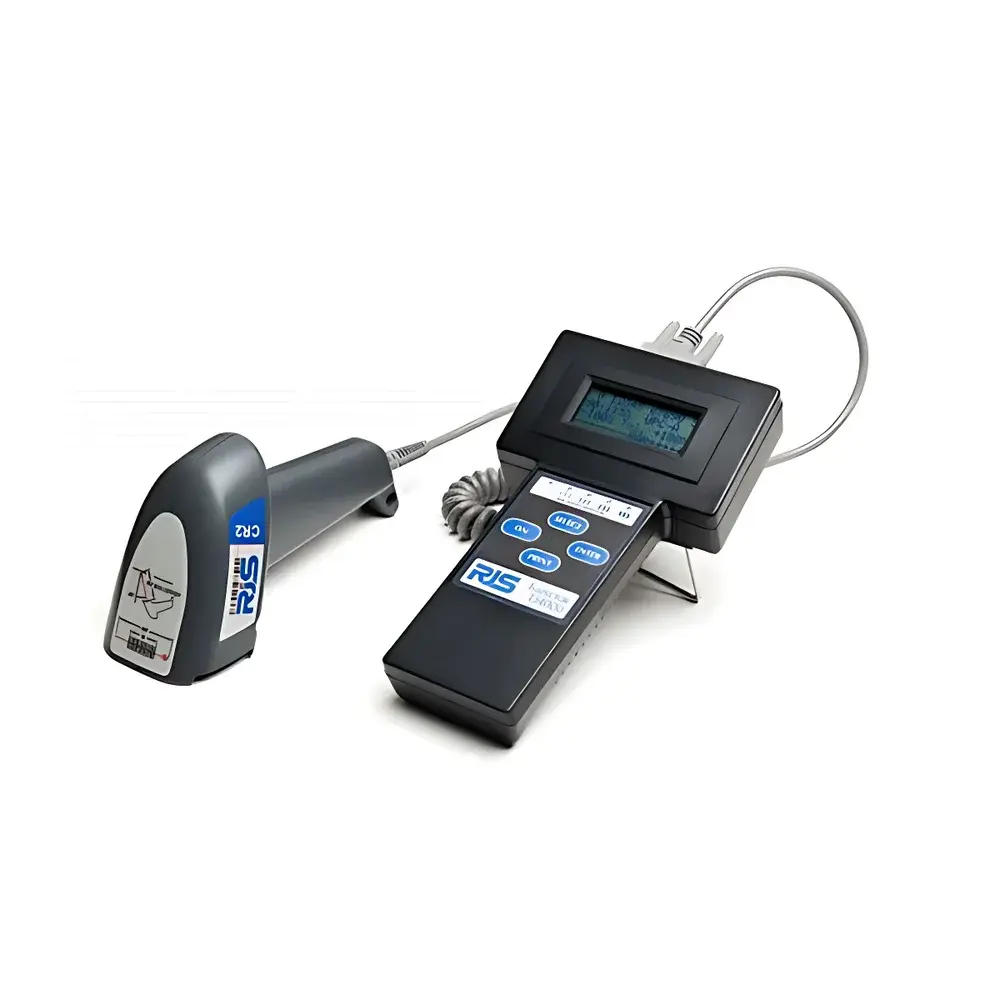
RJS D4000 ANSI-Compliant Laser & Auto-Optic Barcode Verification System
| Brand | RJS |
|---|---|
| Origin | USA |
| Manufacturer Type | Authorized Distributor |
| Origin Category | Imported |
| Model | D4000 |
| Pricing | Available Upon Request |
Overview
The RJS D4000 is a dual-mode, standards-compliant barcode verification system engineered for precision conformance testing in regulated and industrial environments. Unlike generic barcode scanners, the D4000 functions as a metrological verification instrument—designed to quantify optical and dimensional parameters against ANSI X3.182 (now ISO/IEC 15416) and ISO/IEC 15415 standards. It operates in two distinct measurement modalities: Auto-Optic mode (imaging-based, multi-aperture, dual-wavelength reflectance analysis) and Laser mode (single-line, high-resolution scanning with dynamic focus compensation). Each mode delivers traceable, repeatable measurements of critical quality attributes—including symbol contrast, modulation, reflectance margin, decodability, and quiet zone compliance—enabling full Grade A–F reporting per ANSI methodology. The system is widely deployed in pharmaceutical packaging validation, medical device labeling audits, logistics compliance verification, and print process control labs where regulatory documentation (e.g., FDA 21 CFR Part 11, ISO 13485, or GMP traceability) is required.
Key Features
- Dual-Modality Architecture: Switch seamlessly between Auto-Optic (CCD-based imaging with 4 aperture sizes and 660 nm / 925 nm LED illumination) and Laser (650 nm Class II diode, adjustable scan line pitch) verification engines.
- ANSI X3.182 & ISO/IEC 15416 Compliance: Full parameter calculation—including minimum edge contrast, symbol contrast, modulation, reflectance margin, and decode error rate—with automated grade assignment (A–F).
- UCC/EAN-128 & GS1 AI Support: Native parsing of Application Identifiers (AI 00, AI 01, etc.), including structured data format validation and supplemental code verification (2-digit and 5-digit UPC/EAN add-ons).
- On-Device Analytics: Real-time display of decode rate (%), grade history, and pass/fail status via 4×20-character LCD; audible feedback (beep patterns) for result interpretation and low-battery alerts.
- Embedded Storage & Traceability: 20 KB non-volatile memory stores up to 1,000 verification records with timestamp, operator ID (if configured), and full parameter sets—exportable via serial interface for audit-ready reporting.
- Robust Industrial Form Factor: Compact housing (198 × 117 × 48 mm), sealed keypad, and ESD-hardened optics suitable for cleanroom, warehouse, and production floor deployment.
Sample Compatibility & Compliance
The D4000 accommodates diverse substrate geometries and printing conditions without recalibration. Auto-Optic mode supports curved, corrugated, or thermally unstable surfaces (e.g., shrink sleeves, flexographic labels), while Laser mode excels on low-contrast, high-magnification, or IR-sensitive codes (e.g., carbon-black inks on dark substrates). Both modes validate Code 39 (USS, AIAG B-1/B3–B5/B10, LOGMARS, HIBC), Code 128 (USS, UCC/EAN-128), Codabar (USS), Interleaved 2 of 5 (USS, Case Code), and UPC/EAN families—including wet ink, laser-printed, thermal-transfer, and direct thermal barcodes. All measurements comply with ASTM D7907 (Barcode Print Quality Standard) and support GLP/GMP documentation workflows.
Software & Data Management
Data export is supported via RS-232 serial interface to host PCs or local printers (TP140A optional). While the D4000 operates autonomously, its binary record structure enables integration into LIMS or MES platforms through custom middleware. Audit trails include measurement date/time, user-selectable ID field, and raw intensity profiles (in Laser mode) or grayscale image captures (in Auto-Optic mode). Firmware updates preserve calibration constants and maintain traceability to NIST-traceable reference standards used during factory certification.
Applications
- Pharmaceutical secondary packaging verification per FDA UDI requirements and EU MDR Annex I labeling clauses.
- Automotive supplier label audits (AIAG B-1/B5 compliance) across Tier 1–3 manufacturing sites.
- Print shop QC for GS1-certified label vendors validating thermal transfer vs. flexo output stability.
- Medical device serialization line validation under ISO 15418 and ISO/IEC 15424 (Data Matrix) cross-reference protocols.
- In-process inspection of high-speed corrugated case labeling where surface curvature and ink bleed affect decode reliability.
- Regulatory submission support: Generating ANSI-grade reports for 510(k), CE Technical Files, or PMDA dossier annexes.
FAQ
Does the D4000 provide NIST-traceable calibration certificates?
Yes—each unit ships with a factory calibration report referencing NIST SRM 2039 (reflectance standard) and SRM 2040 (line width standard), valid for 12 months.
Can the D4000 verify 2D symbologies like Data Matrix or QR Code?
No—the D4000 is optimized exclusively for linear (1D) symbologies per ANSI X3.182 and ISO/IEC 15416. For 2D verification, RJS recommends the D6000 series.
Is firmware upgrade capability available in the field?
Yes—upgrades are delivered via ASCII text file over RS-232 and retain all stored verification records and user settings.
What environmental conditions affect measurement repeatability?
Ambient light > 500 lux may interfere with Auto-Optic mode; operation is rated for 10–40°C and ≤85% RH non-condensing.
How does the D4000 handle variable-height barcodes (e.g., on tapered containers)?
Laser mode includes dynamic focus tracking that compensates for ±3 mm Z-axis variation during single-pass scanning.





