
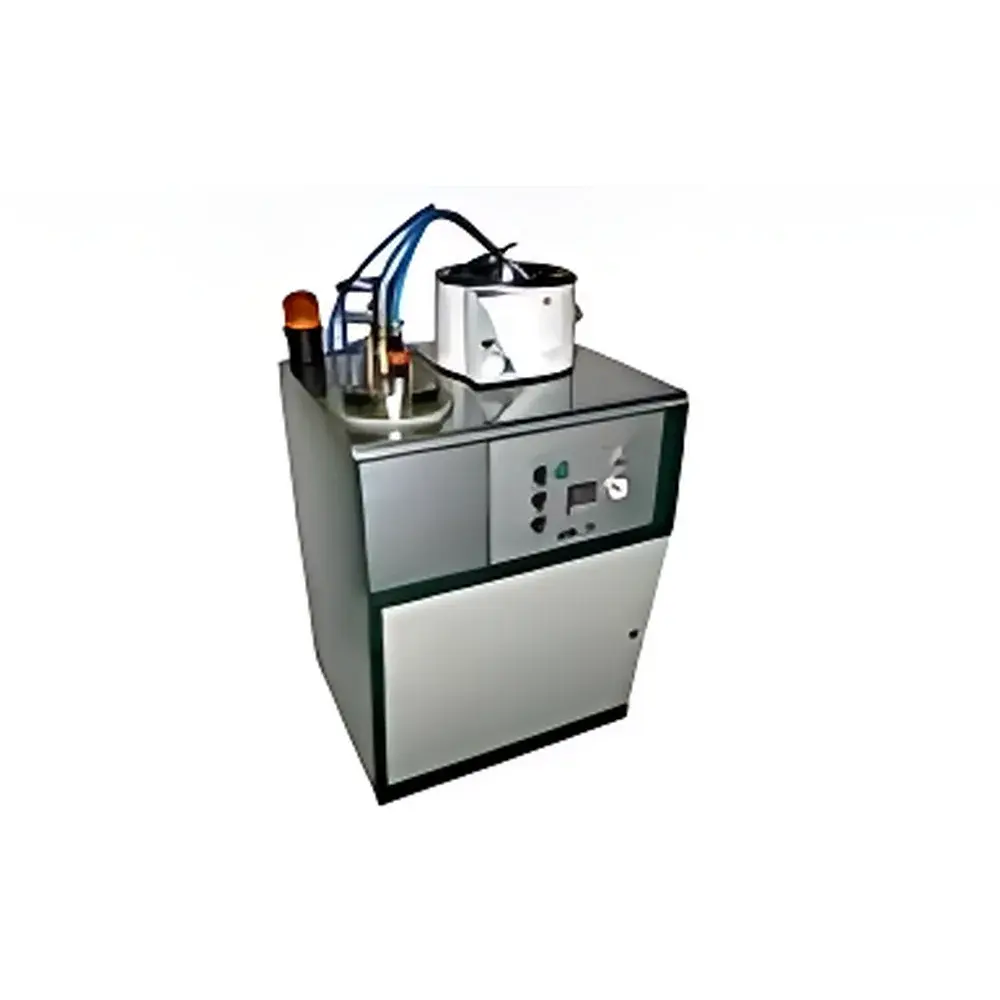
RockCore™ J0409 Geological Impregnation Press by BROT (France)
| Origin | France |
|---|---|
| Manufacturer Type | Authorized Distributor |
| Origin Category | Imported |
| Model | J0409 |
| Quotation | Upon Request |
| Power Supply | 400 V, 3-phase |
| Frequency | 50/60 Hz |
| Main Motor | 750 W |
| Vacuum Pump Motor | 150 W |
| Operating Temperature | Up to 80 °C |
| Vacuum Level | 10⁻² bar |
| Maximum Pressure | 20 bar |
| Resin Chamber Capacity | 1.5 L |
Overview
The RockCore™ J0409 Geological Impregnation Press is a precision-engineered benchtop system designed for controlled epoxy resin impregnation of porous geological specimens—primarily cylindrical rock core samples—under simultaneous vacuum, elevated temperature, and high-pressure conditions. Developed by BROT (France), this instrument implements a sequential three-stage process: vacuum degassing to remove entrapped air from pore networks; thermal-assisted infiltration under controlled pressure to drive low-viscosity, color-coded epoxy resins into micropores and fractures; and in-situ thermal curing stabilization. Its operational envelope—up to 80 °C, 20 bar, and 10⁻² bar vacuum—enables reproducible saturation of low-permeability lithologies (e.g., shales, tight sandstones, and metamorphic rocks), facilitating quantitative petrographic analysis of porosity, pore-throat geometry, and diagenetic pathways. The system is not a generic vacuum chamber but a purpose-built rheo-thermal impregnation platform where pressure gradients, thermal kinetics, and resin viscosity are co-optimized to minimize void formation and ensure complete pore-filling fidelity.
Key Features
- Benchtop-integrated architecture housing vacuum pump (150 W), resistive heating elements (PID-controlled up to 80 °C), hydraulic pressure generation (0–20 bar), and real-time monitoring sensors—all within a compact footprint.
- Dual-mode operation: independent vacuum-only mode for degassing prior to resin introduction; combined vacuum–pressure–heat mode for forced impregnation with precise parameter ramping and hold profiles.
- 1.5 L stainless-steel resin reservoir with sight glass, level indicator, and inert gas purge port to prevent oxidation during storage and dispensing.
- Modular sample chamber accommodating multiple standard-dimension core plugs (e.g., Ø25.4 mm × 50 mm or Ø38.1 mm × 100 mm) on a perforated support tray, enabling parallel processing without cross-contamination.
- Color-coded resin compatibility: engineered for use with low-viscosity, slow-cure epoxy formulations (e.g., Epofix®, Araldite® variants) dyed with non-bleeding pigments to differentiate pore systems in subsequent thin-section or SEM-EDS analysis.
- IP54-rated enclosure with interlocked safety door, overpressure relief valve, and thermal cut-off protection compliant with EN 61000-6-2 (EMC) and EN 61000-6-4 (emission) standards.
Sample Compatibility & Compliance
The J0409 accommodates consolidated and unconsolidated rock cores—including carbonate, siliciclastic, volcanic, and coal-bearing samples—with porosities ranging from <1% to >35% and permeabilities down to 0.01 mD. It supports ASTM D3155 (Standard Practice for Preparation of Rock Core Samples for Petrographic Analysis) and ISO 15752 (Petroleum and natural gas industries — Core analysis — Determination of porosity and permeability). All wetted components contact only chemically resistant materials (316L SS, PTFE, FKM elastomers), ensuring compatibility with aromatic and aliphatic epoxy monomers. The system’s operational logs—including vacuum decay rate, pressure ramp slope, and temperature stability deviation—can be exported for GLP/GMP-aligned audit trails per FDA 21 CFR Part 11 requirements when paired with validated data acquisition software.
Software & Data Management
While the J0409 operates via an intuitive front-panel HMI with programmable multi-step protocols (e.g., 30 min vacuum @ 10⁻² bar → 10 min resin fill → 60 min pressurization to 15 bar @ 60 °C), optional RS485/Modbus RTU interface enables integration with laboratory-wide SCADA or LIMS platforms. Raw sensor data (vacuum mbar, pressure bar, temperature °C, elapsed time min) is timestamped and stored internally (200-cycle buffer) or streamed externally for post-process correlation with micro-CT or mercury intrusion porosimetry results. No proprietary cloud service is embedded; all firmware updates are delivered as signed .bin files via USB for secure offline deployment.
Applications
- Preparation of petrographic thin sections for optical microscopy quantification of effective porosity and pore-type classification (vuggy, intergranular, fracture).
- Enhancing contrast in scanning electron microscopy (SEM) backscattered electron (BSE) imaging by selective dye penetration into interconnected pore networks.
- Stabilizing fragile, friable cores prior to mechanical testing (e.g., triaxial compression, tensile strength) to prevent disaggregation artifacts.
- Simulating subsurface cementation processes in experimental diagenesis studies using temperature-activated resin cure kinetics as analogs for silica or carbonate precipitation rates.
- Quality control in core logging laboratories requiring batch-consistent impregnation across heterogeneous sample sets prior to digital rock physics workflows.
FAQ
What resin viscosities are compatible with the J0409?
Resins with dynamic viscosities between 100–800 mPa·s at 25 °C are recommended; higher-viscosity formulations require pre-heating to ≤60 °C before loading.
Can the system handle acid-sensitive samples?
Yes—provided epoxy selection avoids acidic hardeners; BROT provides material compatibility guidance for common resin/hardener combinations.
Is calibration traceable to national standards?
Pressure transducers are factory-calibrated to EN 837-1; temperature sensors meet IEC 60751 Class B tolerance; vacuum gauge accuracy is certified per ISO 2533.
What maintenance intervals are specified?
Vacuum pump oil replacement every 500 operating hours; O-ring inspection and lubrication every 6 months; full system verification annually per ISO/IEC 17025 internal checklist.
Does the J0409 support automated cycle reporting for regulatory submissions?
Yes—when configured with optional Modbus-enabled data logger, it generates CSV-formatted reports containing all critical process parameters with electronic signature fields for 21 CFR Part 11 compliance.




