
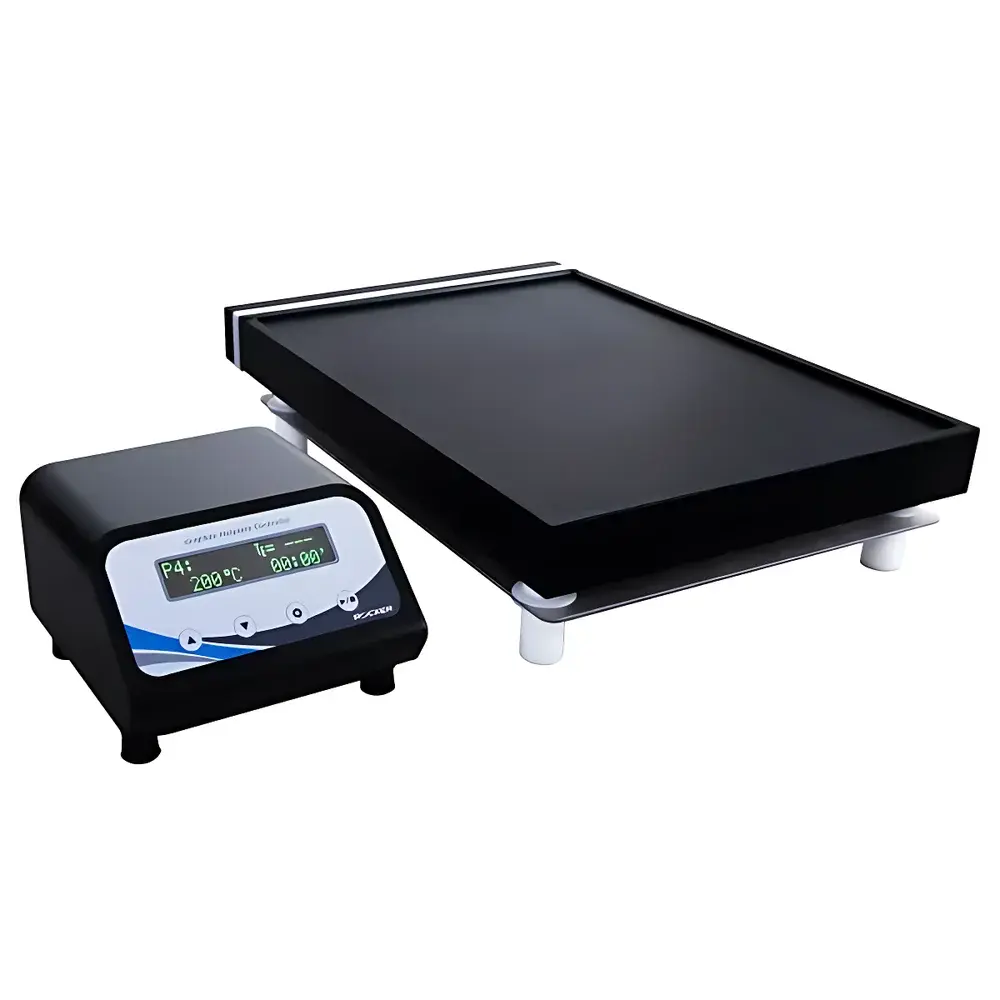
ROCKER Mars320 Graphite Heating Block System
| Brand | ROCKER |
|---|---|
| Origin | Taiwan |
| Model | Mars320 |
| Heating Power | 1000 W |
| Max. Temperature | 200 °C |
| Temperature Uniformity | ±1 °C |
| Heating Surface Dimensions | 36 × 22 × 11 cm |
| Controller | Independent OLED Display Unit |
| Temperature Range | Ambient +5 °C to 200 °C |
| Temp. Resolution | 1 °C |
| Temp. Accuracy | ±1 °C @ 150 °C |
| Timer Modes | Countdown (1 min – 99 h 59 min) & Continuous |
| Overheat Protection | 210 °C Cut-off |
| Compliance | RoHS |
Overview
The ROCKER Mars320 Graphite Heating Block System is an engineered solution for trace and ultra-trace elemental analysis workflows requiring contamination-free, thermally stable sample preparation. Designed around a monolithic isostatically pressed graphite heating plate fully coated with chemically inert polytetrafluoroethylene (PTFE), the Mars320 eliminates metallic leaching risks common in stainless-steel or aluminum hotplates—making it especially suitable for heavy metal digestion prior to ICP-MS, ICP-OES, or AAS analysis. Its thermal architecture employs planar resistive heating elements embedded beneath the graphite substrate, ensuring uniform heat distribution across the entire surface without localized hotspots. Unlike conventional ceramic or aluminum plates, the high-density graphite core delivers superior thermal mass and conductivity, enabling precise temperature maintenance and rapid thermal recovery after sample loading. The system operates exclusively in non-metallic contact zones—no exposed screws, brackets, or hardware—fully satisfying stringent laboratory requirements for low-background analytical chemistry.
Key Features
- 100% non-metallic construction: All external and sample-contact surfaces are PTFE-coated graphite or polymer—eliminating metal ion contamination pathways.
- Isostatic graphite heating plate: Engineered for high density (≥1.8 g/cm³) and thermal homogeneity; achieves ±1 °C uniformity across the full 36 × 22 cm surface at 150 °C.
- Dual-mode digital controller: Independent OLED interface supports both continuous heating and programmable countdown operation (1 minute to 99 hours 59 minutes), with real-time temperature feedback and audible end-of-cycle alert.
- Integrated safety architecture: Dual-stage overtemperature protection includes electronic PID limit control and independent mechanical cut-off at 210 °C.
- Modular compatibility: Accepts interchangeable PTFE-coated graphite blocks (sold separately) for standardized digestion vessels—from 15 mL conical tubes to 100 mL tall-form digesters—enabling method scalability without equipment replacement.
- Energy-efficient design: 1000 W nominal power draw optimized for sustained operation at 150–200 °C with minimal thermal drift (<0.3 °C/h).
Sample Compatibility & Compliance
The Mars320 accommodates a broad range of digestion formats through optional graphite blocks (e.g., 70-hole φ16 mm, 24-hole φ30 mm, 15-hole φ47 mm configurations), all manufactured from high-purity, low-ash graphite and fully PTFE-encapsulated. Each block is validated for use with HNO₃, HCl, HF, and H₂O₂-based microwave-assisted or open-vessel digestion protocols per EPA Method 3050B, ISO 11466, and ASTM D5173. The system conforms to EU RoHS Directive 2011/65/EU for hazardous substance restrictions and meets IEC 61010-1:2010 safety standards for laboratory electrical equipment. While not inherently GLP/GMP-certified, its repeatable temperature profiles, audit-ready timer logs, and absence of calibration-drift-prone analog components support compliance with FDA 21 CFR Part 11 when integrated into validated SOPs.
Software & Data Management
The Mars320 operates as a standalone instrument with no proprietary software dependency. All operational parameters—including setpoint, elapsed time, remaining countdown, and current temperature—are displayed in real time on the high-contrast OLED screen with 0.5-inch character height for readability under fume hood lighting. The controller stores no historical data but provides tactile confirmation of parameter entry and visual status indicators (e.g., heating active, alarm triggered, timer complete). For laboratories requiring electronic recordkeeping, optional external Pt100 temperature probes (ROCKER P/N 178200-45) enable connection to third-party data loggers compliant with ISO/IEC 17025 traceability requirements. No firmware updates or cloud connectivity are implemented—ensuring long-term operational consistency and cybersecurity resilience.
Applications
- Acid digestion of environmental soils, sediments, and sludges for Pb, Cd, As, Hg, and Cr speciation analysis.
- Biological tissue digestion (liver, kidney, hair) in clinical toxicology and nutritional studies.
- Food and feed matrix decomposition prior to multi-element quantification by ICP techniques.
- Pharmaceutical excipient testing per USP <231> heavy metals limits using sulfide precipitation or direct acid digestion.
- Standardized reference material (SRM) preparation where certified low-blank performance is mandatory (e.g., NIST SRM 2711a, 1643f).
- Pre-concentration steps in hydride generation-AAS for Se, Sb, and Bi.
FAQ
Is the Mars320 compatible with hydrofluoric acid (HF) digestion protocols?
Yes—the entire graphite plate and optional blocks are fully PTFE-coated, providing resistance to HF concentrations up to 5% v/v at temperatures ≤180 °C. Always verify vessel compatibility separately.
Can the Mars320 be used without a graphite block—as a flat heating plate?
Yes. The bare graphite surface is calibrated and rated for direct use with beakers, crucibles, and digestion tubes up to 100 mL capacity. Surface flatness tolerance is ±0.1 mm across the full area.
Does the controller support external temperature probe input?
Yes—via standard mini-DIN port (compatible with ROCKER P/N 178200-45 Pt100 probe), enabling sample-core temperature monitoring independent of surface setpoint.
What is the recommended maintenance interval for long-term accuracy?
No routine calibration is required. Annual verification using a NIST-traceable handheld thermometer (±0.2 °C accuracy) at three points (center, front-left, rear-right) is advised per ISO/IEC 17025 clause 6.5.2.
Is the Mars320 suitable for use in Class 100 cleanrooms?
Yes—non-shedding PTFE surface, zero lubricants, and static-dissipative housing meet ISO 14644-1 Class 5 particulate requirements when operated with HEPA-filtered airflow.



