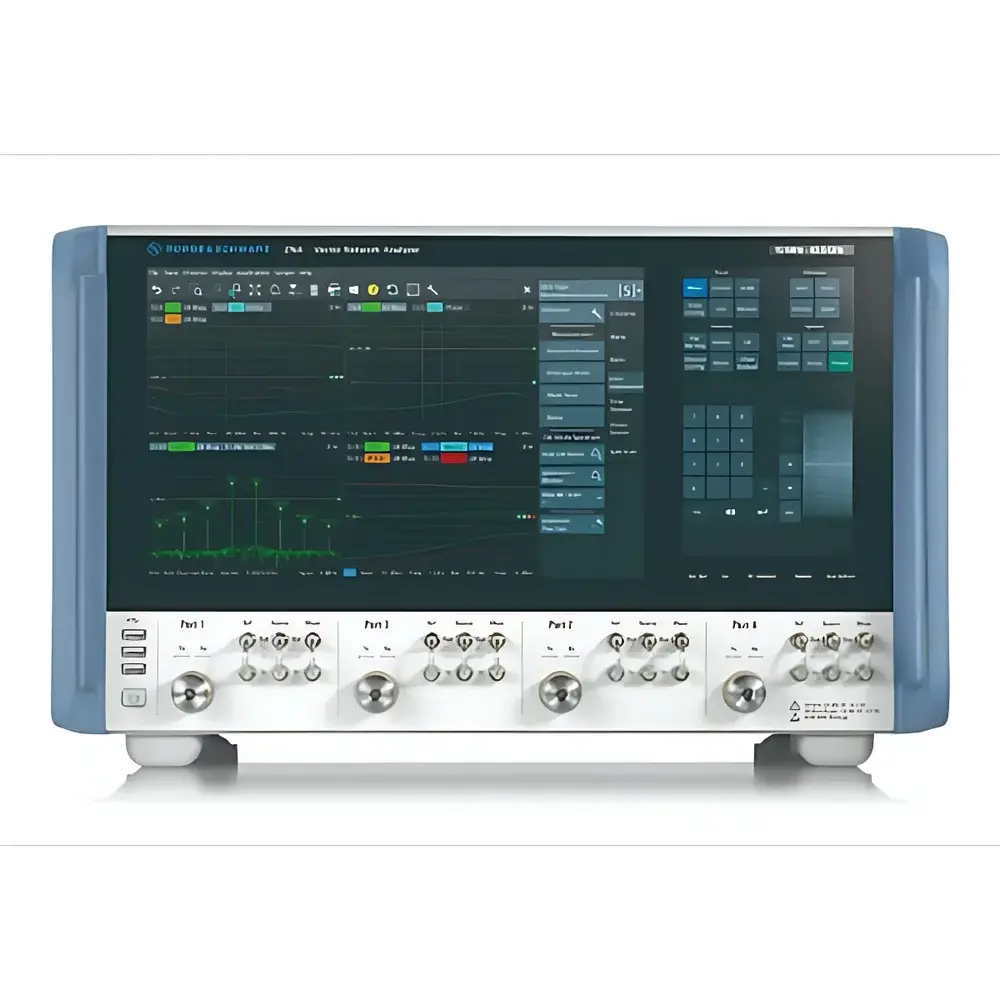
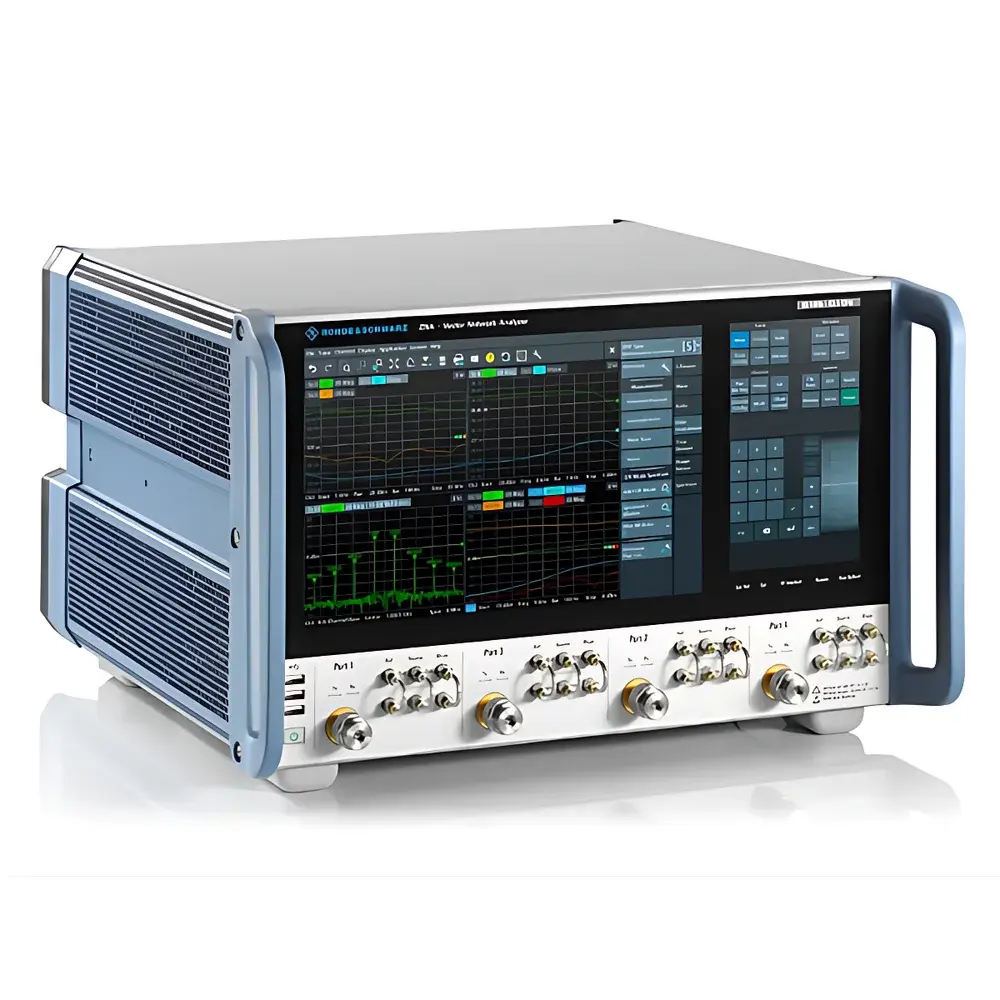
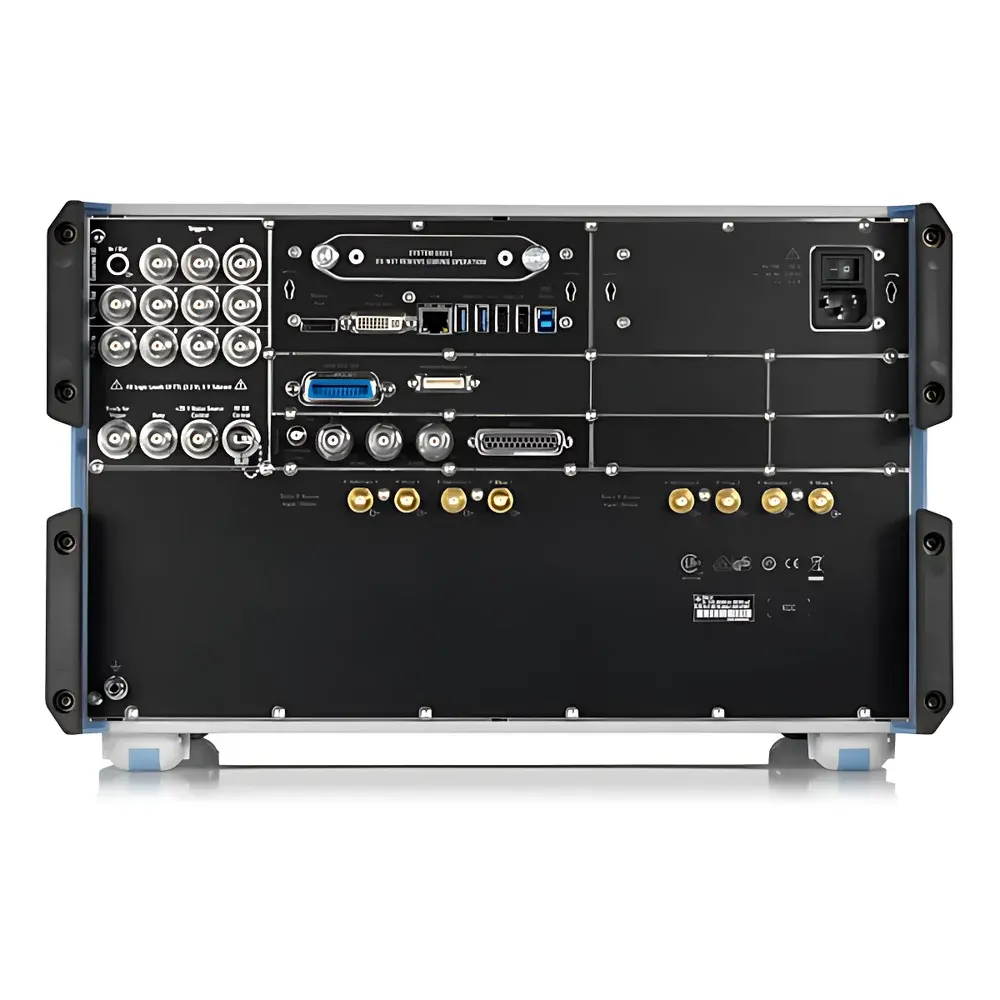
Rohde & Schwarz R&S ZNA Vector Network Analyzer
| Brand | Rohde & Schwarz |
|---|---|
| Origin | Germany |
| Model | R&S ZNA |
| Frequency Range | 9 kHz to 1.5 GHz / 3.2 GHz / 7.5 GHz (base configurations) |
| Extended Frequency Range | Up to 750 GHz with harmonic mixers (e.g., R&S ZVA-Z/ZC series) |
| Dynamic Range | >130 dB (typ. at mid-band, depending on configuration and IF bandwidth) |
| Port Count | 2-port or 4-port configurations available |
| Internal Signal Sources | Up to four phase-coherent synthesized sources |
| Internal Local Oscillators | Up to two dedicated LOs for mixer measurements |
| Receivers | Up to eight independent receivers |
| Pulse Modulation | Up to four integrated pulse modulators/generators |
| Power Sweep Range | –40 dBm to +13 dBm (with optional step attenuators) |
Overview
The Rohde & Schwarz R&S® ZNA Vector Network Analyzer is a high-performance, modular microwave and millimeter-wave measurement platform engineered for precision characterization of passive and active RF/microwave components across demanding R&D, production test, and metrology environments. Operating on the fundamental principle of vector network analysis—measuring complex S-parameters (magnitude and phase) via coherent heterodyne detection—the R&S ZNA delivers traceable, low-uncertainty results essential for device modeling, impedance matching, stability analysis, and nonlinear characterization. Its architecture integrates multiple phase-coherent signal sources, ultra-low-noise receivers, and hardware-accelerated calibration engines to support both scalar and full vector measurements from 9 kHz up to 7.5 GHz in base configurations, with seamless frequency extension to 750 GHz using external harmonic mixer modules (e.g., R&S ZVA-Z and ZC series). Designed for metrological rigor, the system meets requirements for ISO/IEC 17025-compliant laboratories and supports traceable uncertainty evaluation per METAS VNA Tools—enabling real-time measurement uncertainty calculation and validation against national standards.
Key Features
- Modular 2-port and 4-port configurations with direct channel access for minimal signal path loss and maximum dynamic range
- Up to four fully integrated, phase-coherent synthesized signal sources—enabling simultaneous multi-tone, intermodulation, and receiver calibration without external combiners
- Dual internal local oscillators optimized for low-noise, high-speed mixer and frequency-conversion measurements (e.g., conversion loss, isolation, AM/PM distortion)
- Eight independent receivers supporting true multi-channel phase coherence—critical for balanced device analysis, antenna array characterization, and differential S-parameter extraction
- Integrated pulse modulators and generators (up to four) for time-domain analysis of pulsed amplifiers, radar components, and GaN-based power devices
- Optional internal step attenuators (source and receiver) enabling calibrated power sweeps from –40 dBm to +13 dBm, supporting compression and P1dB measurements
- Hardware-accelerated error correction with full 12-term (SOLT, TRL, LRM) and enhanced calibration models—including adapter removal, port extension, and impedance tuning
Sample Compatibility & Compliance
The R&S ZNA supports characterization of a broad spectrum of DUTs—from discrete passives (filters, couplers, isolators) and planar PCB structures to active components (LNAs, PAs, mixers, VCOs, MMICs) and packaged semiconductor devices. Its wide dynamic range (>130 dB typ.) enables accurate measurement of highly reflective or highly lossy devices—even those exhibiting strong blocking signals or narrowband resonances. The system complies with international standards governing RF test instrumentation, including IEEE Std 1785.1 (VNA uncertainty modeling), IEC 61000-4-3 (EMC immunity), and EN 61326-1 (electrical safety). For regulated industries, firmware options support FDA 21 CFR Part 11 compliance (audit trail, electronic signatures, role-based access control), and calibration workflows align with ISO/IEC 17025 and GLP/GMP documentation requirements.
Software & Data Management
R&S ZNA operates on the Windows-based R&S InstrumentView platform, featuring dual independent touchscreens with gesture-driven UI navigation (pinch-to-zoom, drag-and-drop channel/chart assignment). Measurement setup is organized around a DUT-centric workflow—allowing users to define physical ports, connectors, fixtures, and calibration kits before configuring measurement tasks. Software extensions include Time Domain Analysis (TDR/TDT) with gating and impedance profiling; Eye Diagram analysis for high-speed serial links; Scalar and Vector Mixer Measurements (including LO-leakage-free conversion analysis); Spectrum Analysis mode for harmonic and spurious content inspection; and Real-Time Uncertainty Calculation (METAS VNA Tools) for ISO/IEC 17025 traceability. All measurement data is stored in industry-standard formats (Touchstone v1/v2, CSV, HDF5), with built-in scripting support via SCPI over LAN/USB/GPIB and Python API integration for automated test sequences and CI/CD pipeline compatibility.
Applications
- Advanced component development: S-parameter extraction for EM-simulation correlation, de-embedding of fixtures and probes, and on-wafer DUT characterization
- Mixer and frequency converter validation: Vector conversion loss, image rejection, sideband suppression, and AM/PM conversion under swept LO conditions
- Antenna and array testing: Phase-coherent multi-receiver operation for radiation pattern mapping, mutual coupling analysis, and beamforming verification
- High-speed interconnect analysis: TDR-based impedance discontinuity detection, crosstalk assessment, and channel compliance testing (PCIe, USB, DDR)
- Metrology-grade calibration: Primary standard transfer, reference reflectometer validation, and uncertainty budgeting for accredited labs
- Pulsed-RF characterization: Envelope tracking amplifier linearity, pulse-to-pulse stability, and duty-cycle-dependent gain compression
FAQ
What frequency bands does the base R&S ZNA support?
The base instrument is available in three standard frequency ranges: 9 kHz to 1.5 GHz, 9 kHz to 3.2 GHz, and 9 kHz to 7.5 GHz. Frequency extension beyond 7.5 GHz requires external harmonic mixer modules (e.g., R&S ZVA-Z110, ZVA-Z220, ZC170), enabling coverage up to 750 GHz.
Can the R&S ZNA perform true differential measurements?
Yes—using its four-phase-coherent sources and eight receivers, the ZNA supports full differential S-parameter measurement (e.g., SDD11, SDC21) without external baluns, including common-mode rejection ratio (CMRR) and mixed-mode S-parameter extraction.
Is calibration traceability supported for ISO/IEC 17025 accreditation?
Yes—METAS VNA Tools provide real-time uncertainty estimation, automated calibration certificate generation, and full audit trail logging compliant with ISO/IEC 17025 Annex A.2 requirements for measurement uncertainty reporting.
Does the system support automated production test integration?
Yes—via SCPI command set, IVI-COM drivers, and Python SDK, the ZNA integrates into industrial ATE platforms and supports parallel test execution, pass/fail limit checking, and database logging (SQL/ODBC).
How is thermal drift managed during long-duration measurements?
The ZNA employs active temperature stabilization of critical RF paths, real-time receiver normalization, and optional periodic reference-plane recalibration—ensuring traceable stability better than ±0.01 dB/°C in magnitude and ±0.1°/°C in phase over 8-hour sessions.