
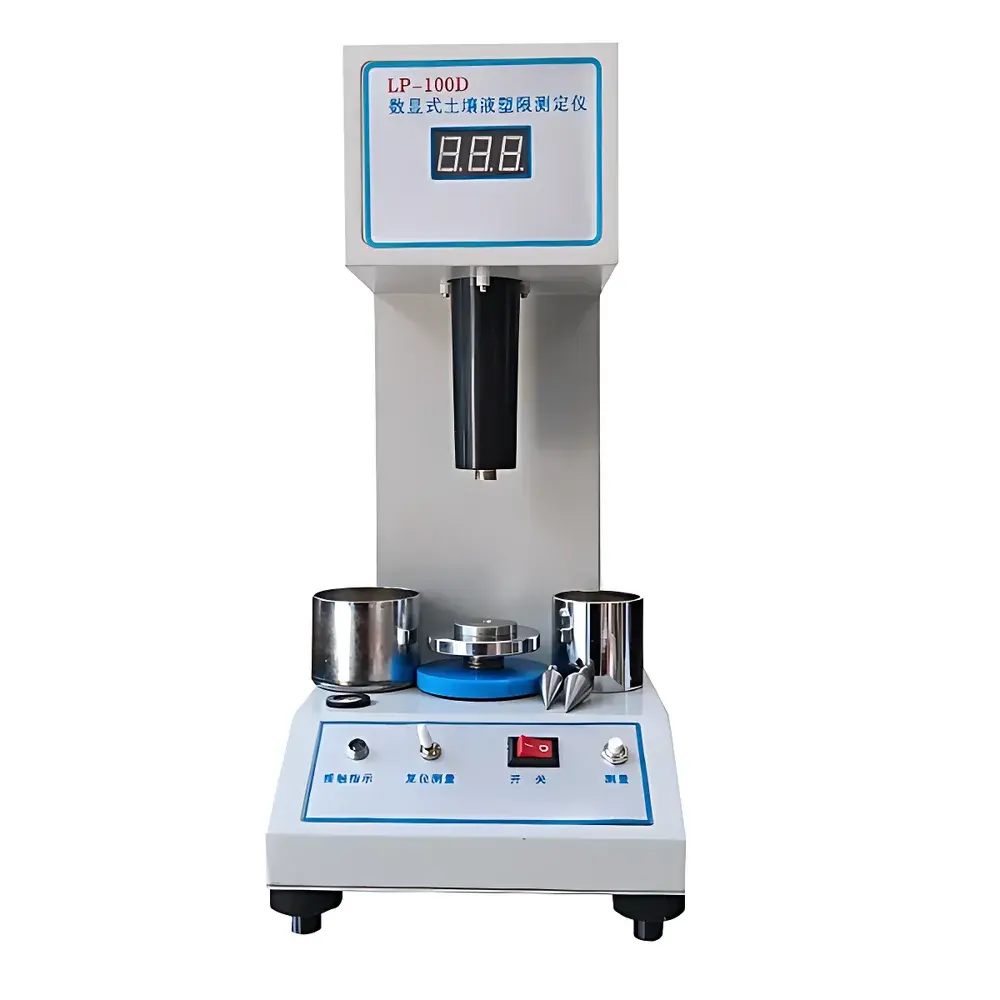
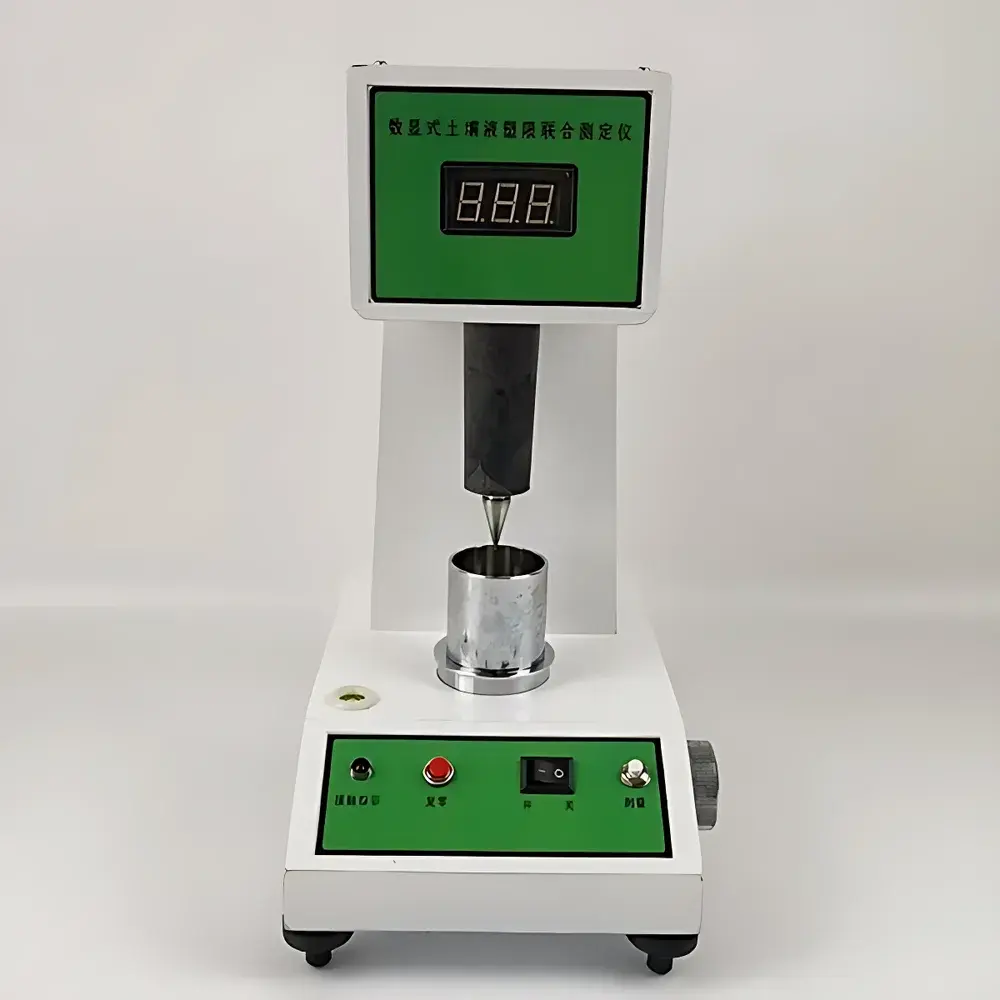
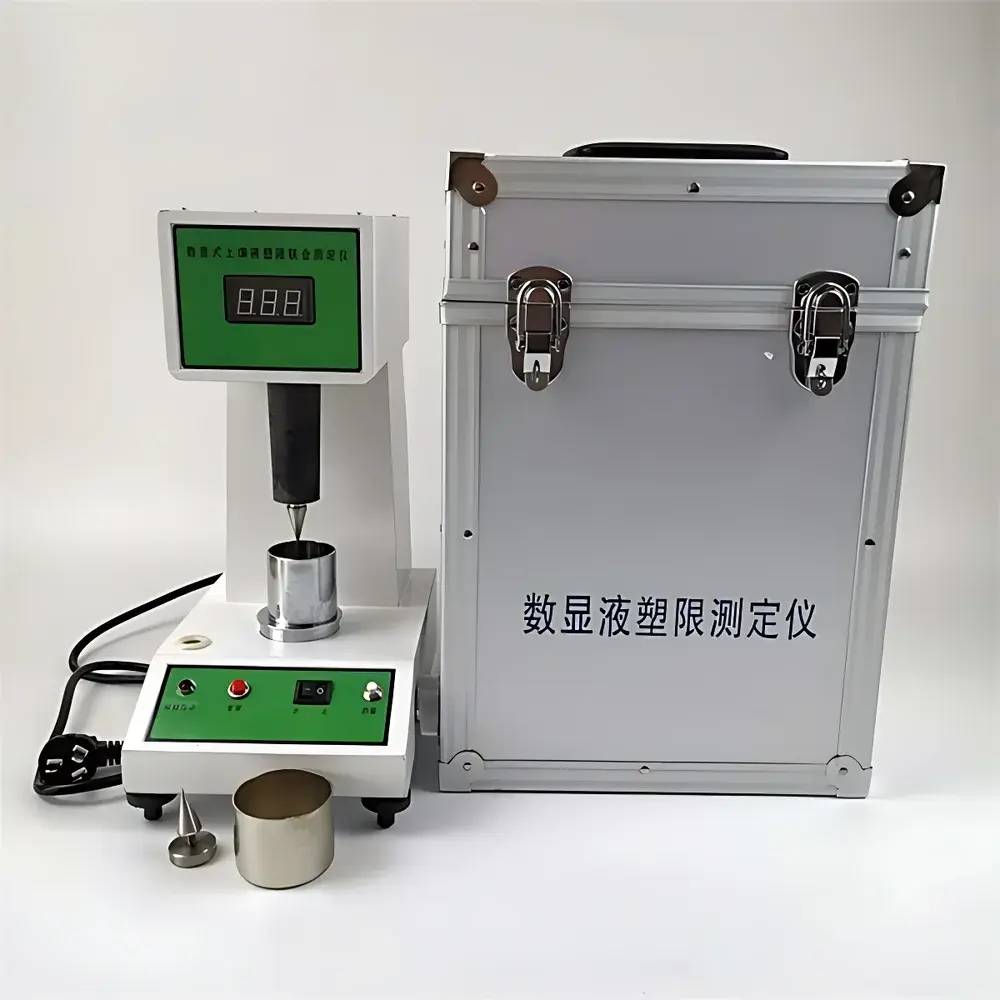
Rongjida LP-100D Digital Combined Liquid Limit and Plastic Limit Tester with Optical Cone Penetration System
| Brand | Rongjida |
|---|---|
| Origin | Shanghai, China |
| Manufacturer Type | Direct Manufacturer |
| Region of Origin | Domestic (China) |
| Model | LP-100D |
| Measurement Type | Soil Atterberg Limits (Cone Penetration Method) |
| Maximum Penetration Range | ~22 mm |
| Resolution | 0.1 mm |
| Nonlinear Error | <2% |
| Contact Detection Sensitivity | >10 MΩ |
| Cone Mass Options | 100 g (±0.1 g) and 76 g (±0.1 g) |
| Cone Angle | 30° ±2° |
| Standard Penetration Duration | 5 s |
| Power Supply | 220 V ±10%, 50 Hz |
| Continuous Operation Time | 8 h |
| Net Weight | 5.3 kg |
| Dimensions (W×D×H) | 240 × 158 × 320 mm |
Overview
The Rongjida LP-100D Digital Combined Liquid Limit and Plastic Limit Tester is a precision geotechnical instrument engineered for the standardized determination of soil Atterberg limits—specifically the liquid limit (LL) and plastic limit (PL)—using the cone penetration method per ASTM D4318, ISO 11277, and China’s JTG E40-2007 (Highway Geotechnical Test Specifications). It operates on the principle of controlled static cone penetration into remolded soil paste under defined mass and time conditions. The device employs a high-sensitivity optical contact detection system to precisely identify initial cone–soil contact, followed by automated 5-second timed penetration measurement with digital displacement readout. Its dual-cone configuration (100 g and 76 g options) supports both international standard protocols—enabling direct correlation with Casagrande cup-based LL data and facilitating consistent classification across Unified Soil Classification System (USCS) and AASHTO design frameworks.
Key Features
- Dual-mass conical penetrometer system: Interchangeable 100 g (±0.1 g) and 76 g (±0.1 g) cones, each fitted with a precision-ground 30° ±2° stainless-steel tip compliant with ASTM D4318 Annex A1 requirements.
- Optical contact sensing circuitry: Detects cone–soil interface engagement with >10 MΩ sensitivity, eliminating mechanical hysteresis and ensuring repeatable start-point registration.
- Digital linear displacement transducer: 0.1 mm resolution over a 22 mm full-scale range, with nonlinear error <2% across the operational span—calibrated traceable to national metrology standards.
- Automated timing and display module: Embedded microcontroller executes fixed 5 s penetration duration, triggers audible alert upon completion, and displays final penetration depth in millimeters with zero-reset functionality.
- Robust benchtop architecture: Aluminum alloy chassis (240 × 158 × 320 mm), integrated leveling feet with bubble level, and 5.3 kg mass ensure vibration-damped stability during field or lab deployment.
- Compliance-ready design: Pre-configured for routine calibration verification per ASTM D4318 Section 6.2 and JTG E40-2007 Clause 4.2.2; includes dedicated test cup holder, cone cleaning tools, and storage compartment for accessories.
Sample Compatibility & Compliance
The LP-100D accommodates standard 50 mm diameter, 30 mm height soil test cups (ASTM D4318 Figure 1) filled with air-dried, pulverized, and moisture-conditioned fine-grained soils (clays and silts). It is validated for use with natural, reconstituted, and stabilized soil specimens exhibiting plasticity indices (PI) from 0 to ≥50. All operational procedures align with GLP principles: measurement timestamps, operator ID fields (via optional external logging), and manual calibration records support auditability under ISO/IEC 17025-accredited laboratories. While not FDA 21 CFR Part 11–certified (as it generates non-electronic primary records), its analog-digital hybrid architecture permits integration into LIMS environments via RS-232 output (optional adapter required).
Software & Data Management
The LP-100D operates as a standalone hardware system without embedded firmware-based data storage. All measurements are displayed in real time on a high-contrast LED screen and require manual transcription into laboratory notebooks or digital spreadsheets. For enhanced traceability, users may pair the instrument with third-party data acquisition software using an optional analog voltage output or TTL-level pulse interface (available upon request). Calibration logs—including cone mass verification, displacement sensor linearity checks, and contact sensitivity validation—must be maintained per ISO 17025 Clause 6.4.6 and retained for minimum 5 years per internal QA policy.
Applications
- Geotechnical site characterization for highway, railway, and dam foundation design per AASHTO T89/T90 and GB/T 50123–2019.
- Determination of soil consistency indices (e.g., liquidity index, plasticity index) used in slope stability modeling and embankment compaction control.
- Quality assurance of imported fill materials and quarry-sourced aggregates in civil infrastructure projects.
- Research-grade soil behavior studies involving clay mineralogy, organic content effects, and chemical stabilization impacts on Atterberg boundaries.
- Teaching laboratories supporting undergraduate geotechnical engineering curricula aligned with ABET accreditation criteria.
FAQ
What cone mass should I use for compliance with ASTM D4318?
ASTM D4318 permits either 76 g or 100 g cones. The 76 g cone is specified in Annex A1 for direct correlation with Casagrande cup results; the 100 g cone is used where higher sensitivity for low-plasticity soils is required.
How often must the displacement sensor be calibrated?
Per ASTM D4318 Section 6.2, verify linearity and zero offset before each test session using certified gauge blocks. Full recalibration by an accredited metrology lab is recommended annually or after physical impact.
Can the LP-100D be used for organic soils or peats?
No. The cone penetration method is not valid for highly organic soils (OH, Pt) per ASTM D4318 Section 1.3; alternative methods such as moisture content–density relationships or specialized rheological testing are required.
Is the optical contact sensor field-serviceable?
Yes—the contact detection circuit uses industry-standard IR emitter/detector pairs. Replacement components and schematic diagrams are available under Rongjida’s Technical Support Agreement (TSA-2023).
Does the instrument meet CE or UKCA marking requirements?
The LP-100D complies with IEC 61010-1:2010 for electrical safety and EMC Directive 2014/30/EU when supplied with CE-marked power adapters. UKCA marking requires additional UK-recognized notified body assessment, which is available upon order specification.







