
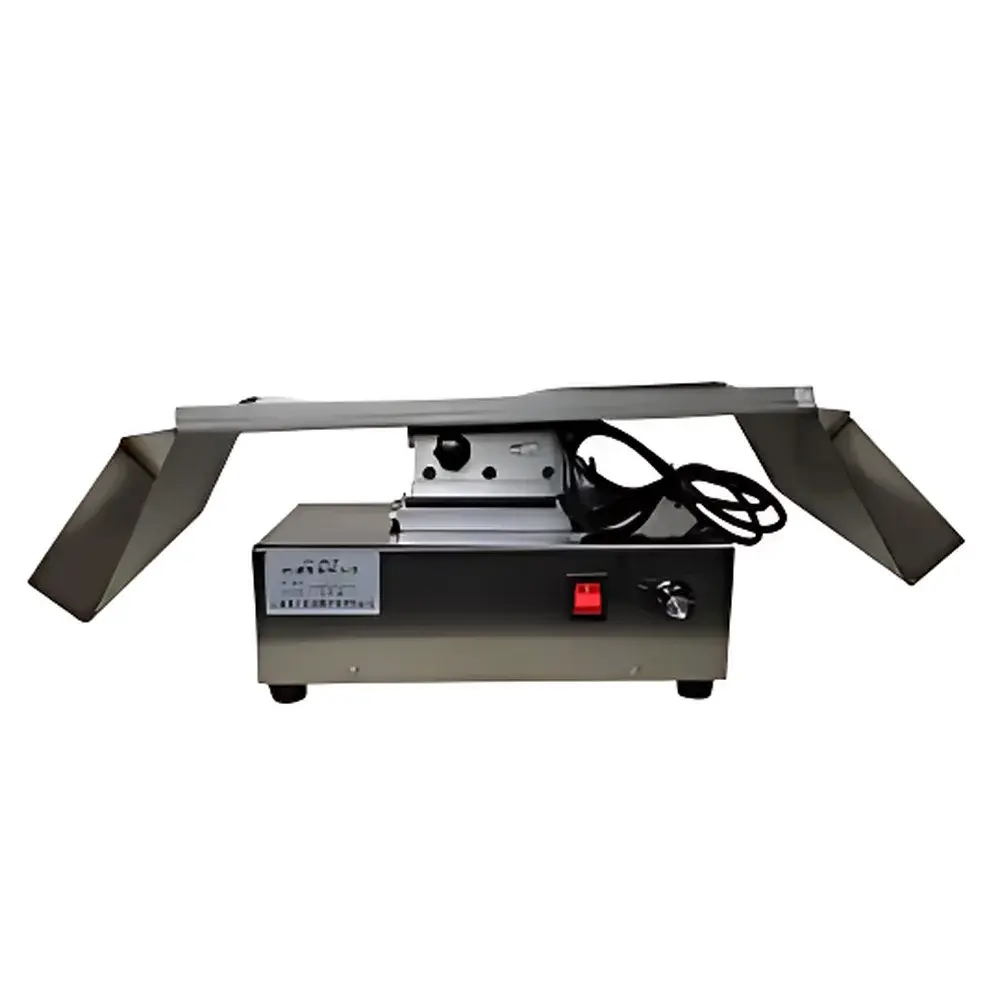
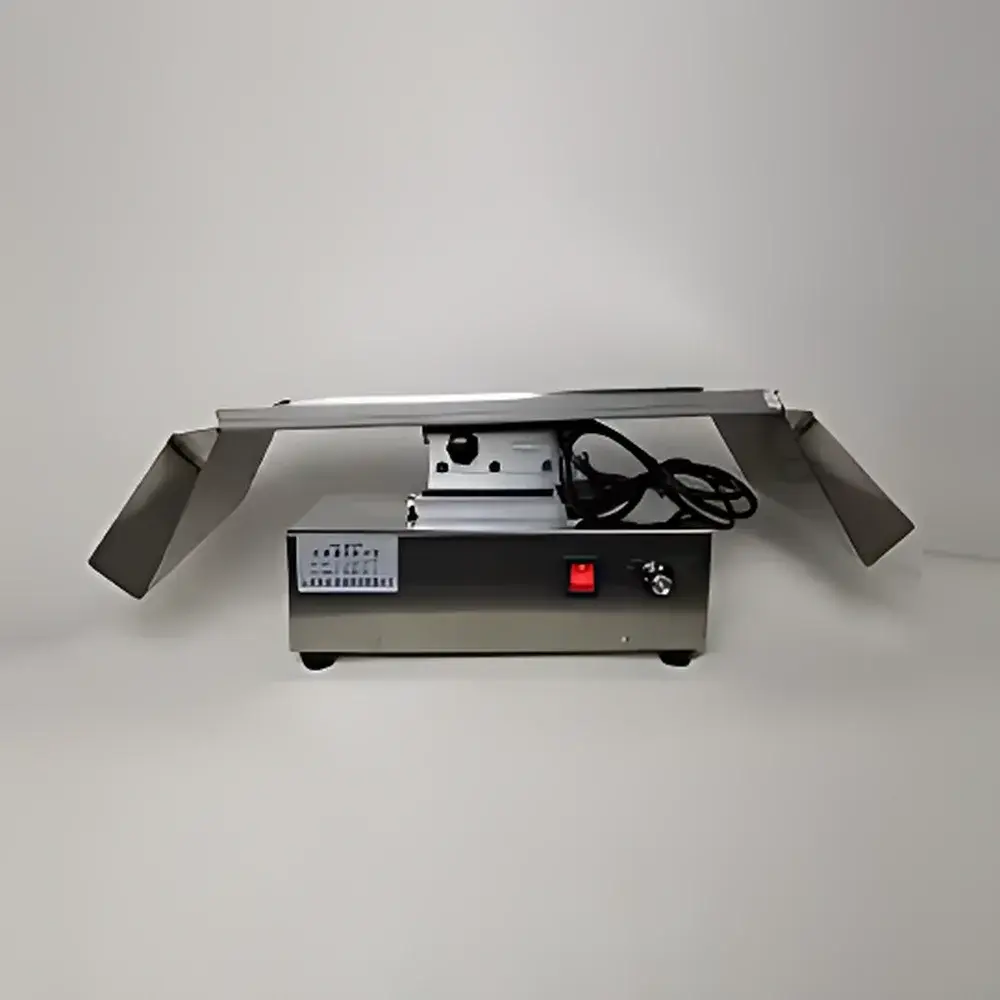
Rongjida SF-III Magnetic Glass Bead Separator
| Brand | Rongjida |
|---|---|
| Origin | Shanghai, China |
| Manufacturer Type | Manufacturer |
| Country of Origin | China |
| Model | SF-III |
| Test Type | Magnetic Particle Separation |
| Glass Plate Dimensions | 292 × 152 mm |
| Inclination Angle | 40° |
| Compliance | GB/T 24722–2009 |
Overview
The Rongjida SF-III Magnetic Glass Bead Separator is a precision-engineered laboratory instrument designed for the quantitative isolation and assessment of ferromagnetic contaminants in glass microspheres used primarily in road marking materials. It operates on the principle of controlled gravitational flow over an inclined, magnetically active surface—leveraging magnetic susceptibility differences between non-magnetic soda-lime glass beads and trace iron-based impurities (e.g., Fe₃O₄, Fe₂O₃). This physical separation method enables rapid, operator-independent determination of magnetic particle content—a critical quality control parameter specified in national standard GB/T 24722–2009 for reflective road marking glass beads. The device is not a sieve or vibratory classifier; rather, it functions as a gravity-assisted magnetic fractionator, where sample dispersion, plate geometry, and magnetic field gradient jointly govern separation efficiency and repeatability.
Key Features
- Optimized 40° inclination angle ensures consistent laminar bead flow across the 292 × 152 mm tempered glass plate, minimizing turbulence and particle rebound.
- Integrated permanent magnet assembly—positioned beneath the glass surface—generates a stable, non-uniform magnetic field sufficient to retain ferromagnetic particles while allowing non-magnetic glass beads to pass unimpeded.
- Modular frame construction provides mechanical rigidity and alignment stability during repeated operational cycles, supporting long-term measurement reproducibility.
- Tool-free assembly/disassembly facilitates cleaning, calibration verification, and routine maintenance without specialized instrumentation.
- No electrical power, vacuum, or compressed air requirements—ensures intrinsic safety, low total cost of ownership, and suitability for field laboratories or construction site QC tents.
Sample Compatibility & Compliance
The SF-III is validated for use with spherical glass microspheres ranging from 75 µm to 850 µm in nominal diameter, including Type I (non-retroreflective), Type II (pre-coated), and Type III (retroreflective) beads per GB/T 24722–2009. It accommodates sample masses up to 200 g (±0.01 g tolerance), with protocol-defined triple-pass operation ensuring >95% capture efficiency for particles ≥10 µm in equivalent magnetic diameter. The separator complies fully with Clause 6.3 (“Magnetic Impurity Test”) of GB/T 24722–2009 and supports traceability under ISO/IEC 17025:2017 accredited testing environments. While not certified to ASTM E1155 or EN 1423, its operational methodology aligns with the fundamental principles of magnetic separation outlined in ISO 11253:2015 (Road marking materials — Test methods).
Software & Data Management
The SF-III is a manual, analog measurement system with no embedded electronics or digital interface. All data acquisition—including initial sample mass (M₁), recovered magnetic mass (M₂), and calculated magnetic content (C = (M₂/M₁) × 100%)—is performed externally using calibrated analytical balances (0.01 g resolution minimum) and recorded in laboratory notebooks or LIMS-compatible spreadsheets. Users may integrate results into electronic lab notebooks (ELN) or quality management systems (QMS) compliant with FDA 21 CFR Part 11 via manual entry or CSV import. Audit trails, user authentication, and electronic signatures are maintained at the institutional software level—not by the instrument itself—supporting GLP and GMP-aligned documentation practices.
Applications
- QC/QA testing of glass microspheres prior to incorporation into thermoplastic or cold-applied road marking paints.
- Batch release verification in manufacturing facilities producing retroreflective pavement markings.
- Third-party conformity assessment for certification bodies verifying compliance with GB/T 24722–2009, JT/T 446–2019, or municipal procurement specifications.
- Root-cause analysis of premature retroreflectivity loss in field-applied markings, where elevated magnetic content correlates with accelerated oxidation and coating delamination.
- Educational use in materials science laboratories demonstrating magnetic susceptibility-based particulate separation physics.
FAQ
What is the maximum recommended sample size for a single test cycle?
The standard protocol specifies 200 g ±0.01 g. Larger masses increase risk of particle overlap and incomplete magnetic capture; smaller masses reduce statistical confidence in low-concentration (<0.1%) contaminant detection.
Does the SF-III require recalibration or periodic magnetic field verification?
No scheduled recalibration is mandated. However, users should verify magnet integrity annually using a gaussmeter (±5% field strength tolerance) or by performing a reference test with a certified magnetic standard (e.g., NIST SRM 2876).
Can the SF-III be used for non-glass spherical particles?
It is specifically engineered for soda-lime glass microspheres. Use with polymer beads, ceramic spheres, or irregularly shaped particles is not validated and may yield non-representative recovery rates due to differing density, surface friction, and magnetic response.
Is the glass plate replaceable, and what is its expected service life?
Yes—the 6-mm-thick tempered glass plate is a field-replaceable component. Under proper handling (no thermal shock, no abrasive cleaning), service life exceeds 5 years or 2,000+ test cycles.
How does ambient temperature affect test results?
Temperature has negligible impact on magnetic separation efficiency within the range of 10–35°C. However, extreme humidity (>80% RH) may cause minor electrostatic adhesion; use in climate-controlled labs is recommended for highest precision.





