
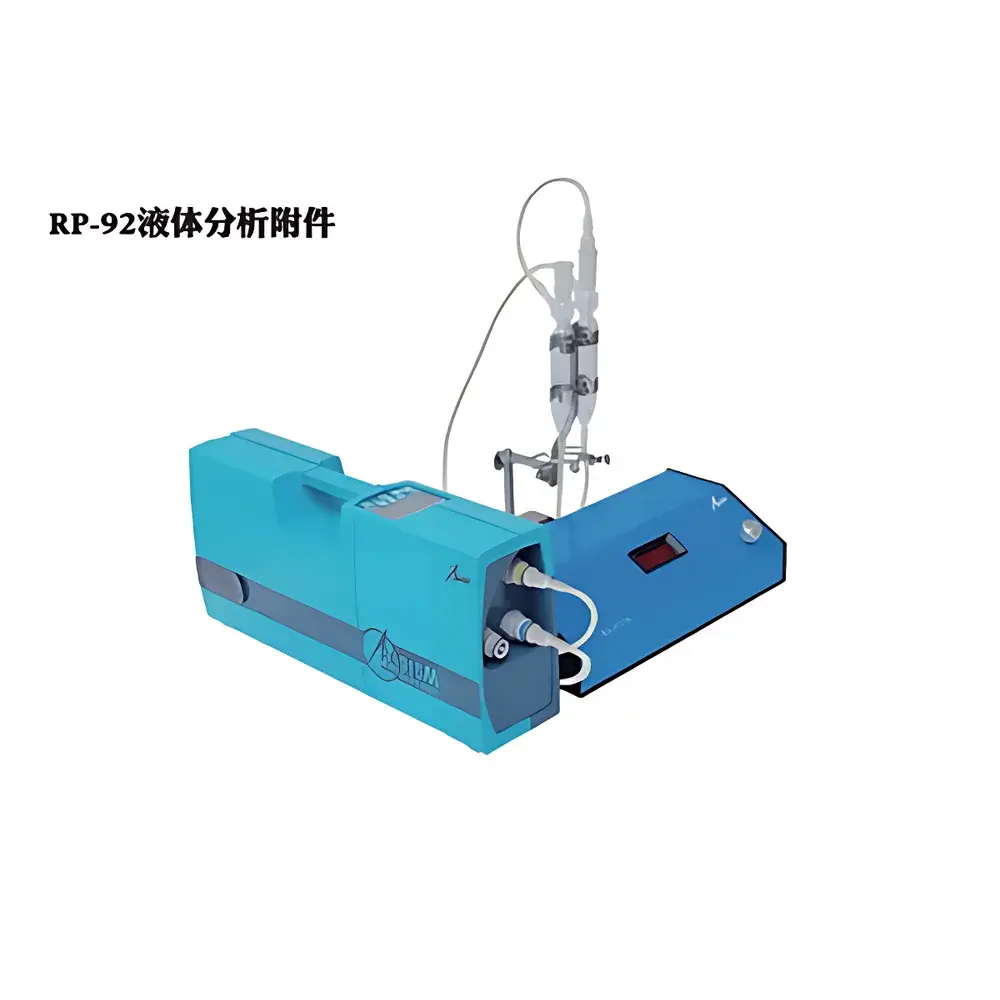
RP-92 Multi-Mode Mercury Analyzer
| Brand | — |
|---|---|
| Origin | Beijing, China |
| Manufacturer Type | Authorized Distributor |
| Regional Classification | Domestic (PRC) |
| Model | RP-92 |
| Pricing | Upon Request |
| Instrument Type | Online/Field-Deployable |
| Analytical Principle | Cold Vapor Atomic Fluorescence Spectrometry (CV-AFS) |
Overview
The RP-92 Multi-Mode Mercury Analyzer is a field-deployable, modular mercury detection system designed for quantitative determination of total mercury (Hg) across gaseous, liquid, and solid matrices—including environmental waters, biological fluids (urine, blood, serum), tissues (hair, placenta), soils, sediments, and industrial process streams. It operates on the principle of Cold Vapor Atomic Fluorescence Spectrometry (CV-AFS), a highly selective and sensitive technique in which mercury is chemically reduced to elemental vapor, transported via carrier gas into a quartz cell, and excited by 254 nm ultraviolet light; the resulting atomic fluorescence emission at 253.7 nm is measured with photomultiplier tube detection. CV-AFS provides sub-picogram-level detection limits (typically <0.01 ng/L in aqueous solutions) and exceptional specificity—free from interferences common in atomic absorption or ICP-based methods. The RP-92 is engineered for precision, robustness, and operational flexibility in both laboratory and uncontrolled field environments.
Key Features
- Modular sample introduction architecture supporting gas, liquid, and solid sample pathways—compatible with RA-915M analyzer host for seamless integration.
- Direct aqueous analysis without pre-concentration on gold traps, reducing consumable costs and eliminating memory effects associated with amalgamation steps.
- Configurable optical path length: selectable single-pass or multi-pass flow-through quartz cells to optimize sensitivity for trace-level (e.g., drinking water) or elevated (e.g., wastewater, industrial effluent) concentration ranges—dynamic linear range spans >3 orders of magnitude (0.01–100 ng/L in solution).
- Onboard reagent delivery and reaction control: automated hydride generation using sodium borohydride (NaBH₄) or tin(II) chloride (SnCl₂) reduction under programmable pH and temperature conditions.
- Integrated carrier gas management: self-contained air compressor eliminates dependency on external compressed gas cylinders—critical for mobile and remote monitoring applications.
- Low-power design (<15 W standby, <45 W during analysis) enabling extended battery or solar-powered operation; unit weight <8.5 kg with full field kit.
- Daily calibration verification protocol: built-in reference check using stable Hg⁰ permeation source—no daily standard curve required unless regulatory audit mandates full recalibration.
Sample Compatibility & Compliance
The RP-92 accommodates diverse sample types through standardized preparation modules: EPA Method 1631 (for ambient and wastewater), EN 1483 (water quality), ISO 17892-10 (soils), and ASTM D6725 (petroleum products). For biological matrices, it supports digestion protocols aligned with USP and ICH Q3D for elemental impurities in pharmaceuticals. All measurement workflows comply with GLP documentation requirements, including electronic audit trails, user-access controls, and data integrity safeguards per FDA 21 CFR Part 11 when paired with compliant RA-915M firmware. Solid samples are processed via microwave-assisted acid digestion (HNO₃/H₂SO₄/HClO₄) or thermal decomposition (for mercury-rich ores or coal), followed by cold vapor transfer. Gaseous sampling utilizes calibrated permeation tubes or dynamic dilution systems traceable to NIST SRM 2670a.
Software & Data Management
Instrument control, method setup, real-time spectral visualization, and report generation are managed via MercuryControl™ v4.x software (Windows 10/11 compatible). Software features include method templates for EPA/ISO-compliant workflows, automatic peak integration with baseline correction, drift compensation algorithms, and export to CSV, PDF, or LIMS-ready XML formats. Raw fluorescence intensity time-series data are stored with full metadata (operator ID, timestamp, ambient T/P, carrier flow rate, lamp energy). Audit logs record all parameter modifications, calibration events, and data exports—retained for ≥36 months per internal QA policy. Optional cloud synchronization enables centralized fleet monitoring for multi-site environmental compliance programs.
Applications
- Regulatory monitoring of Hg in drinking water sources, surface waters, and wastewater treatment plant influent/effluent per WHO, EU Drinking Water Directive, and China’s GB 5749–2022.
- Clinical toxicology screening: quantification of urinary Hg (µg/g creatinine) and whole-blood Hg (ng/mL) for occupational exposure assessment (OSHA PEL: 0.1 mg/m³ TWA; ACGIH TLV: 0.025 mg/m³).
- Environmental forensics: spatial mapping of Hg contamination plumes in floodplains, mining tailings, and legacy industrial sites using GPS-tagged field measurements.
- Process validation: real-time tracking of Hg removal efficiency in activated carbon, sulfur-impregnated adsorbents, or catalytic oxidation units—supporting ISO 50001 energy management and ISO 14001 environmental performance reporting.
- Food safety surveillance: screening of fish tissue, rice, and infant formula per Codex Alimentarius GSFA limits (0.5 mg/kg for predatory fish; 0.02 mg/kg for milk powder).
FAQ
Does the RP-92 require gold-coated traps for mercury preconcentration?
No. The RP-92 employs direct CV-AFS detection without amalgamation, eliminating trap-related carryover, regeneration cycles, and associated calibration drift.
Can it analyze solid samples without laboratory digestion?
Solid samples require matrix decomposition—either via onboard thermal decomposition module (optional) or off-line microwave digestion. Direct solid analysis is not supported.
Is the system compliant with EPA Method 1631 revision E?
Yes. When operated with certified reagents, calibrated flow controllers, and documented QC checks (blanks, spikes, duplicates), the RP-92/RA-915M platform meets all performance criteria outlined in EPA 1631E for aqueous mercury analysis.
What maintenance intervals are recommended for field use?
Optical windows require cleaning every 50 analyses; pump tubing replacement every 300 runs; UV lamp lifetime is ≥2,000 hours. Full system verification is recommended quarterly using NIST-traceable standards.
How is data integrity ensured during remote deployments?
All measurements are cryptographically timestamped and digitally signed. Local storage uses write-once SD card emulation; synchronized backups occur automatically upon Wi-Fi reconnection.




