
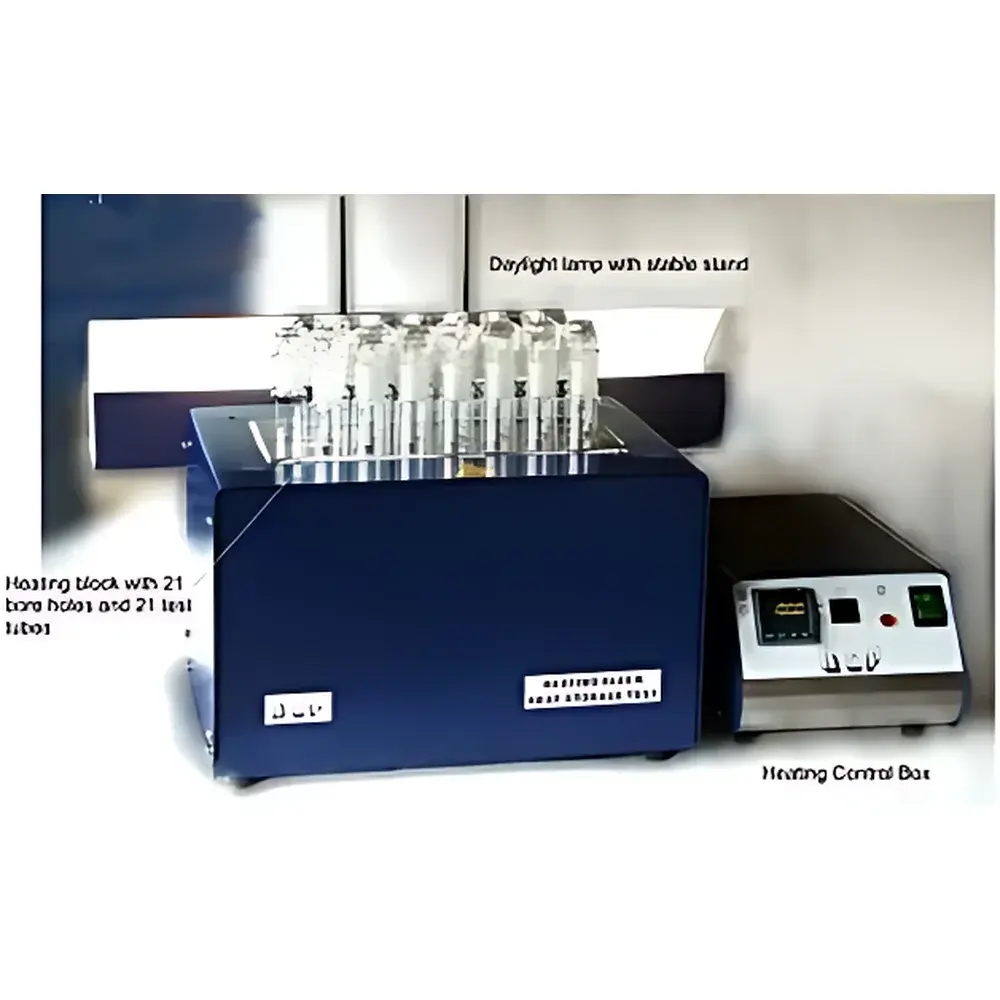
R&P Thermogravimetric Stability Tester for Nitrocellulose and Nitrocompounds
| Brand | R&P |
|---|---|
| Origin | Germany |
| Model | Thermogravimetric Stability Tester |
| Max Operating Temperature | 110 °C |
| Temperature Control Accuracy | ±0.1 °C |
| Heating Block | Aluminum, 21-hole, Ø31 mm × 170 mm depth |
| Temperature Sensor | PT100 |
| Overtemperature Cut-off | 120 °C |
| Sample Tubes | 21 × cylindrical borosilicate glass tubes, Ø30 ± 0.3 mm × 230 ± 2 mm, ground neck with stopper |
| Optical Detection System | UV-A fluorescent lamp (365 nm), non-glaring, rigidly mounted on solid support |
| Electrical Supply | 230 V, 50–60 Hz |
| Power Consumption | 1200 VA |
Overview
The R&P Thermogravimetric Stability Tester is a purpose-built instrument engineered for standardized thermal stability assessment of nitrocellulose-based propellants, nitroester explosives, and other thermally sensitive nitrocompounds. It implements the classical Bergmann-Junk test principle—also referenced in NATO AEP-55, STANAG 4147, and ASTM D5630—as a controlled, isothermal storage method at elevated temperatures (typically 100 °C) to quantify decomposition onset via visible nitrogen oxide (NOx) evolution. Unlike generic ovens or TGA systems, this tester integrates metrologically traceable temperature regulation, geometrically optimized sample geometry, and spectrally selective optical detection to ensure inter-laboratory reproducibility required for defense logistics, ammunition qualification, and regulatory compliance under EU Directive 2014/28/EU (Pyrotechnic Articles).
Key Features
- Aluminum heating block with precisely machined 21 vertical bores (Ø31 mm × 170 mm depth), ensuring uniform radial heat transfer and minimal thermal gradient across all sample positions.
- High-stability PT100 platinum resistance thermometer embedded directly in the block core, delivering real-time feedback to an external PID controller housed in a dedicated control cabinet—eliminating electromagnetic interference from heating elements.
- Dual-stage thermal safety architecture: primary setpoint limit at 110 °C (operational maximum), secondary hardware cut-off at 120 °C, independently monitored by a redundant bimetallic switch.
- Digitally displayed dual-channel readout showing both user-defined setpoint and actual block temperature, calibrated to NIST-traceable standards with ±0.1 °C accuracy over the 80–110 °C range.
- Optimized optical detection subsystem comprising a UV-A fluorescent lamp (peak emission 365 nm), selected for its strong excitation of NO2 chemiluminescence without inducing photolytic side reactions; lamp intensity and positioning are fixed via rigid aluminum mounting to ensure consistent illumination geometry per tube.
- 21 individually capped borosilicate glass test tubes (Ø30 ± 0.3 mm × 230 ± 2 mm) with ground-glass necks and PTFE-faced stoppers, designed to minimize vapor leakage while permitting visual monitoring of yellow-brown NO2 accumulation during extended 40–120 h exposures.
Sample Compatibility & Compliance
This instrument is validated for use with nitrocellulose (NC), double-base propellants (NC + NG), nitroglycerin (NG), pentaerythritol tetranitrate (PETN), and other nitroaromatic/nitroaliphatic compounds listed in UN Class 1.1–1.4 hazard classifications. Tube dimensions and bore spacing comply with ISO 8097:2019 requirements for thermal stability test apparatus geometry. The system supports full audit trails per GLP and GMP environments when paired with optional electronic logbook software, and meets electrical safety requirements per EN 61010-1:2019 (Safety Requirements for Electrical Equipment for Measurement, Control, and Laboratory Use). All materials in contact with samples conform to USP and cytotoxicity testing protocols.
Software & Data Management
While the base configuration operates via analog PID control, optional firmware upgrades enable RS-485 Modbus RTU connectivity for integration into centralized laboratory information management systems (LIMS). Time-stamped temperature logs (sampled every 10 s), operator ID entry, and pass/fail flagging based on preconfigured NOx visibility thresholds can be exported in CSV or PDF format compliant with FDA 21 CFR Part 11 Annex 11 requirements. Electronic signatures, role-based access control, and immutable audit trails are available through the R&P LabControl Suite v3.2 (sold separately).
Applications
- Qualification testing of batch-produced smokeless powders prior to military acceptance (MIL-STD-2105D, MIL-PRF-22466F).
- Stability screening of legacy munitions during long-term storage surveillance programs (DoD 4140.01-R, DA PAM 385-64).
- Accelerated aging studies for nitrocompound-based pharmaceutical intermediates under ICH Q1A(R2) guidelines.
- Research-level kinetic modeling of thermal decomposition pathways using time-to-discoloration data correlated with Arrhenius parameters.
- Validation of stabilizer efficacy (e.g., diphenylamine, ethyl centralite) in NC formulations per STANAG 4555.
FAQ
What standards does this instrument satisfy for military propellant testing?
It conforms to NATO AEP-55 (Edition 3), STANAG 4147, and ASTM D5630 for thermal stability determination of nitrocellulose. Calibration and operational procedures align with ISO/IEC 17025:2017 requirements for accredited testing laboratories.
Can the heating block accommodate alternative tube geometries?
No—the 21-hole aluminum block is dimensionally fixed to match ISO 8097:2019 specifications. Custom blocks are not offered due to metrological validation constraints.
Is the UV lamp output intensity calibrated or certified?
The lamp is supplied with manufacturer’s spectral irradiance certificate (365 nm ±5 nm bandwidth, 1.2 mW/cm² at 10 cm distance), traceable to PTB (Physikalisch-Technische Bundesanstalt) standards.
Does the system include validation documentation for IQ/OQ/PQ protocols?
Yes—factory-issued Installation Qualification (IQ) and Operational Qualification (OQ) templates are provided. Performance Qualification (PQ) must be executed in situ using certified reference materials (e.g., NIST SRM 2910a) and documented per client SOPs.
What maintenance intervals are recommended for long-term reliability?
PT100 sensor recalibration annually; heating block surface inspection for oxidation every 500 operating hours; UV lamp replacement after 2,000 hours of cumulative operation or if visible darkening occurs.







