
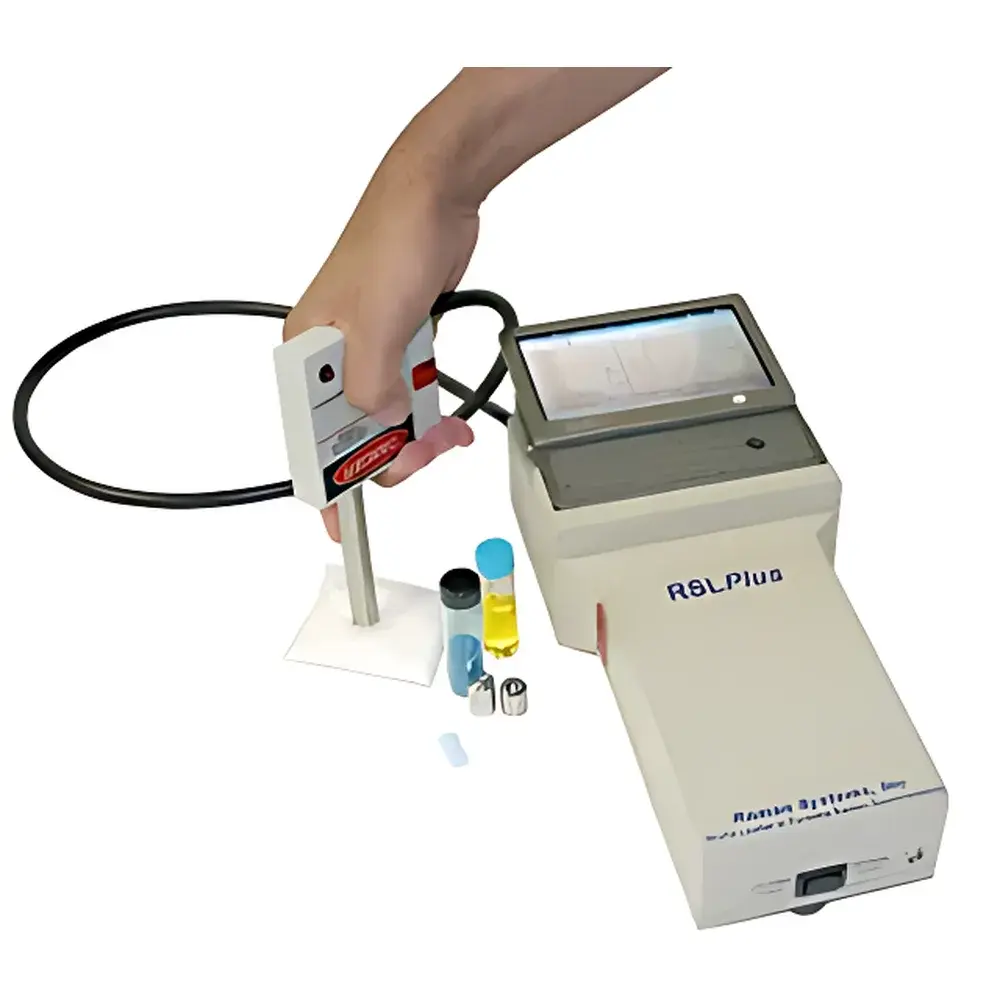
RSI RSL-Plus Handheld Raman Spectrometer
| Origin | USA |
|---|---|
| Manufacturer Type | Authorized Distributor |
| Origin Category | Imported |
| Model | RSL-Plus |
| Pricing | Available Upon Request |
Overview
The RSI RSL-Plus Handheld Raman Spectrometer is a field-deployable, battery-powered analytical instrument engineered for rapid, non-destructive molecular identification of solids, liquids, and gels in real time. Based on confocal dispersive Raman spectroscopy with 785 nm laser excitation, the system minimizes fluorescence interference while maintaining sufficient photon energy for robust signal generation across diverse chemical classes—including pharmaceuticals, explosives, polymers, illicit substances, and industrial chemicals. Its compact, ergonomic design meets MIL-STD-810G environmental ruggedness requirements for shock, vibration, and temperature variation, enabling reliable operation in forensic crime scenes, customs checkpoints, warehouse quality checks, and hazardous material response scenarios. The RSL-Plus has been validated in operational use by law enforcement agencies and was featured in CBS’s forensic procedural programming as a representative of modern portable spectral identification tools.
Key Features
- 785 nm diode laser with thermoelectric cooling and fixed-grating stabilization, delivering <0.5 nm spectral linewidth and power output adjustable between 125 mW (HI) and 250 mW (LOW) via software interface
- High-sensitivity linear-array CCD detector coupled to a Czerny–Turner optical bench, achieving spectral resolution better than 10 cm⁻¹ across the 200–2700 cm⁻¹ Raman shift range
- Integrated fiber-optic probe with interchangeable sampling accessories: immersion cap for liquids, contact cap for solids, vial/cuvette holder, and verification cap for daily performance validation
- Dual-purpose software suite: RSIScan for spectral acquisition, real-time display, baseline correction, and metadata tagging; RSIIdent for library-matched identification of pure compounds and multi-component mixtures using correlation-based algorithms and spectral deconvolution
- Embedded industrial-grade touchscreen PC with Windows OS, onboard storage, USB 3.0 ports, Wi-Fi 5 (802.11ac), and Bluetooth 5.0 for peripheral integration and remote data synchronization
- Compliance-ready architecture supporting audit trails, user access levels, and electronic signatures—aligned with GLP/GMP documentation expectations for regulated environments
Sample Compatibility & Compliance
The RSL-Plus accommodates direct surface analysis of powders, tablets, crystals, films, solutions, suspensions, and opaque matrices without sample preparation. Its contact-mode sampling cap enables consistent pressure-controlled measurement geometry, minimizing inter-operator variability. For regulatory traceability, the system supports NIST-traceable calibration verification using the included verification cap, which contains certified reference materials for peak position and intensity stability assessment. The instrument conforms to IEC 61000-4 electromagnetic compatibility standards and carries CE marking for EMC and safety. While not FDA-cleared as a medical device, its configuration and software workflows are compatible with ISO/IEC 17025 laboratory accreditation requirements and support compliance with USP , ASTM E1840, and EU Pharmacopoeia 2.2.48 for Raman-based identity testing.
Software & Data Management
RSIScan provides intuitive control over integration time, laser power, background subtraction, and spectral averaging—enabling optimization for low-concentration analytes or highly fluorescent samples. All acquired spectra are timestamped, geotagged (via optional GPS module), and stored in vendor-neutral .spc format compliant with ASTM E131. RSIIdent leverages the STJapan Raman Spectral Library containing >14,000 high-purity reference spectra, each acquired at AIST (National Institute of Advanced Industrial Science and Technology, Japan) under controlled conditions and certified for peak fidelity. Library search includes hit quality index (HQI), similarity scoring, and false-positive suppression logic. Data export supports CSV, PDF reports, and XML metadata exchange. Audit logs record all user actions—including spectral acquisition, library search, parameter changes, and calibration events—in accordance with 21 CFR Part 11 principles for electronic records and signatures.
Applications
- Forensic chemistry: Identification of unknown white powders, tablet coatings, ink formulations, and explosive residues at scene-of-crime locations
- Pharmaceutical QA/QC: Raw material verification, counterfeit detection, blend uniformity screening, and packaging integrity assessment
- Hazardous material response: On-site identification of unknown chemicals in spill containment or transportation incidents
- Customs and border protection: Rapid screening of consumer goods, cosmetics, and agricultural imports for adulterants or banned substances
- Academic and industrial research: In situ reaction monitoring, polymorph characterization, and nanomaterial dispersion analysis
FAQ
What is the typical measurement time per spectrum?
Spectral acquisition ranges from 1 to 10 seconds depending on sample fluorescence, concentration, and selected laser power—optimized automatically by RSIScan’s adaptive exposure algorithm.
Does the system require external calibration before use?
No. The verification cap provides built-in reference standards for daily performance verification; full recalibration is only required annually or after physical impact per manufacturer recommendations.
Can the RSL-Plus identify mixtures quantitatively?
RSIIdent supports semi-quantitative mixture analysis through peak ratio modeling and library-constrained fitting, though absolute quantification requires method-specific validation per ISO 80000-9.
Is the STJapan database updatable?
Yes—licensed users receive quarterly database updates via secure RSI portal download, including newly added spectra and revised metadata fields.
What battery life can be expected during continuous field operation?
The integrated lithium-ion battery supports ≥4 hours of active scanning at nominal laser power, with hot-swappable options available for extended missions.
Related Products



