
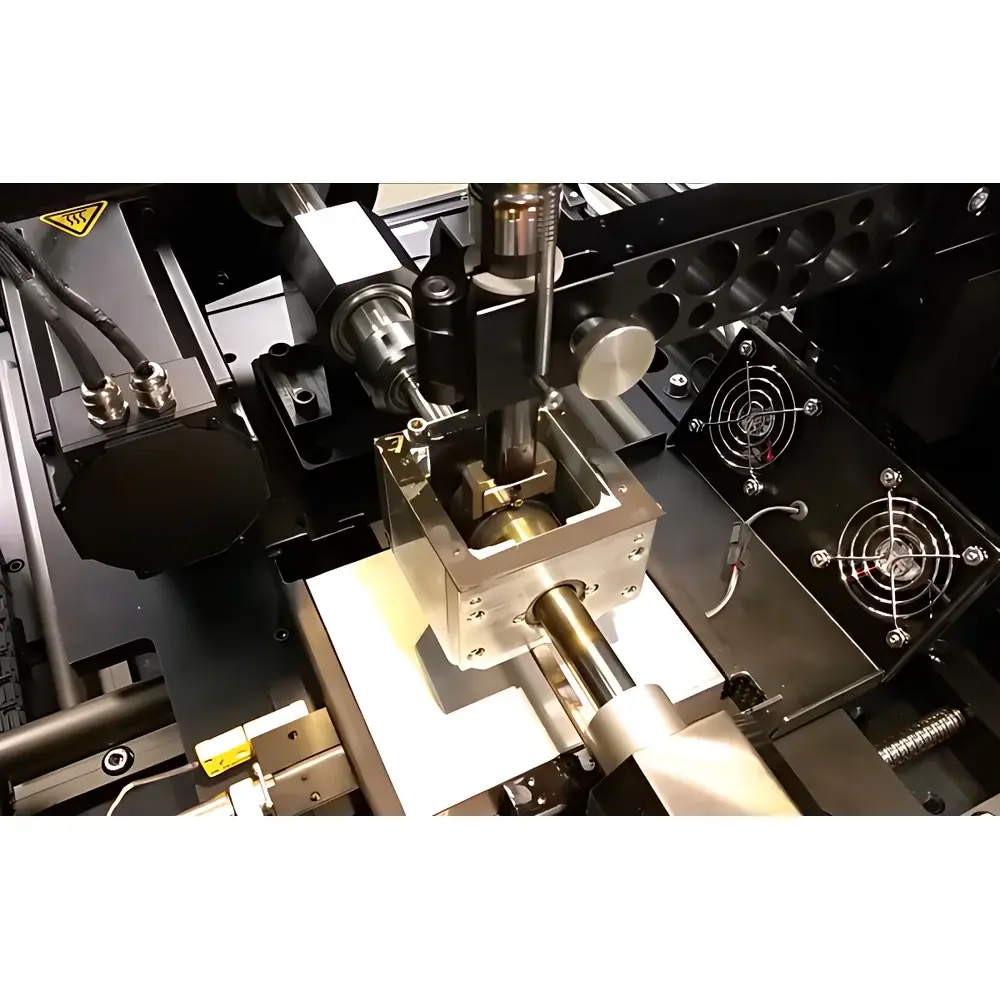
Rtec BOR-3000 High-Speed Pin-on-Disk Tribometer
| Brand | Rtec |
|---|---|
| Origin | USA |
| Model | BOR-3000 |
| Load Capacity | Up to 3000 N |
| Rotational Speed Range | 0.1–5000 rpm (0.1 rpm resolution) |
| Temperature Range | Ambient to +200 °C |
| Optional Low-Temp Control | −40 °C to +200 °C |
| Optional High-Temp Control | Ambient to +500 °C |
| Test Standards Compliance | ASTM G77, ASTM D2509, ASTM D2714, ASTM D2782, ASTM D2981, ASTM D3704, SH/T 0203, GB/T 11144 |
Overview
The Rtec BOR-3000 High-Speed Pin-on-Disk Tribometer is an engineered precision instrument designed for quantitative tribological evaluation of lubricants, greases, and solid material surfaces under controlled mechanical, thermal, and environmental conditions. Operating on the standardized pin-on-disk (or ring-on-block) configuration per ASTM G77 and ISO 7148-1, the system measures friction coefficient, wear volume, wear rate, and surface temperature evolution in real time during dynamic sliding contact. Its modular architecture supports both conventional lubricant performance assessment—such as anti-scuffing capability of automotive gear oils—and advanced material science applications including coating durability, polymer tribology, and high-temperature solid-lubricant behavior. The instrument is purpose-built for laboratories requiring traceable, repeatable, and standards-compliant tribological data generation in accordance with international test protocols.
Key Features
- High-fidelity load control up to 3000 N with closed-loop feedback, enabling precise simulation of boundary, mixed, and hydrodynamic lubrication regimes.
- Motor-driven rotational stage with 0.1 rpm resolution and speed stability ±0.05% across the full 0.1–5000 rpm range—critical for low-speed creep studies and high-speed scuffing onset detection.
- Integrated temperature control system covering ambient to +200 °C; optional extended-range modules support operation from −40 °C to +200 °C (low-temperature chamber) or ambient to +500 °C (high-temperature furnace assembly) with PID-regulated accuracy of ±1 °C.
- Dual-sensor friction measurement: simultaneous acquisition of tangential force (via calibrated load cell) and normal load ensures robust coefficient-of-friction (COF) calculation independent of drive torque artifacts.
- Modular sample holder design accommodates standard ASTM/ISO-compliant specimens (e.g., 12.7 mm diameter pins, 101.6 mm diameter disks, or custom ring/block geometries), with quick-change tooling for rapid method reconfiguration.
- Real-time data logging at up to 10 kHz sampling rate, capturing transient events such as seizure initiation, stick-slip oscillations, and thermal runaway.
Sample Compatibility & Compliance
The BOR-3000 supports a broad spectrum of sample types—including metallic alloys (steel, aluminum, titanium), ceramics, polymers, composites, and thin-film coatings—mounted in standardized geometries per ASTM D2509 (grease EP performance), ASTM D2782 (gear oil scuffing), and SH/T 0203 (Chinese national standard for gear oil evaluation). All test configurations are fully traceable to ISO/IEC 17025-accredited calibration procedures. The system meets functional requirements for GLP-compliant testing environments and provides audit-ready documentation for FDA 21 CFR Part 11 compliance when paired with Rtec’s validated software suite. Test reports include raw sensor outputs, derived metrics (wear scar diameter, wear volume via profilometry integration), and metadata stamped with operator ID, timestamp, environmental setpoints, and calibration certificate references.
Software & Data Management
Control and analysis are performed using Rtec’s TRIBOVIEW™ v5.x platform—a Windows-based application developed for scientific rigor and regulatory readiness. The software features intuitive method wizards aligned with ASTM and ISO test templates, automated pass/fail decision logic based on user-defined thresholds (e.g., COF > 0.9 indicating seizure), and synchronized multi-channel visualization (friction, temperature, acoustic emission, motor current). Raw data exports in CSV and HDF5 formats ensure interoperability with MATLAB, Python (Pandas/NumPy), and LIMS systems. Audit trails record all parameter changes, user logins, and report generations with immutable timestamps. Optional 21 CFR Part 11 module enables electronic signatures, role-based access control, and secure archive retention meeting pharmaceutical and aerospace QA/QC requirements.
Applications
- Evaluation of extreme pressure (EP) and anti-wear (AW) additive packages in engine oils, gear oils, and hydraulic fluids per ASTM D2714 and D2981.
- Scuffing resistance qualification of SAE 75W–90 to 85W–140 gear lubricants used in heavy-duty transmissions and differentials.
- Screening of solid lubricants (MoS₂, graphite, PTFE composites) for aerospace bearing applications under vacuum or inert gas environments.
- Wear mechanism analysis of biomedical implant materials (CoCr, Ti-6Al-4V, UHMWPE) under simulated joint kinematics.
- Development and validation of water-based and bio-derived lubricants where oxidative stability and film-forming capacity must be quantified across thermal gradients.
- Correlation studies between bench-scale tribological performance and field service life using accelerated aging protocols.
FAQ
What standards does the BOR-3000 directly support?
ASTM G77 (pin-on-disk wear), ASTM D2509 (grease EP performance), ASTM D2714 (gear oil scuffing), ASTM D2782 (FZG gear test correlation), ASTM D2981 (lubricant film strength), ASTM D3704 (oil rust inhibition), SH/T 0203 (Chinese gear oil standard), and GB/T 11144 (Chinese lubricant test method).
Can the system operate under inert or vacuum conditions?
Yes—the base chamber is vacuum-rated to 1 × 10⁻³ mbar; optional glovebox integration or purge ports enable nitrogen/argon atmosphere control for oxidation-sensitive tests.
Is wear volume calculated automatically?
Not natively—but the system exports high-resolution positional and force data compatible with third-party profilometers (e.g., Bruker Sensofar, Zygo) for post-test volumetric wear quantification; optional add-on laser displacement sensors enable in-situ wear depth tracking.
Does the BOR-3000 meet ISO 17025 calibration requirements?
All load cells, encoders, and thermocouples are supplied with NIST-traceable calibration certificates; annual recalibration services are available through Rtec’s ISO/IEC 17025-accredited service centers in North America and Europe.
How is temperature uniformity verified across the test interface?
Calibration includes thermal mapping using embedded micro-thermocouples and IR thermography at multiple load/speed points; uniformity is maintained within ±1.5 °C over the central 80% of the disk surface at steady state.





