
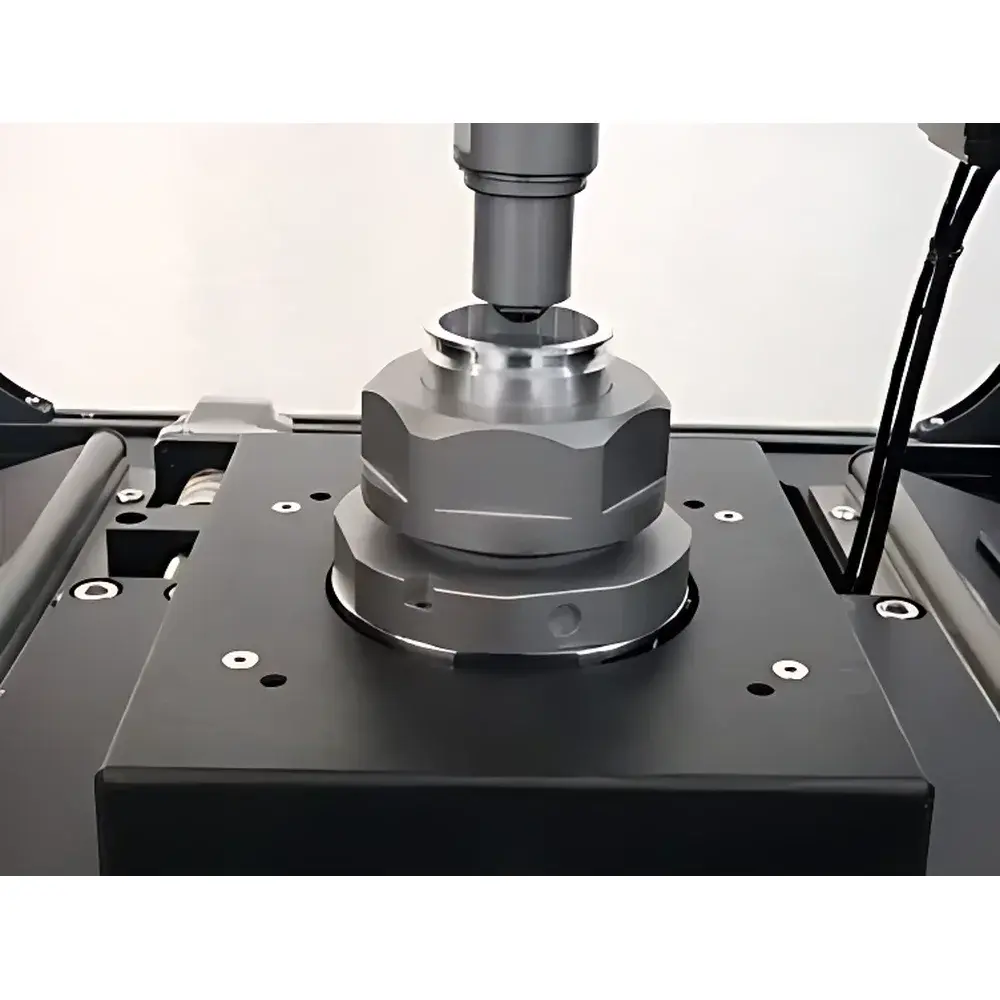
Rtec FBT-12000 Four-Ball Tribometer
| Brand | Rtec |
|---|---|
| Origin | USA |
| Model | FBT-12000 |
| Load Capacity | Up to 12,000 N (closed-loop servo-controlled) |
| Torque Measurement Range | 0–20 N·m |
| Rotational Speed | 0–3000 rpm (0.1 rpm resolution) |
| Temperature Range | Ambient to +150 °C |
| Optional Low-Temperature Control | Ambient to –40 °C |
| Compliance | ASTM D2596, D2783, D2266, D4172, D5183 |
Overview
The Rtec FBT-12000 Four-Ball Tribometer is a precision-engineered laboratory instrument designed for standardized evaluation of lubricant performance under controlled tribological conditions. Based on the classical four-ball geometry—three stationary balls held in a triangular cup and one rotating upper ball—the system quantifies frictional behavior, wear resistance, and extreme pressure (EP) characteristics of lubricating oils, greases, and additive packages. Its operation adheres to well-established rheo-mechanical principles where friction torque, wear scar diameter (WSD), and weld point are derived from real-time measurement of rotational resistance, load response, and post-test optical metrology. The instrument serves as a critical quality assurance tool across R&D laboratories, OEM lubricant formulation centers, and third-party testing facilities engaged in compliance-driven certification workflows.
Key Features
- High-fidelity closed-loop servo loading system delivering precise, repeatable normal forces up to 12,000 N with dynamic compensation for thermal drift and mechanical hysteresis.
- Integrated torque transducer with 0–20 N·m range and sub-mN·m resolution, enabling accurate coefficient of friction (COF) calculation across low- to high-load regimes.
- Variable-speed motor drive supporting continuous rotation from 0 to 3000 rpm at 0.1 rpm resolution—essential for simulating diverse operational speeds encountered in gearboxes, engines, and hydraulic systems.
- Modular temperature control architecture: standard heating capability to +150 °C; optional cryogenic cooling module extends operational range down to –40 °C for low-temperature lubricity assessment (e.g., arctic-grade engine oils).
- Expandable platform architecture supporting factory-integrated options including automated wear scar imaging (ISO 19403-compliant digital microscopy), KRL shear stability testing per DIN 51350-3, and high-speed data acquisition at ≥1 kHz sampling rate.
- Rigid monolithic frame with vibration-damped base and precision-ground spindle assembly ensures mechanical stability during long-duration EP tests and minimizes measurement noise.
Sample Compatibility & Compliance
The FBT-12000 accommodates standard 12.7 mm (½-inch) steel balls (AISI E52100 or equivalent) and accepts liquid lubricants, semi-solid greases, and solid lubricant dispersions. Sample volume requirements are optimized for minimal consumption while maintaining test repeatability. All core test methodologies conform to internationally recognized standards, including ASTM D2596 (EP wear), D2783 (EP load-carrying capacity), D2266 (wear scar measurement), D4172 (anti-wear performance), and D5183 (friction coefficient). It also satisfies Chinese national standards GB/T 3142 and GB/T 12583, as well as industry-specific protocols such as SH/T 0202 (gear oil EP), SH/T 0204 (grease EP), SH/T 0189 (oxidation stability correlation), and SH/T 0845 (low-temperature pumpability). Full traceability is supported via embedded audit trails compliant with GLP and GMP documentation requirements.
Software & Data Management
Control and analysis are managed through Rtec’s proprietary Tribosuite™ software—a Windows-based application supporting real-time parameter monitoring, automated test sequencing, and post-processing analytics. The software includes built-in calculation modules for weld point determination, mean WSD, friction trend mapping, and statistical outlier detection per ISO 5725. Raw data export is available in CSV, Excel, and HDF5 formats. For regulated environments, optional 21 CFR Part 11 compliance packages provide electronic signature support, user role management, and immutable audit logs. All firmware and software updates are delivered via secure HTTPS channels with version-controlled release notes.
Applications
- Formulation screening of anti-wear (AW) and extreme pressure (EP) additives for engine oils, gear oils, and metalworking fluids.
- Performance validation of biobased lubricants and synthetic esters under high-load, elevated-temperature conditions.
- Quality control of grease consistency, dropping point correlation, and mechanical stability via extended four-ball wear cycling.
- Failure mode analysis of field-failed lubricants by correlating WSD growth kinetics with oxidation state and contaminant profile.
- Supporting OEM specification development (e.g., GM dexos®, Ford WSS-M2C945-A, API SP/CK-4) through reproducible benchmarking against reference oils.
- Academic research in boundary lubrication mechanisms, tribofilm formation kinetics, and nanomaterial-enhanced lubricant behavior.
FAQ
What standards does the FBT-12000 fully support out-of-the-box?
The system ships with preconfigured test methods for ASTM D2596, D2783, D2266, D4172, and GB/T 3142, including automatic pass/fail logic and report templates aligned with each standard’s reporting clauses.
Can the instrument perform both wear and EP testing in a single run?
Yes—via programmable ramped-load protocols that incrementally increase applied force while continuously monitoring torque and acoustic emission, enabling simultaneous assessment of wear onset and catastrophic failure thresholds.
Is calibration traceable to NIST or other national metrology institutes?
All torque, load, and temperature sensors are supplied with individual calibration certificates traceable to NIST (USA) or PTB (Germany), with optional annual recalibration services available through Rtec-certified service centers.
How is wear scar diameter measured when the optional imaging module is installed?
The integrated digital microscope captures high-contrast, diffraction-limited images of the lower ball triad; automated edge-detection algorithms compute mean WSD per ISO 19403-2 with ±0.5 µm repeatability across ≥10 repeated measurements.
Does the system support unattended overnight testing?
Yes—fully autonomous operation is enabled via scheduled start/stop commands, thermal soak stabilization routines, and fault-condition shutdown logic with email/SNMP alerting.




