
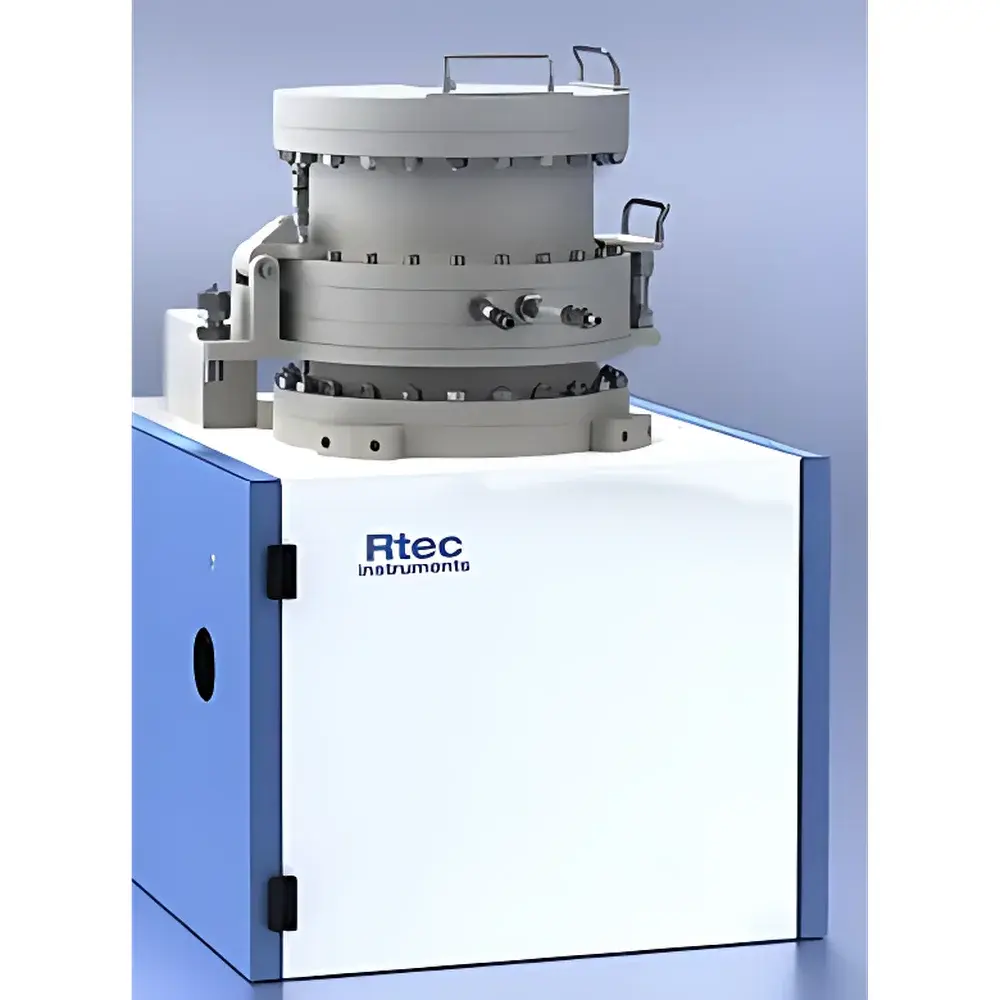
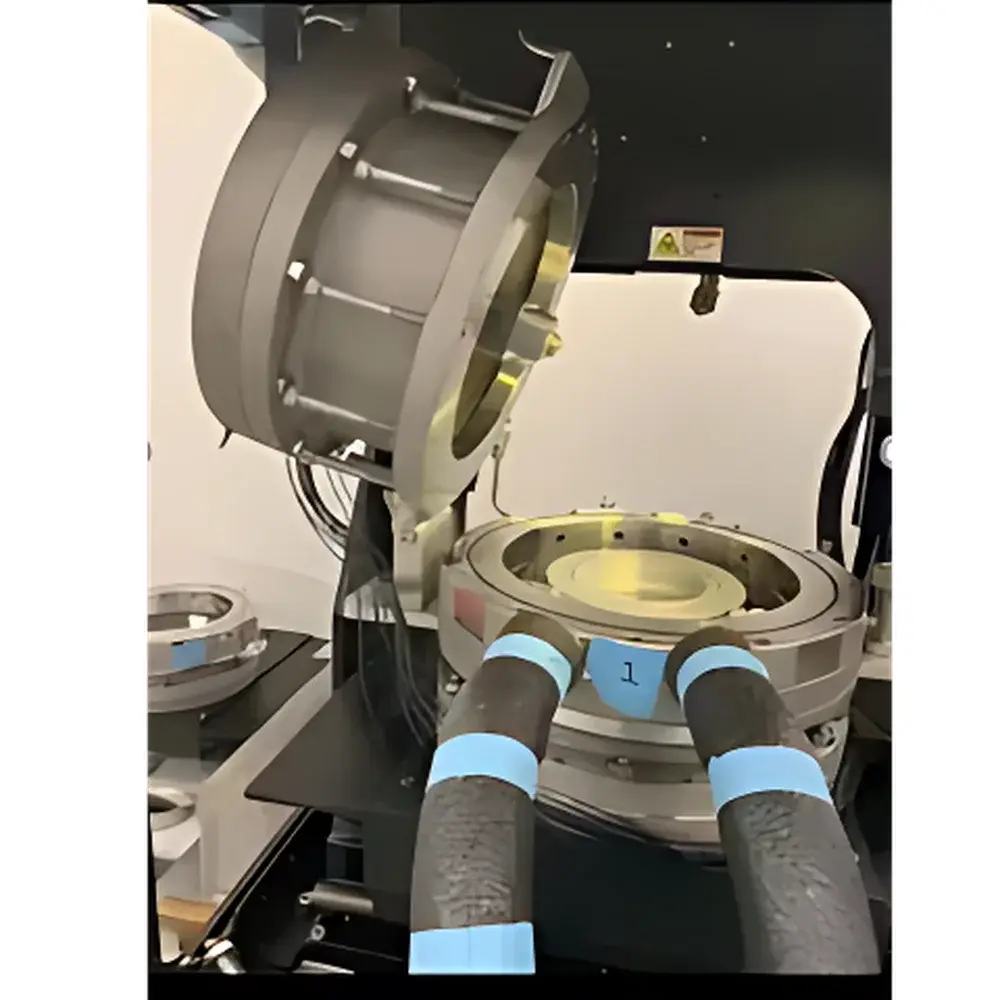
Rtec HPT-1000 High-Temperature Tribological Tester with Integrated Hardness Measurement Capability
| Brand | Rtec |
|---|---|
| Origin | Switzerland |
| Model | HPT-1000 |
| Maximum Operating Temperature | 1200 °C |
| Maximum Closed-Loop Load | 2000 N |
| Environmental Control | Inert Gas Sealed Chamber (N₂/Ar) |
| Sample Stage | Motorized XY Positioning System |
| Compliance | ASTM E23, ISO 6507, ISO 14577, USP <1031>, FDA 21 CFR Part 11 (Software Module) |
Overview
The Rtec HPT-1000 is a high-temperature tribological testing system engineered for simultaneous and sequential evaluation of hardness, wear, and friction behavior under controlled thermal conditions up to 1200 °C. Unlike conventional hardness testers limited to ambient or moderately elevated temperatures, the HPT-1000 integrates a fully sealed inert-gas chamber, precision programmable load actuation, and thermally isolated sensor architecture to enable reproducible mechanical property characterization across extreme thermal gradients. Its core measurement principle combines quasi-static indentation mechanics (per ISO 14577 for instrumented indentation testing) with real-time tribological sliding protocols under sustained elevated temperature—making it uniquely suited for materials subjected to thermo-mechanical service conditions in aerospace, power generation, and advanced manufacturing. The system maintains thermal stability within ±2 °C of setpoint during indentation and wear cycles, while proprietary thermal shielding minimizes heat conduction to force transducers and displacement sensors—ensuring sub-micron depth resolution and <0.5% load drift over 30-minute dwell periods at 1200 °C.
Key Features
- High-temperature test chamber rated to 1200 °C with dual-zone heating and integrated thermocouple feedback (Type S, calibrated traceable to NIST standards)
- Inert atmosphere enclosure with automated gas purge sequence, O₂ concentration monitoring (0–100 ppm range), and leak-tight sealing (<1×10⁻⁷ mbar·L/s He leak rate)
- Closed-loop electrodynamic actuator delivering precise force control from 1 mN to 2000 N with 0.01% full-scale repeatability
- Motorized XY sample stage (100 × 100 mm travel, 0.1 µm positioning resolution) enabling multi-site indentation and wear track mapping on single or multiple specimens
- Modular indenter turret supporting Rockwell, Vickers, Knoop, and spherical geometries (including high-temp diamond and sintered carbide tips)
- Thermally decoupled optical microscope (5–200× magnification) with LED cold illumination and digital image capture synchronized to indentation events
Sample Compatibility & Compliance
The HPT-1000 accommodates flat, polished specimens up to 25 mm thick and 100 mm in diameter. Compatible material classes include nickel-based superalloys (e.g., Inconel 718, Hastelloy X), ceramic matrix composites (CMCs), refractory metals (Mo, W, Nb), oxide and non-oxide ceramics (Al₂O₃, SiC, ZrO₂), and functionally graded coatings. All hardware components exposed to high temperature—including the sample stage, indenter holder, and chamber liner—are fabricated from proprietary oxidation-resistant alloys meeting ASTM B574 and ISO 9001 material certification requirements. The system supports GLP/GMP-compliant operation through audit-trail-enabled software, electronic signatures, and data integrity features aligned with FDA 21 CFR Part 11 and EU Annex 11 regulations. Calibration protocols follow ISO/IEC 17025-accredited procedures, with annual verification using NIST-traceable reference blocks certified per ASTM E23 Annex A2.
Software & Data Management
TruTribology™ v5.2 software provides unified control of thermal ramping, load application, motion sequencing, and real-time data acquisition at 10 kHz sampling rate. All test parameters—including temperature ramp rate, dwell time, indentation depth, coefficient of friction, and wear volume—are stored in structured XML metadata alongside raw sensor streams. Built-in statistical analysis modules compute hardness vs. temperature curves, Arrhenius activation energies for plastic deformation, and wear rate derivatives per ISO 20808. Export formats include CSV, HDF5, and ASTM E1445-compliant .tdms files. Data encryption, role-based access control, and automatic backup to network-attached storage ensure long-term archival compliance with ISO 15189 and ICH M10 guidelines.
Applications
- Thermo-mechanical fatigue assessment of turbine blade coatings under simulated service temperatures
- Hardness degradation kinetics in austenitic stainless steels during phase transformation near 800–1000 °C
- Interfacial wear resistance of diffusion-bonded TiAl/Ti64 joints in hypersonic vehicle structures
- Creep-assisted wear modeling of silicon nitride bearings in concentrated solar power receivers
- Validation of thermodynamic models predicting solid-solution strengthening loss in CoCrFeNiMn high-entropy alloys
- QC screening of batch-to-batch consistency in hot-pressed SiC-Si composites for nuclear cladding applications
FAQ
Can the HPT-1000 perform both hardness and tribological tests on the same specimen without repositioning?
Yes—the motorized XY stage and modular indenter/wear-pin turret allow automated transition between indentation arrays and linear reciprocating wear tracks within the same thermal cycle.
Is calibration required before each high-temperature test run?
No—system-level thermal compensation algorithms eliminate need for per-run calibration; however, quarterly verification using certified reference materials at three temperature points (room temp, 600 °C, 1200 °C) is recommended per ISO 14577 Annex D.
Does the inert gas environment affect hardness measurement accuracy?
No—inert atmospheres prevent surface oxidation and carbide/nitride formation that would otherwise artificially elevate apparent hardness; measurements reflect true bulk material response.
What is the maximum allowable thermal gradient across a specimen during testing?
The chamber design limits axial thermal gradients to ≤5 °C/mm at 1200 °C, verified by embedded thermocouple mapping per ASTM E220 practice.
Can third-party data analysis tools import raw HPT-1000 output?
Yes—all acquired datasets include timestamped force-displacement-temperature-position vectors in open-format HDF5 containers compatible with MATLAB, Python (h5py), and commercial FEA preprocessors.



