
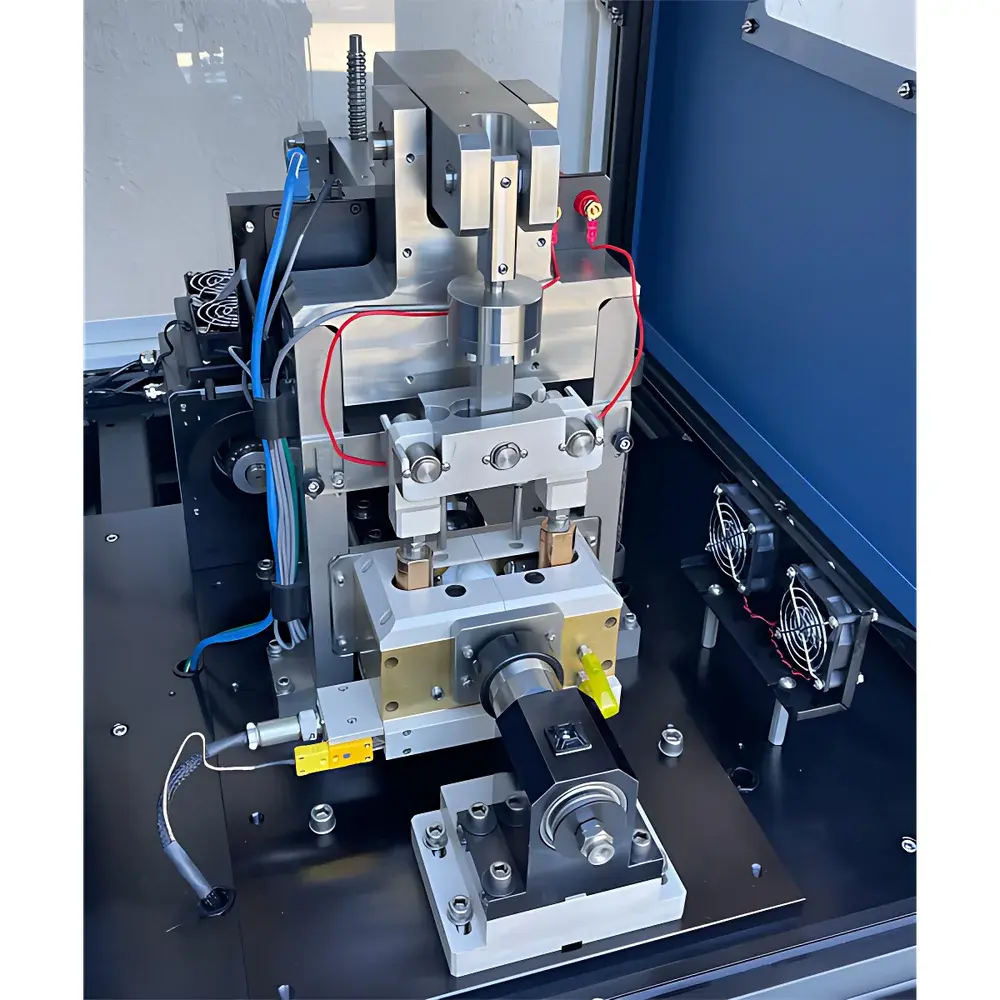
Rtec MBT-5000 Multifunctional Tribological Tester for Bearing Applications
| Brand | Rtec |
|---|---|
| Origin | Switzerland |
| Model | MBT-5000 |
| Instrument Type | Multifunctional Tribological Tester |
| Load Capacity | Up to 10 kN (customizable) |
| Motion Modes | Continuous Rotation & Oscillatory Motion |
| Temperature Control | Integrated Heating & Real-time Monitoring |
| Electrical Contact Resistance (ECR) Testing | Supported (programmable current/voltage) |
| Force Sensor | High-resolution capacitive tribometer |
| Software | Fully Integrated Control, Data Acquisition, and Analysis Suite with Logic-Based Test Termination |
| Compliance | Designed for ASTM D3702, ISO 20808, ISO 7148-1, and GLP/GMP-aligned data audit trails (21 CFR Part 11-ready configuration available) |
Overview
The Rtec MBT-5000 is a high-precision, multifunctional tribological tester engineered specifically for comprehensive bearing performance evaluation under controlled mechanical, thermal, and electrical boundary conditions. Built on a rigid, low-vibration base architecture and driven by a high-torque AC servo motor with closed-loop load control, the MBT-5000 implements standardized tribological measurement principles—including Coulomb friction law validation, Archard wear volume quantification, and PV (pressure × velocity) limit determination—across both rolling and sliding contact configurations. Its modular design enables direct mounting of standard bearing geometries (e.g., deep groove ball, tapered roller, plain bushings) as well as custom substrates, supporting research into material pairing, surface engineering (e.g., DLC, MoS₂, WS₂ coatings), and lubricant film formation mechanisms. Unlike conventional bearing testers limited to single-mode operation, the MBT-5000 integrates rotational, oscillatory, and hybrid motion profiles within a single platform—enabling dynamic simulation of real-world bearing kinematics encountered in aerospace actuators, railway axle boxes, wind turbine main shafts, and electric vehicle (EV) e-axle systems.
Key Features
- Load application via closed-loop servo-controlled actuator, with programmable static/dynamic loads up to 10 kN (higher capacity variants available upon request)
- Simultaneous high-fidelity measurement of normal force, tangential friction force, and real-time coefficient of friction (COF) using calibrated capacitive micro-force sensors (resolution < 0.01 N)
- Oscillation mode with adjustable amplitude (±0.1° to ±90°) and frequency (0.01–10 Hz), enabling fretting wear and stick-slip behavior analysis relevant to misaligned or preloaded bearings
- Integrated temperature control system (ambient to 300 °C) with dual-point thermocouple monitoring at interface and housing, ensuring thermal stability during high-PV testing
- Electrical Contact Resistance (ECR) module supporting DC/AC current injection (0–10 A) and voltage biasing (0–100 V), critical for evaluating bearing degradation mechanisms in EV drivetrain applications where stray currents induce electrochemical wear
- Modular sample stage accommodating industry-standard bearing housings, thrust washers, journal pins, and flat-on-flat or ball-on-disk configurations per ASTM G99 and ISO 20808
Sample Compatibility & Compliance
The MBT-5000 accepts full-size and sub-scale bearing assemblies—including radial, angular contact, spherical, and plain sleeve types—as well as coated substrate coupons used in bearing cage, raceway, and rolling element development. Sample holders are precision-machined to maintain alignment tolerances ≤ ±2 µm, minimizing parasitic moments that distort friction torque readings. The system supports test protocols aligned with international standards including ASTM D3702 (thrust washer wear), ISO 20808 (rolling contact fatigue), ISO 7148-1 (tribological testing terminology), and DIN 50320 (wear measurement). All raw sensor data—including time-stamped load, displacement, torque, temperature, and ECR signals—are timestamped, digitally signed, and stored with full metadata for traceability. Optional 21 CFR Part 11-compliant software configuration provides electronic signatures, audit trail logging, and role-based access control required for regulated quality assurance environments.
Software & Data Management
Rtec’s proprietary Tribos™ software provides unified control of hardware parameters, real-time visualization of multi-channel sensor streams, and post-test analytical tools including COF hysteresis loop generation, wear scar morphology mapping (via integrated optical imaging option), and statistical wear rate regression. Users define repeatable test sequences (“Methods”) composed of nested steps—e.g., break-in phase → steady-state measurement → overload ramp → failure detection trigger. Logic-based termination rules allow automatic test halting upon user-defined thresholds (e.g., COF increase >15%, temperature rise >50 °C/min, or ECR drop >30%). Export formats include ASCII (.txt), CSV, MATLAB (.mat), and HDF5 for integration with institutional data lakes or AI-driven failure prediction pipelines. All data files embed instrument calibration certificates, environmental logs, and operator metadata to satisfy GLP and ISO/IEC 17025 documentation requirements.
Applications
The MBT-5000 serves as a primary characterization tool across industrial R&D and academic tribology laboratories. Key application domains include: evaluation of low-friction coatings for EV motor bearings subjected to high-frequency PWM-induced eddy currents; optimization of biodegradable lubricants for rail traction motors under variable humidity and particulate contamination; lifetime modeling of ceramic hybrid bearings in aerospace auxiliary power units; screening of polymer composites for dry-running plain bearings in medical devices; and accelerated wear testing of gear oil additives under mixed-elastohydrodynamic (EHD) regimes. Its ability to decouple mechanical, thermal, and electrical stressors makes it uniquely suited for failure root-cause analysis in mission-critical rotating equipment.
FAQ
Can the MBT-5000 test full-size automotive wheel hub units?
Yes—the modular test chamber accommodates hub assemblies up to Ø300 mm diameter with optional custom fixtures for preload application and rotational speed synchronization.
Is third-party calibration certification included?
Standard delivery includes NIST-traceable calibration certificates for load, torque, temperature, and displacement channels; ISO/IEC 17025-certified recalibration services are available annually.
Does the system support vacuum or inert atmosphere testing?
An optional sealed chamber with gas purge ports (N₂, Ar) and pressure regulation (10⁻³ to 2 bar) is available for oxidation-sensitive coating evaluation.
How is wear volume quantified without destructive profilometry?
Integrated non-contact white-light interferometry (optional add-on) enables in situ 3D topography mapping before/after testing; volumetric wear is calculated via surface difference algorithms compliant with ISO 25178.
Can test methods be exported and shared across global lab sites?
Yes—Method files (.tmf) are platform-independent and include embedded calibration references, ensuring identical test execution across geographically distributed R&D centers.



