
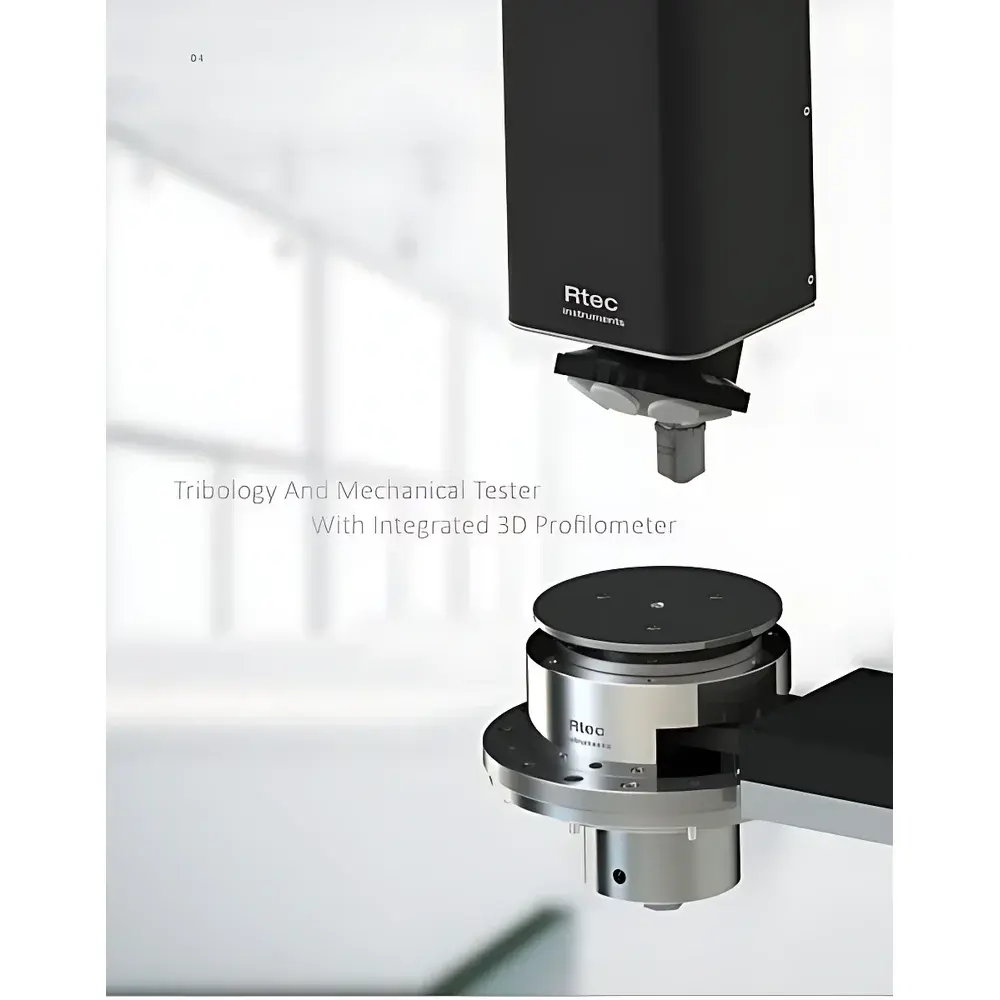
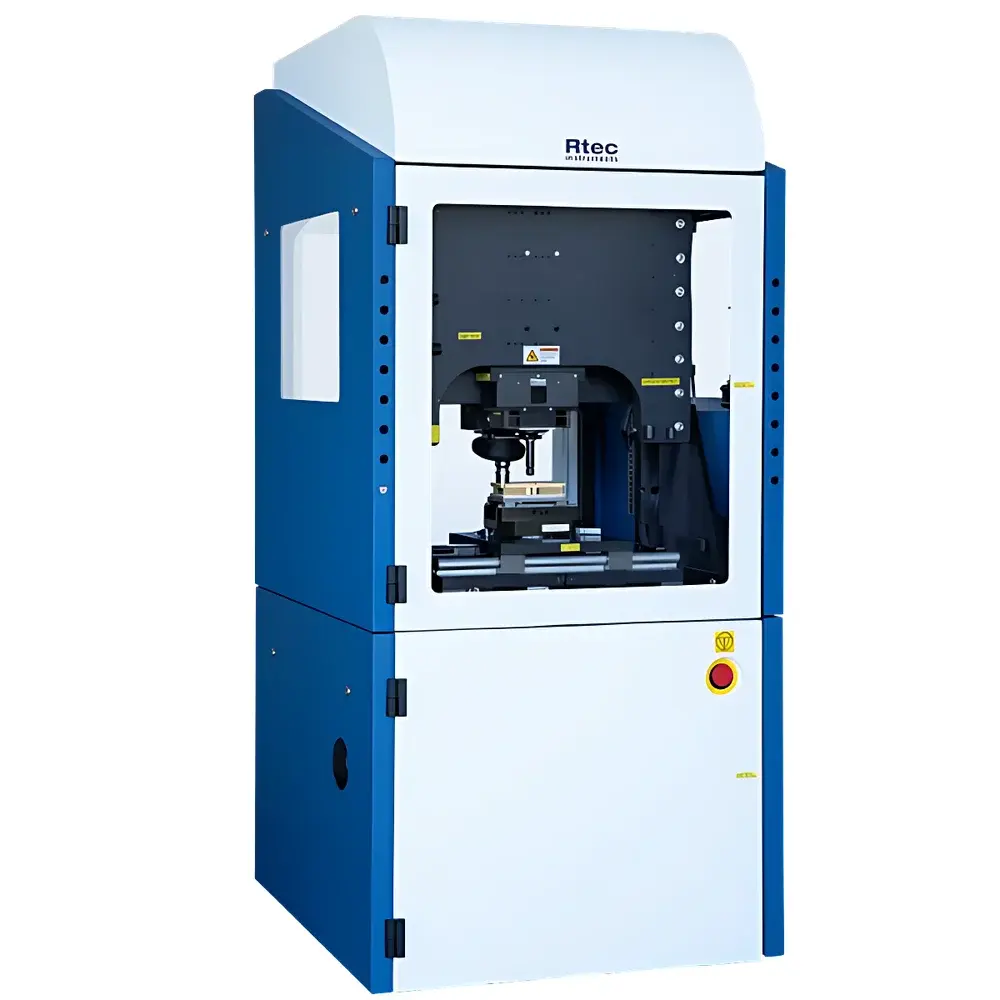
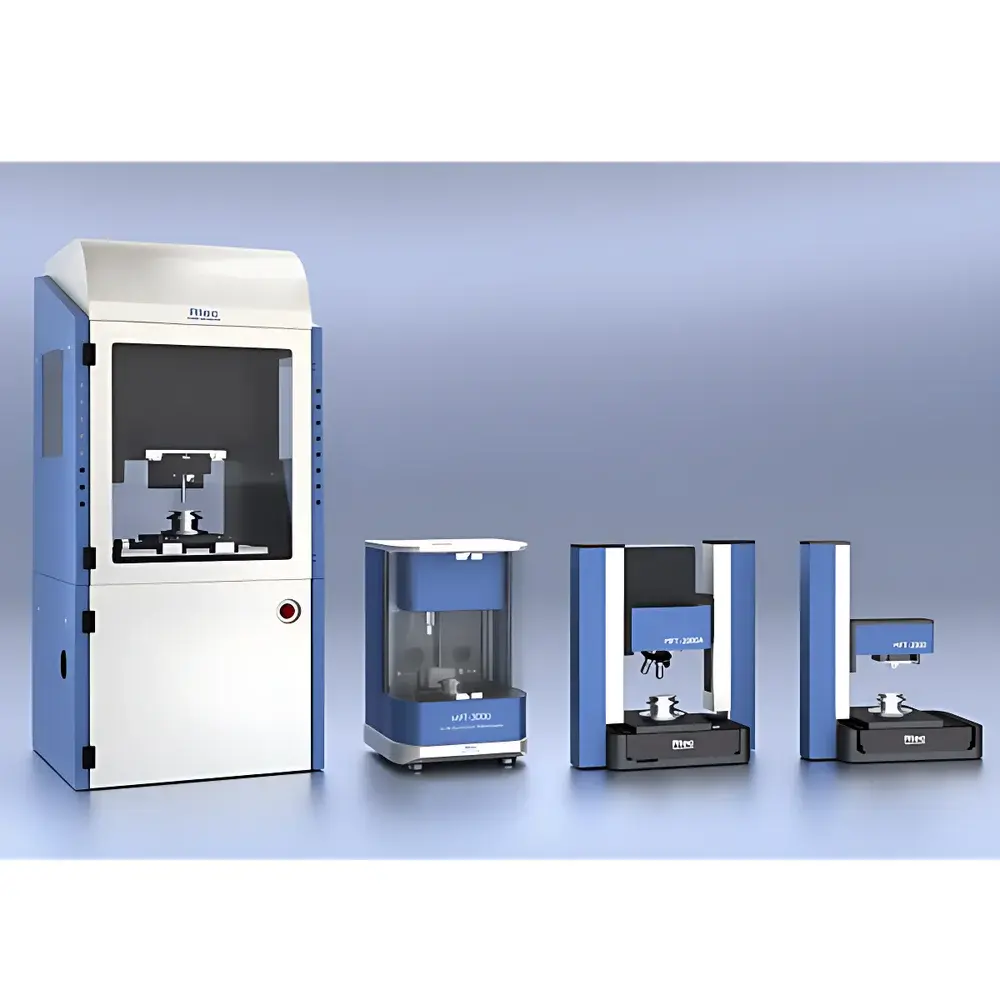
Rtec MFT-5000 Advanced Modular Tribological Tester
| Brand | Rtec |
|---|---|
| Origin | Switzerland |
| Model | MFT-5000 |
| Maximum Friction Force | 3000 N |
| Friction Force Resolution | 0.1 mN |
| Maximum Temperature | 1200 °C |
| Load Range | 1 mN – 12,000 N |
| XY Stage Travel | X = 150 mm, Y = 210 mm |
| Positional Resolution | 0.1 µm (XY), 0.25 µm / 10 nm (Z) |
| Rotational Speed | 0.001 – 10,000 rpm |
| Reciprocating Frequency | up to 70 Hz |
| Stroke Range | 0.1 – 40 mm |
| Environmental Chamber Range | −120 °C to 1200 °C, 5–95% RH, vacuum down to 10⁻⁷ Torr, corrosive/atmospheric/gas/liquid/humidity/high-pressure options |
| In-situ 3D Topography | Confocal + White-Light Interferometry + Dark/Bright Field |
Overview
The Rtec MFT-5000 Advanced Modular Tribological Tester is a high-precision, multi-configuration platform engineered for quantitative tribomechanical characterization across length scales—from nanoscale interfacial phenomena to macro-scale component-level performance. It operates on the fundamental principles of controlled contact mechanics, dynamic force transduction, and synchronized in-situ metrology, enabling simultaneous measurement of frictional response, normal load, displacement, wear volume, surface topography, and chemical evolution under programmable mechanical, thermal, and environmental conditions. Unlike single-purpose testers, the MFT-5000 integrates modular motion drivers (rotary, reciprocating, micro-oscillatory, ring-on-block, and Timken configurations) onto a rigid, vibration-damped base frame—allowing standardized ASTM, ISO, DIN, and GB-compliant testing as well as application-specific protocol development. Its architecture supports full traceability, reproducible calibration, and compliance-ready data acquisition workflows essential for GLP, GMP, and FDA 21 CFR Part 11 environments.
Key Features
- Modular motion architecture supporting interchangeable test modules: ball-on-disk, pin-on-disk, high-frequency reciprocation (SRV), long-stroke linear oscillation, micro-motion, ring-on-block, and Timken configurations—all operating on a common mechanical and control platform.
- Multi-range force sensing system with selectable transducers: capacitive (low drift, high stability), piezoelectric (optimized for dynamic/high-frequency friction capture), and strain-gauge (broad load range up to 12,000 N).
- In-situ 3D surface metrology integrated into the test chamber: Lambda optical imaging system combining confocal microscopy, white-light interferometry, bright-field, and dark-field modes; sub-nanometer vertical resolution; automated wear volume, depth, width, and roughness quantification without sample removal.
- Programmable environmental control: temperature from −120 °C to 1200 °C, humidity (5–95% RH), vacuum (≤10⁻⁷ Torr), inert/corrosive gas atmospheres, liquid immersion, salt fog, and high-pressure cells (up to 100 MPa).
- Multi-signal synchronization: real-time acquisition of friction force, normal load, displacement, acoustic emission, contact resistance, pH, and electrochemical potential—correlated with Raman spectral data when equipped with integrated spectrometer.
- Computer-controlled operation via Windows-based software with audit trail, user permission levels, electronic signatures, and export formats compliant with LIMS and ELN systems.
Sample Compatibility & Compliance
The MFT-5000 accommodates specimens ranging from thin-film coatings (≥10 nm) and bulk metallic/ceramic substrates to functionalized polymers, biological tissues, lubricants (oils, greases, solid films), and finished components (e.g., bearing surfaces, piston rings, MEMS devices). Its modular stage design enables automatic translation between tribological interaction zones and post-test surface analysis stations—eliminating manual handling and positional uncertainty. The system meets or exceeds requirements of over 60 international standards including ASTM G99, G133, G77, G119, G203–G206, D2509, D2714, D3704, D5183, ISO 20808, ISO 12156-1, ISO 20502, GB/T 3960, GB/T 11144, SH/T 0532, and SAE J2522. Calibration protocols follow ISO/IEC 17025 guidelines, and force/torque/temperature sensors are NIST-traceable. Environmental chamber validation reports and sensor calibration certificates are supplied with each system.
Software & Data Management
Rtec’s TriboSoft™ v8.2 provides unified control, real-time visualization, and post-processing for all hardware modules. It features scriptable test sequencing, adaptive feedback loops (e.g., constant friction coefficient or wear rate control), and synchronized multi-channel waveform capture at up to 1 MHz sampling rate. Data files include embedded metadata (operator, timestamp, environmental setpoints, calibration IDs) and support HDF5 and ASCII export. Built-in analysis tools compute wear rates (mm³/N·m), friction coefficients (µ), coating adhesion energy (J/m²), scratch hardness (GPa), and Raman peak shifts (cm⁻¹) correlated spatially with topographic features. Software complies with FDA 21 CFR Part 11 through role-based access control, electronic signature logging, and immutable audit trails—fully auditable during regulatory inspections.
Applications
The MFT-5000 serves research and quality assurance laboratories in academia, national institutes, and industrial R&D centers. Key application domains include: development and qualification of hard coatings (TiN, DLC, CrN) and low-friction polymer composites; tribocorrosion behavior of biomedical implants (CoCrMo, Ti-6Al-4V) in simulated synovial fluid; thermal stability and shear degradation of synthetic lubricants under extreme pressure; wear mapping of semiconductor wafer polishing pads; failure mode analysis of aerospace bearing alloys under thermal cycling; validation of self-lubricating mechanisms in MEMS actuators; and standard conformance testing for automotive gear oils per ASTM D5707 and diesel fuel lubricity per ISO 12156-1. Its ability to correlate mechanical degradation with chemical transformation (via Raman) and nanoscale topography makes it indispensable for mechanism-driven materials development.
FAQ
Can the MFT-5000 perform both ASTM G99 (pin-on-disk) and ASTM G133 (reciprocating) tests on the same platform without hardware reconfiguration?
Yes—the system uses quick-release motion modules with pre-aligned kinematic mounts and auto-recognized sensor calibration profiles, enabling seamless transition between test modes within minutes.
Is in-situ 3D topography performed during active sliding, or only post-test?
Both: non-contact white-light interferometry can acquire topography during pauses in motion (quasi-in-situ), while confocal imaging supports limited real-time monitoring at reduced frame rates; full-resolution 3D reconstruction occurs post-test with sub-micron registration accuracy.
Does the system support automated pass/fail evaluation against specification limits?
Yes—TriboSoft™ allows definition of acceptance criteria (e.g., max wear volume ≤ 0.05 mm³, µ ≤ 0.12 ± 0.01), with automatic flagging, report generation, and integration into enterprise QMS platforms via API.
Are environmental chamber validation documents and IQ/OQ protocols available?
Yes—Rtec provides factory-validated IQ/OQ packages, chamber uniformity maps, temperature ramp-rate verification reports, and sensor calibration certificates aligned with ISO 17025 and ASTM E74 requirements.
Can third-party instruments (e.g., external SEM or XRD) be synchronized with MFT-5000 data streams?
Yes—via TTL triggers, analog voltage outputs, and TCP/IP API, enabling time-synchronized acquisition across complementary analytical platforms for correlative tribology studies.



