
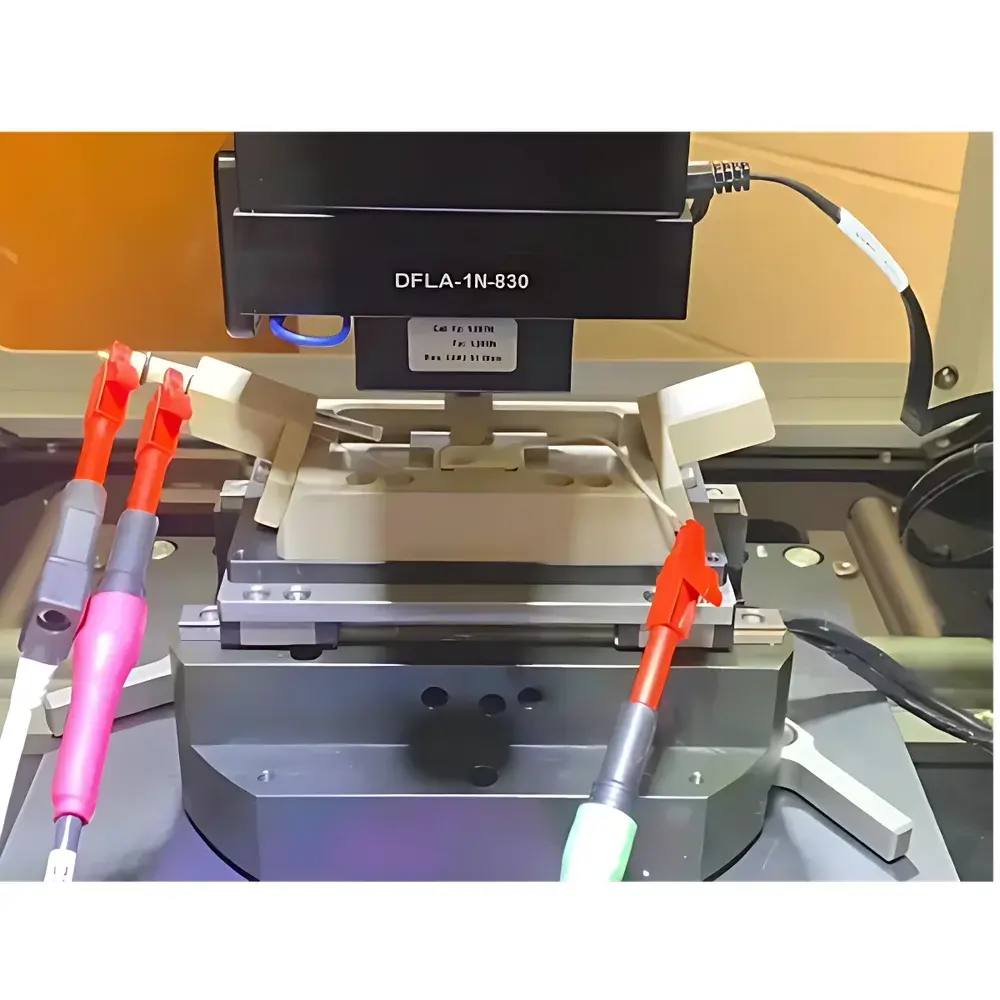
Rtec MFT-5000-EC Electrochemical Corrosion Tribometer
| Brand | Rtec |
|---|---|
| Origin | Switzerland |
| Model | MFT-5000-EC |
| Instrument Type | Multifunctional Tribological Tester |
| Max Normal Load | 5000 N |
| Friction Force Resolution | 5 mN |
| Max Operating Temperature | 500 °C |
| Temperature Control Range | −25 to 150 °C |
| Humidity Control Range | 10–95 % RH |
| Reciprocating Frequency | 0.1–60 Hz |
| Reciprocating Stroke | up to 25 mm |
| Rotational Speed (CW) | 0.1–3000 rpm |
| Rotational Speed (CCW) | 0.001–100 rpm |
| Minimum Sliding Velocity | 0.1 µm/s |
| Electrochemical Configuration | Three-electrode system (working, counter, reference) |
| Liquid Circulation | Dynamic and passive |
| Environmental Chamber | Electrically insulated, splash-resistant |
Overview
The Rtec MFT-5000-EC Electrochemical Corrosion Tribometer is a high-precision, multi-axis tribological testing platform engineered for simultaneous mechanical wear assessment and electrochemical monitoring under controlled corrosive environments. It integrates a servo-controlled mechanical testing module with a fully synchronized, galvanically isolated electrochemical workstation—enabling real-time correlation between tribomechanical events (e.g., friction coefficient evolution, wear volume, critical load onset) and electrochemical responses (e.g., open-circuit potential drift, polarization resistance, anodic/cathodic current transients). Designed in accordance with ASTM G199–22 (“Standard Guide for Conducting Wear Tests Using a Pin-on-Disk Apparatus in Aqueous Environments”), the system supports rigorous evaluation of material degradation mechanisms—such as tribocorrosion synergy, passivation breakdown, and repassivation kinetics—in aggressive media including synthetic seawater, phosphate-buffered saline (PBS), lubricant emulsions, and acidic/alkaline electrolytes.
Key Features
- Integrated tribo-electrochemical architecture: Fully decoupled mechanical actuation and electrochemical measurement paths minimize electromagnetic interference and ensure signal fidelity.
- High-resolution force sensing: Dual-range load cells (1 mN–1 kN static/dynamic; optional up to 5 kN) with 5 mN friction resolution enable quantification of sub-micron-scale interfacial events.
- Multi-modal motion control: Independent reciprocating (0.1–60 Hz, stroke up to 25 mm) and rotational (0.001–3000 rpm) modules support ASTM G99, G133, and ISO 7148-2 test protocols.
- Thermo-hygro-controlled environmental chamber: Precise regulation from −25 °C to 150 °C and 10–95 % RH allows simulation of service conditions ranging from cryogenic tribology to high-temperature oxidation-assisted wear.
- Electrochemically optimized test cell: Splash-resistant, electrically insulated cavity with integrated three-electrode configuration (Ag/AgCl reference, Pt counter, sample working electrode) and configurable liquid circulation (dynamic flow or static immersion).
- Servo-driven dynamic loading: Closed-loop force control eliminates inertial artifacts during high-speed reciprocation (up to 70 Hz) and enables curvature-adaptive constant-normal-load application on non-planar specimens.
Sample Compatibility & Compliance
The MFT-5000-EC accommodates bulk metallic alloys (e.g., stainless steels, Ti-6Al-4V), ceramic coatings (Al₂O₃, CrN), polymer composites, and thin-film systems (DLC, MoS₂) with diameters up to 50 mm and thicknesses ≥ 2 mm. Sample mounting fixtures are machined from non-conductive, chemically inert polymers (PEEK, Vespel) to prevent parasitic currents. The system complies with ISO 20806:2021 (tribocorrosion terminology), ASTM G199–22, and EN 10002-1 for mechanical testing traceability. All electrochemical measurements adhere to ASTM G59 (potentiodynamic polarization) and G61 (electrochemical impedance spectroscopy) standards. Data acquisition meets GLP audit requirements with timestamped, metadata-embedded raw files supporting FDA 21 CFR Part 11-compliant electronic signatures when paired with validated software modules.
Software & Data Management
Rtec’s Tribosoft™ v5.2 provides synchronized acquisition of 24+ parallel channels—including normal load, friction force, displacement, temperature, humidity, OCP, corrosion current density (icorr), and EIS spectra—at sampling rates up to 100 kHz. Real-time visualization includes overlay plots of μ(t) vs. EOCP(t), wear depth vs. charge passed, and dynamic polarization curves updated per sliding cycle. Post-processing tools support ISO 25178-based surface texture analysis, Archard wear coefficient derivation, and statistical wear rate mapping across multiple test zones. Export formats include CSV, HDF5, and MATLAB-compatible .mat files. Audit trails record operator ID, calibration history, environmental setpoints, and instrument firmware versions—ensuring full data provenance for regulatory submissions.
Applications
- Quantifying synergistic wear-corrosion contributions in biomedical implants exposed to simulated body fluid (SBF) under cyclic loading.
- Evaluating lubricant additive efficacy (e.g., ZDDP, ionic liquids) via in-situ monitoring of boundary film formation and breakdown potentials.
- Assessing high-temperature tribocorrosion behavior of thermal barrier coatings in molten salt environments (e.g., for concentrated solar power applications).
- Mapping localized corrosion susceptibility of welded joints under fretting conditions using spatially resolved potentiodynamic scans.
- Validating anti-wear coating durability in offshore hydraulic systems using synthetic seawater at 3.5 wt% NaCl and 60 °C.
FAQ
Can the MFT-5000-EC perform potentiostatic wear tests under constant potential control?
Yes—the electrochemical module supports potentiostatic, potentiodynamic, galvanostatic, and EIS modes, all fully synchronized with mechanical motion profiles.
Is the liquid test cell compatible with organic solvents such as ethanol or acetone?
The standard cell uses fluoropolymer seals and PEEK components rated for compatibility with most polar organic solvents; custom configurations are available for aggressive halogenated media.
How is electrical isolation verified between the tribological stage and electrochemical circuitry?
Each system undergoes factory certification per IEC 61000-4-8 (power frequency magnetic field immunity) and includes continuous leakage current monitoring (<1 µA) during operation.
Does the software support automated sequence execution across multiple environmental conditions?
Yes—Tribosoft™ includes scriptable test sequences that auto-adjust temperature, humidity, pH, and electrochemical parameters between stages without user intervention.
What calibration standards are supplied for traceable force and electrochemical measurements?
NIST-traceable deadweight load calibration kits and certified reference electrodes (Ag/AgCl, saturated KCl) are included, with documented uncertainty budgets per ISO/IEC 17025 requirements.



