
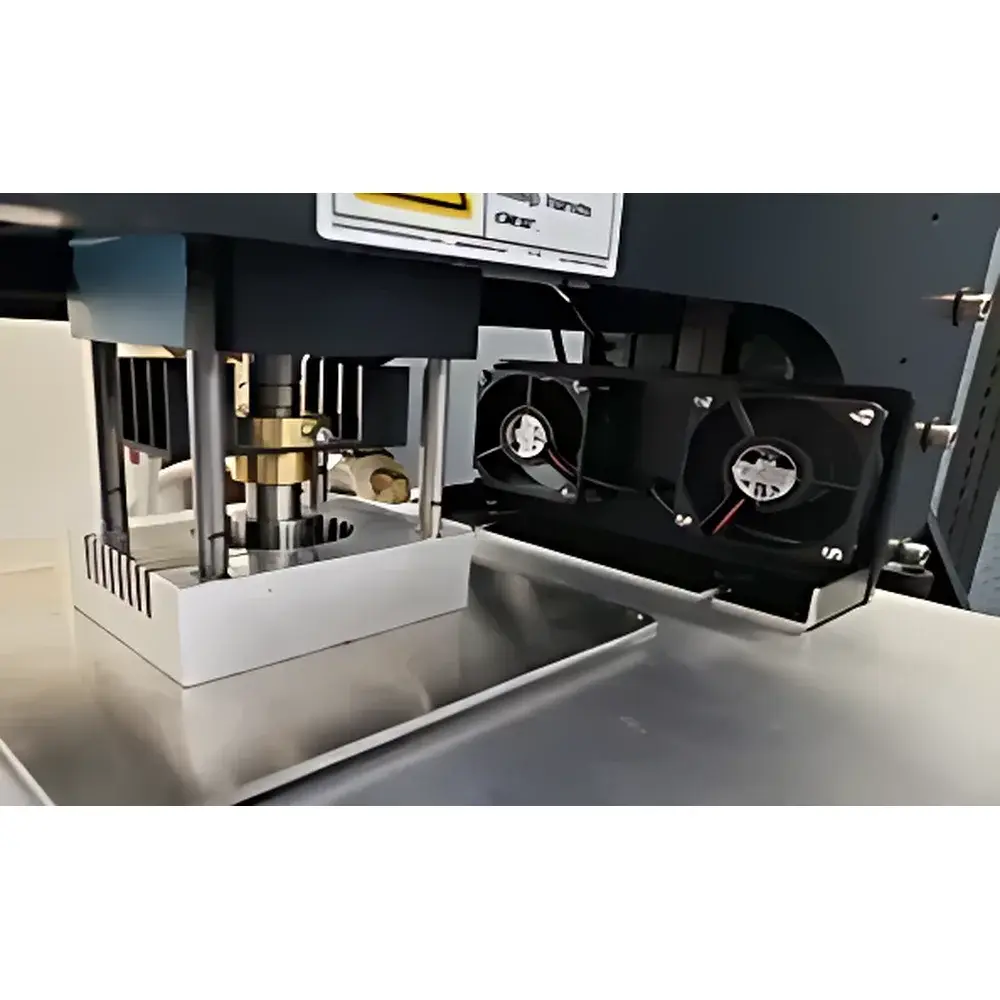
Rtec MFT-5000-HD High-Temperature Hardness Tester
| Brand | Rtec |
|---|---|
| Origin | Switzerland |
| Model | MFT-5000-HD |
| Instrument Type | Integrated Nanoindentation and Scratch Tester |
| Maximum Test Temperature | 1200 °C |
| Environmental Control | Inert Gas (Ar/N₂) or Vacuum (down to 10⁻⁷ mbar) |
| Load Range | 0.25–2000 N |
| Load Resolution | < 0.1% of full scale |
| Temperature Uniformity | ±2 °C across sample zone |
| Sample Stage | Motorized XY with programmable multi-point mapping |
| Compliance | ASTM E18, ISO 6508, ISO 14577, ASTM G171 (scratch), ASTM C1327 (ceramics) |
| Operating System | Windows 10 Professional |
| Power Supply | 110/220 V AC, 50/60 Hz |
| Environmental Chamber | Sealed, water-cooled, dual-zone heated |
Overview
The Rtec MFT-5000-HD High-Temperature Hardness Tester is an engineered metrology platform designed for quantitative mechanical property evaluation of advanced materials under thermally controlled, inert or vacuum environments. It operates on the fundamental principles of static indentation hardness measurement—specifically calibrated to ASTM E18 (Rockwell hardness) and ISO 6508 standards—while integrating high-precision load-displacement sensing compatible with nanoindentation protocols per ISO 14577. Unlike conventional room-temperature hardness testers, the MFT-5000-HD incorporates a fully sealed, water-cooled environmental chamber with dual-zone resistive heating elements, enabling stable, uniform thermal control from ambient up to 1200 °C. This architecture supports direct correlation between thermal state and mechanical response—critical for validating material performance in aerospace turbine components, refractory ceramics, sintered carbides, and high-temperature alloys subjected to service conditions.
Key Features
- Thermally stable test environment: Dual-zone heating system ensures ±2 °C temperature uniformity across the 50 × 50 mm active sample area, verified by integrated Pt100 sensors with real-time feedback compensation.
- High-force modular actuation: Electromechanical loading module delivers calibrated forces from 0.25 N to 2000 N with < 0.1% full-scale resolution, traceable to NIST-traceable force standards.
- Programmable multi-point mapping: Motorized XY stage (±0.5 µm repeatability) enables automated grid-based hardness profiling, supporting statistical analysis of microstructural heterogeneity and thermal gradient effects.
- Dual-atmosphere capability: Switchable operation under high-purity inert gas (Ar or N₂, dew point < –60 °C) or ultra-high vacuum (10⁻⁷ mbar), with integrated residual gas analyzer (RGA) port for process validation.
- Integrated thermal drift compensation: Real-time displacement correction via capacitive sensor referencing against thermally anchored reference frame, minimizing thermal artifact in depth measurement.
- Modular indenter interface: Standard Rockwell C-scale diamond cone (120° apex, 0.2 mm tip radius) and optional Berkovich/Vickers pyramidal tips for comparative nano/micro-hardness analysis.
Sample Compatibility & Compliance
The MFT-5000-HD accommodates flat, polished specimens up to 25 mm thickness and 100 mm diameter—including sintered ceramics (Al₂O₃, SiC, ZrO₂), Ni-based superalloys (Inconel 718, Hastelloy X), tool steels (M2, H13), and powder metallurgy compacts. All test sequences comply with regulatory documentation requirements for GLP and GMP environments: audit trails, electronic signatures, and 21 CFR Part 11–compliant data integrity are enforced through the embedded software framework. Calibration certificates for load cell, temperature sensor, and displacement transducer are supplied with each system and maintained per ISO/IEC 17025-accredited procedures.
Software & Data Management
Control and analysis are executed via Rtec’s proprietary WinTest HT v5.2 software suite, running on a dedicated Windows 10 Professional workstation. The interface provides synchronized acquisition of load, displacement, temperature, and environmental pressure at up to 1 kHz sampling rate. Hardness values (HRC, HRB, HV, HK) are calculated in real time using ASTM E18-compliant algorithms; raw force–displacement curves and thermal transients are stored in HDF5 format with embedded metadata (timestamp, operator ID, calibration status, atmospheric log). Export options include CSV, XML, and PDF reports compliant with ISO 17025 reporting templates. Data archiving supports network-attached storage (NAS) integration and automated backup to encrypted local drives.
Applications
- High-temperature hardness mapping of thermal barrier coatings (TBCs) on gas turbine blades under simulated service temperatures.
- Creep-hardness correlation studies in directionally solidified superalloys for jet engine disk applications.
- Phase-dependent hardness evolution in alumina–zirconia composites during in-situ heat treatment.
- Quality assurance of sintered tungsten carbide cutting inserts after HIP processing at 1100 °C.
- Interfacial hardness profiling across diffusion-bonded dissimilar metal joints (e.g., Ti–steel) post-thermal cycling.
- Validation of ASTM C1327 scratch resistance for refractory ceramic tiles used in industrial furnace linings.
FAQ
What temperature stability is achieved during extended dwell tests at 1100 °C?
Temperature deviation remains within ±1.5 °C over 2-hour dwell periods, confirmed by independent thermocouple validation and chamber thermal modeling.
Can the system perform both Rockwell and Vickers hardness measurements at elevated temperatures?
Yes—switchable indenter turrets support ASTM E18 (Rockwell) and ASTM E92/E384 (Vickers/Knoop) protocols with automatic hardness scale conversion and uncertainty propagation.
Is vacuum compatibility required for all high-temperature tests?
No—most metallic and oxide systems are tested under flowing Ar; vacuum is reserved for reactive materials (e.g., Ti alloys, Mg-based composites) or oxidation-sensitive evaluations.
How is thermal drift corrected during nanoindentation-mode testing above 800 °C?
Capacitive displacement sensors reference a thermally isolated baseplate; software applies real-time polynomial drift compensation derived from pre-test thermal soak characterization.
Does the system support third-party automation integration?
Yes—OPC UA server interface and LabVIEW-compatible DLL libraries enable synchronization with external furnaces, dilatometers, or synchrotron beamlines.



