
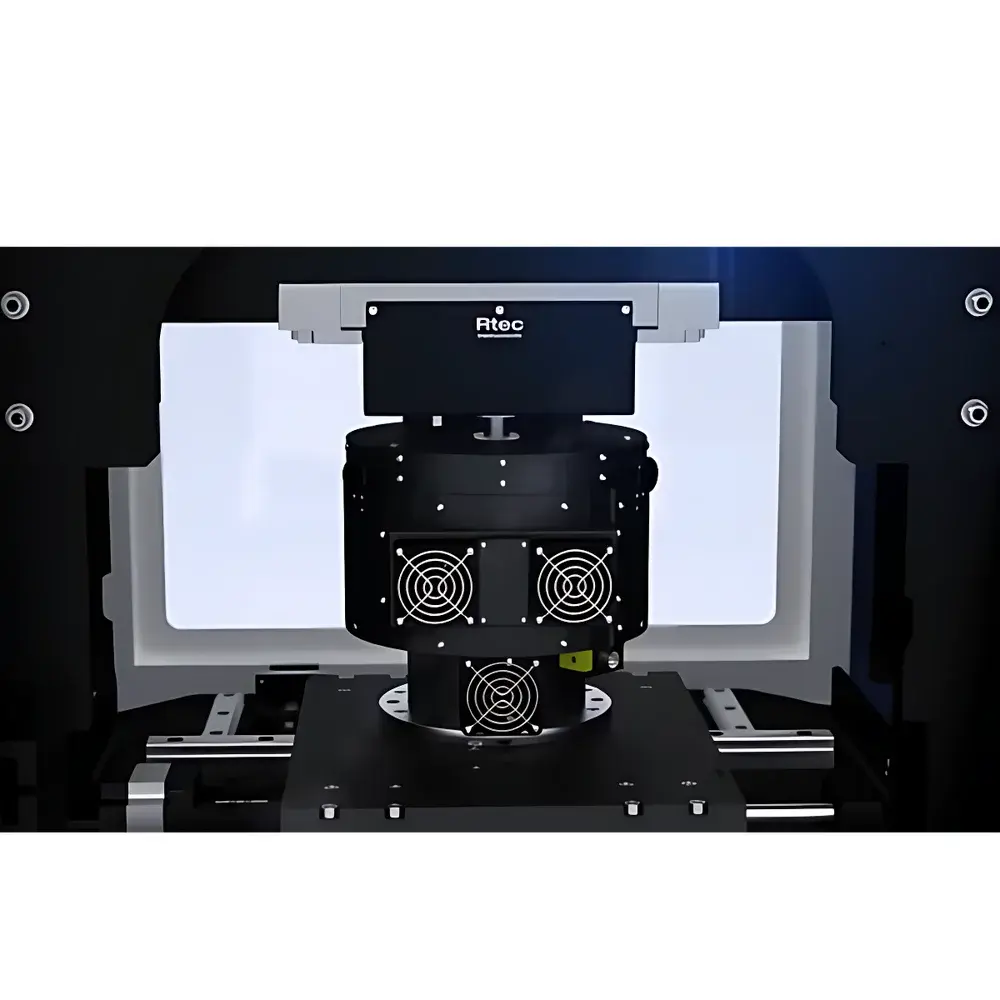
Rtec MFT-5000-H High-Temperature Tribological Tester
| Brand | Rtec |
|---|---|
| Origin | Switzerland |
| Model | MFT-5000-H |
| Maximum Normal Load | 12,000 N |
| Friction Force Resolution | 20 µN |
| Maximum Operating Temperature | 1200 °C |
| Motion Modes | Rotational & Reciprocating |
| Atmosphere Options | Inert Gas (N₂, Ar) |
| Thermal Drift Compensation | Active Cooling & Sensor Isolation |
| Compliance | ASTM G99, ISO 20808, ASTM D3702, ISO 7148-1 |
Overview
The Rtec MFT-5000-H High-Temperature Tribological Tester is an engineered platform for quantitative evaluation of frictional behavior and wear mechanisms under extreme thermal conditions—up to 1200 °C. It operates on the principles of controlled-contact tribometry, utilizing precision force transduction, real-time thermal monitoring, and programmable motion control to characterize material interactions in sliding, rolling, or oscillating configurations. Designed for fundamental research and industrial validation, the system enables reproducible measurement of coefficient of friction (COF), wear volume, wear rate, and tribofilm evolution across a wide parameter space: normal loads up to 12,000 N, sliding velocities from 0.1 mm/s to 5 m/s, and temperature ramps with ±1 °C stability at steady state. Its architecture integrates thermal management strategies—including active cooling of critical sensor assemblies and thermally decoupled sample stages—to ensure mechanical integrity and metrological fidelity during prolonged high-temperature operation.
Key Features
- High-temperature capability: Fully functional testing environment up to 1200 °C, with dual-zone thermal control (furnace + sample interface)
- Ultra-high-resolution force sensing: 20 µN friction resolution maintained across full temperature range via thermally isolated load cell design
- Multi-mode motion control: Interchangeable modules supporting rotational (pin-on-disk), linear reciprocating (block-on-ring), and oscillatory configurations
- Inert atmosphere compatibility: Sealed environmental chamber with mass flow-controlled N₂ or Ar purge, enabling oxidation-sensitive testing
- Thermal drift mitigation: Integrated Peltier-based cooling of transducer housings and low-conductivity alloy sample holders minimize thermal artifact propagation
- Automated safety interlocks: Real-time thermal overload detection, friction threshold shutdown, and emergency cooldown protocols compliant with IEC 61000-6-2
Sample Compatibility & Compliance
The MFT-5000-H accommodates standard tribological specimens per ASTM G99 (pin-on-disk), ASTM D3702 (thrust washer), and ISO 20808 (high-temperature wear testing). Compatible geometries include cylindrical pins (Ø1–10 mm), flat disks (Ø25–100 mm), and custom fixtures for turbine blade coatings, ceramic matrix composites (CMCs), refractory alloys, and thermal barrier coatings (TBCs). All hardware meets CE marking requirements and supports GLP/GMP documentation workflows. Test data output conforms to ASTM E2928 for traceability, and system firmware supports audit trails required under FDA 21 CFR Part 11 when paired with validated software configurations.
Software & Data Management
Control and analysis are executed via Rtec’s Tribometer Control Suite (v8.2+), a Windows-based application offering synchronized acquisition of friction force, normal load, displacement, temperature (dual-point: furnace + specimen), and acoustic emission signals at up to 10 kHz sampling. The software provides automated test sequencing, real-time COF mapping, wear depth profiling via integrated profilometry export, and statistical reporting aligned with ISO/IEC 17025 calibration records. Raw data exports in HDF5 and CSV formats support third-party analysis in MATLAB, Python (Pandas/NumPy), or JMP. Optional IQ/OQ/PQ documentation packages are available for regulated environments requiring installation and operational qualification.
Applications
This instrument serves critical roles in materials development and quality assurance for sectors where thermal-mechanical degradation governs service life: aerospace (turbine disk alloys, abradable seals), energy (nuclear cladding, boiler tube steels), automotive (exhaust valve seats, turbocharger bearings), advanced manufacturing (hot forging dies, sintering tooling), and next-generation ceramics (SiC/Si₃N₄ composites, MAX-phase coatings). It supports failure mode analysis of solid lubricants (e.g., MoS₂, CaF₂) above 800 °C, oxidation-assisted wear kinetics in Ni-based superalloys, and tribocorrosion studies under simulated molten salt exposure.
FAQ
What standards does the MFT-5000-H comply with for high-temperature wear testing?
ASTM G99, ISO 20808, ASTM D3702, and ISO 7148-1 define test methodologies supported by this system; full compliance requires appropriate fixture selection and calibration against certified reference materials.
Can the system operate under vacuum or reactive gas atmospheres?
The base configuration supports inert gas (N₂, Ar); vacuum integration (≤10⁻³ mbar) and reactive gas (H₂, CO) options are available as factory-installed upgrades with enhanced sealing and gas-handling certification.
How is thermal expansion of the test stage compensated during long-duration tests?
The stage employs Inconel 718 structural members with matched CTE to common test specimens, combined with real-time position feedback from capacitive displacement sensors to correct for thermal growth in closed-loop motion control.
Is remote operation and monitoring supported?
Yes—via secure RDP or VNC over Ethernet; optional cloud-based telemetry (with on-premise data residency) enables cross-site collaboration while maintaining ISO 27001-aligned access controls.
What maintenance intervals are recommended for sustained 1200 °C operation?
Furnace insulation inspection every 200 h; thermocouple recalibration every 500 h; load cell verification annually or after 1000 thermal cycles—per Rtec’s Preventive Maintenance Protocol PM-MFT5K-H.



