
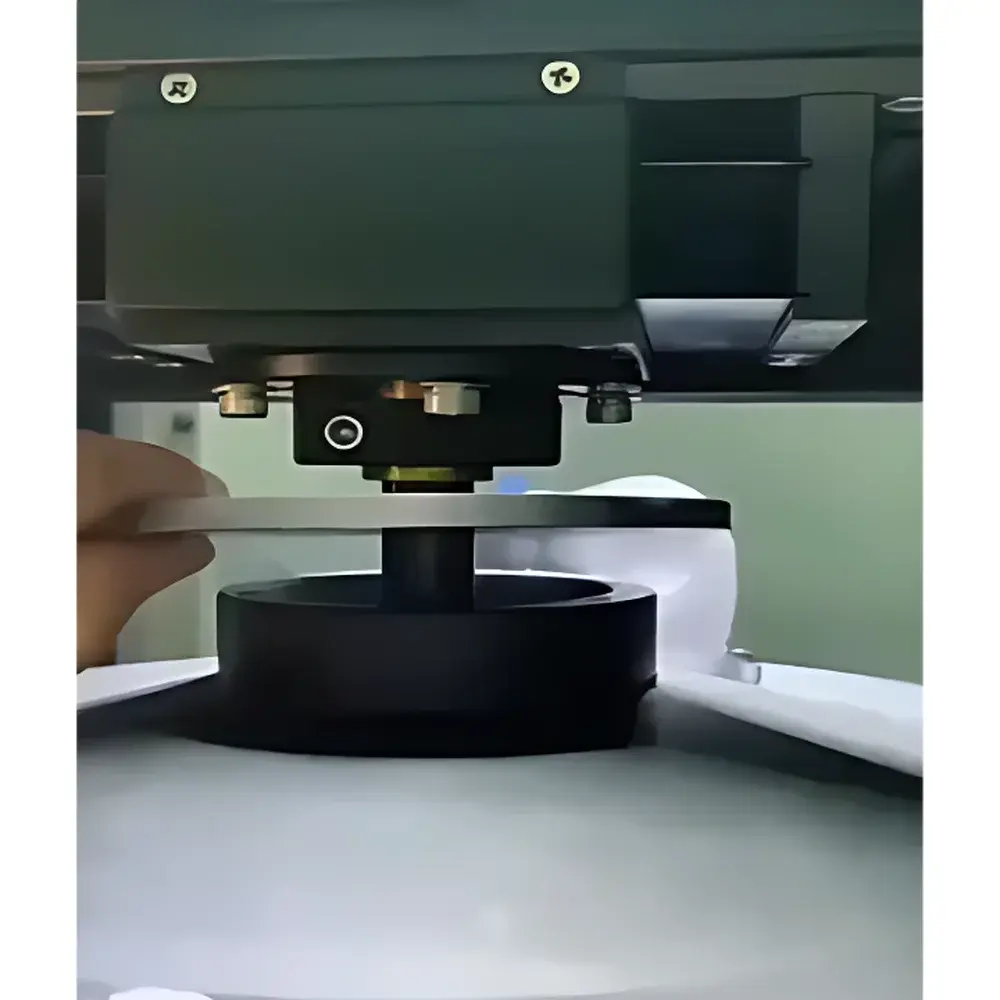
Rtec MFT-5000-SST Salt Spray Environmental Tribological Tester
| Brand | Rtec |
|---|---|
| Origin | Switzerland |
| Model | MFT-5000-SST |
| Maximum Normal Load (Fz) | 5000 N |
| Friction Force Resolution | 5 µN |
| Maximum Operating Temperature | 150 °C |
| Environmental Chamber Compatibility | Salt Fog (ASTM B117, ISO 9227 compliant) |
Overview
The Rtec MFT-5000-SST Salt Spray Environmental Tribological Tester is a high-precision, modular platform engineered for quantitative tribological evaluation under corrosive atmospheric conditions. It operates on the principle of controlled contact mechanics—measuring real-time normal and tangential forces, displacement, and coefficient of friction while simultaneously exposing specimens to standardized salt fog environments per ASTM B117 and ISO 9227. Unlike conventional corrosion-only chambers or standalone wear testers, the MFT-5000-SST integrates environmental simulation with dynamic mechanical measurement at the interface, enabling direct correlation between surface degradation kinetics and tribomechanical response. Its rigid granite base, low-noise servo-hydraulic actuation system, and sub-micron positioning repeatability ensure high reproducibility across long-duration tests (up to 1,000+ hours). Designed for laboratories requiring GLP-compliant data traceability and multi-standard validation, it serves as a foundational instrument for accelerated reliability assessment of protective coatings, metallic alloys, polymer composites, and functional thin films in marine, automotive, aerospace, and energy infrastructure applications.
Key Features
- Modular environmental chamber integration: Dedicated salt fog module with programmable NaCl concentration (5 ± 1 wt%), pH-controlled solution delivery, and adjustable fog density (1.0–2.0 mL/80 cm²/h), fully compliant with ASTM B117 and ISO 9227 test protocols.
- Multi-range force sensing architecture: Interchangeable transducers—including piezoelectric (for high-frequency friction dynamics), capacitive (for ultra-stable low-load measurements down to 1 mN), and strain-gauge-based (for macro-scale loads up to 5000 N)—each calibrated traceably to NIST standards.
- In-situ 3D surface metrology: Lambda optical profiler integrated into the test chamber enables non-contact, real-time topographic imaging during active wear testing. Supports four modalities: confocal microscopy, white-light interferometry, dark-field, and bright-field imaging—delivering lateral resolution < 0.5 µm and vertical resolution < 0.1 nm.
- Multi-motion capability: Configurable drive units support rotational, reciprocating, pin-on-disk, block-on-ring, micro-oscillatory, and linear long-stroke motion profiles—all programmable via synchronized motion and environmental control sequences.
- Thermal regulation: Integrated Peltier and resistive heating elements maintain chamber temperature from ambient to 150 °C with ±0.5 °C stability, enabling combined thermal–corrosive–tribological stress testing.
Sample Compatibility & Compliance
The MFT-5000-SST accommodates standard geometry specimens (e.g., pins, balls, disks, blocks) as well as near-net-shape industrial components (valve seats, bearing races, gear teeth, turbine blades) up to Ø150 mm × 50 mm height. Fixturing supports ASTM G99 (pin-on-disk), ASTM D3702 (thrust washer), ISO 7148-1 (rolling contact fatigue), and DIN 50021 (salt spray) configurations. All hardware and software comply with ISO/IEC 17025 requirements for testing laboratories. Data acquisition meets FDA 21 CFR Part 11 criteria for electronic records and signatures, including full audit trail logging, user access controls, and secure data export (CSV, HDF5, .tdms formats).
Software & Data Management
Rtec’s Tribometer Control Suite (TCS v6.2) provides unified control of mechanical, environmental, and optical subsystems. The software features real-time synchronized plotting of friction coefficient (µ), wear volume (calculated via profilometry integration), mass loss (with optional microbalance interface), and environmental parameters (chamber humidity, temperature, fog deposition rate). Automated test sequencing allows unattended execution of multi-step protocols—for example: 2 hr salt fog exposure → 30 min dry storage → 1 hr reciprocating wear at 5 Hz → 5 min in-situ topography scan. Raw data is stored in vendor-neutral HDF5 containers with embedded metadata (test standard, calibration certificates, operator ID, timestamped environmental logs), facilitating third-party analysis and regulatory submission.
Applications
- Development and qualification of anti-corrosion coatings (e.g., Zn-Ni, CrN, DLC, epoxy-polyamide systems) under combined mechanical loading and chloride exposure.
- Failure analysis of biomedical implants subjected to saline-body-fluid simulants and cyclic articulation.
- Screening of lubricant additives for marine-grade greases under salt-contaminated boundary lubrication regimes.
- Reliability validation of electrical contact materials in offshore wind turbine switchgear exposed to coastal aerosol.
- Standardized wear-corrosion synergy testing per ASTM G119 (determining synergistic wear-corrosion factor).
FAQ
Does the MFT-5000-SST meet ASTM B117 requirements for salt fog generation and chamber uniformity?
Yes—the salt fog module undergoes quarterly verification using ASTM B117-defined copper coupon corrosion rate (6.5–8.0 g/m²/day) and chamber temperature/humidity mapping per ISO 9001 internal audit procedures.
Can the system perform wear testing while maintaining continuous salt fog exposure?
Yes—unlike batch-mode corrosion chambers, the MFT-5000-SST delivers uninterrupted fog generation during active tribological motion, with real-time compensation for condensate accumulation on sensors and optics.
Is third-party calibration documentation included with shipment?
Each unit ships with NIST-traceable calibration certificates for all force sensors, temperature controllers, and optical profiler modules, valid for 12 months from date of installation.
What level of software validation support is provided for regulated industries?
Rtec supplies IQ/OQ documentation packages, 21 CFR Part 11 configuration files, and on-site validation assistance for pharmaceutical, aerospace, and defense clients requiring GxP compliance.
How is cross-contamination prevented between salt fog and sensitive optical components?
The Lambda profiler employs hermetically sealed optical paths, inert gas purging (N₂), and hydrophobic anti-fog coatings on all front lenses; fog chamber exhaust is routed through dedicated acid-resistant ducting separate from main lab HVAC.



