
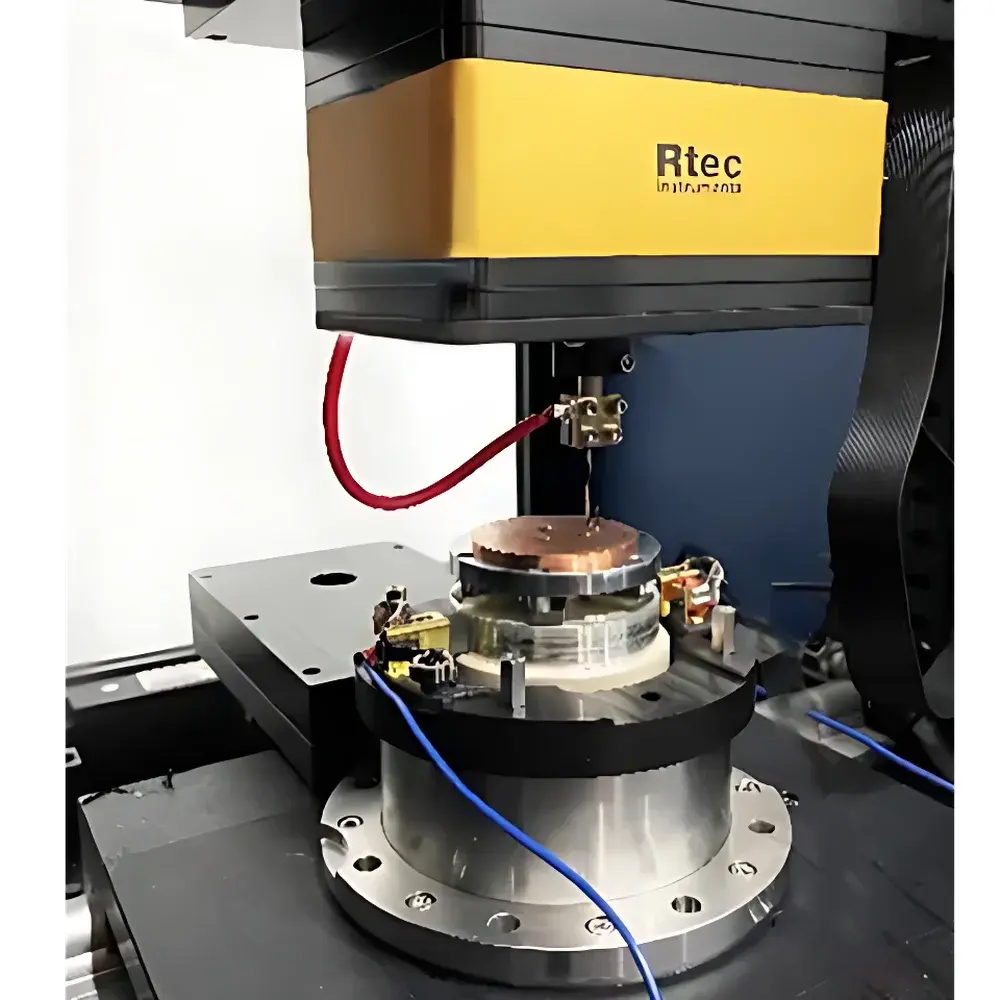
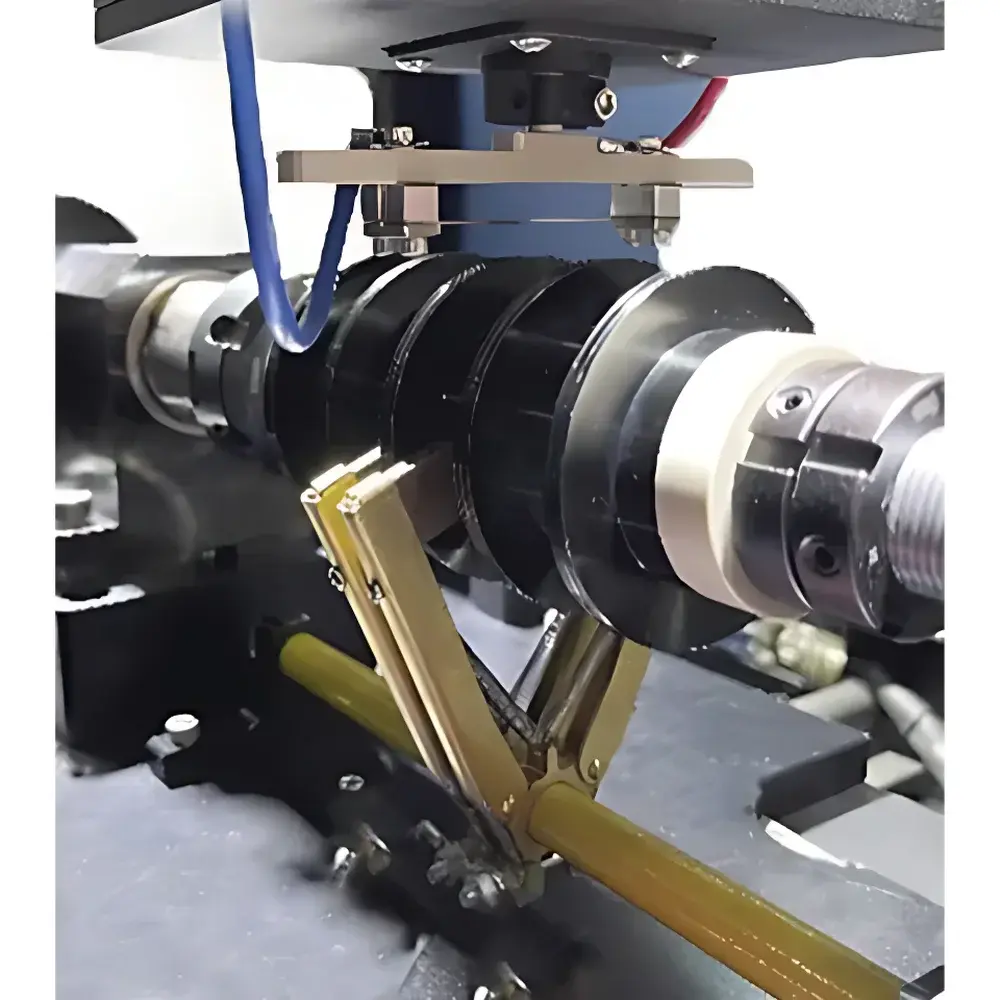
Rtec MFT-EF Multifunctional Tribological Tester
| Brand | Rtec |
|---|---|
| Origin | Switzerland |
| Model | MFT-EF |
| Type | Multifunctional Tribological Tester |
| Category | Import Instrument |
| Distributor Type | Authorized General Distributor |
| Pricing | Available Upon Request |
Overview
The Rtec MFT-EF Multifunctional Tribological Tester is an advanced, modular benchtop system engineered for high-precision evaluation of friction, wear, and electrical contact behavior under controlled mechanical and electrical loading conditions. Unlike conventional tribometers limited to dry or lubricated sliding, the MFT-EF uniquely integrates real-time current-carrying capability—enabling simultaneous measurement of mechanical tribological response (coefficient of friction, wear volume, surface topography evolution) and electrical parameters (contact resistance, voltage drop, current-induced heating, arc initiation thresholds). Its core architecture is based on a precision servo-controlled linear/rotary actuation platform coupled with a calibrated four-wire Kelvin probe interface, ensuring nanovolt-level resolution in electrical monitoring during dynamic sliding or oscillatory motion. Designed for materials science laboratories, electrical contact R&D centers, and automotive electrification testing facilities, the MFT-EF supports fundamental research into triboelectric coupling, fretting corrosion in current-carrying contacts, and degradation mechanisms in slip-ring assemblies, EV battery interconnects, and power relay materials.
Key Features
- Integrated current-carrying capability: Supports DC and pulsed current loads up to 100 A (configurable), with real-time synchronized acquisition of force, displacement, temperature, and electrical signals.
- Modular test configurations: Compatible with pin-on-disk, ball-on-flat, reciprocating, and micro-oscillation modes—each configurable with motorized Z-axis load control (0.1–200 N range) and sub-micron position resolution.
- Dual-sensor tribometry: Simultaneous high-frequency sampling (up to 10 kHz) of normal and tangential forces, enabling transient friction analysis during current transients or stick-slip events.
- Electrical interface compliance: Four-wire Kelvin connection minimizes lead resistance error; built-in galvanostatic/potentiostatic control options for electrochemical tribocorrosion studies.
- Environmental chamber compatibility: Optional temperature-controlled (-40°C to +300°C) and inert gas (N₂, Ar) enclosures support testing under realistic service conditions.
- Robust mechanical architecture: Granite base, preloaded linear guides, and active vibration isolation ensure measurement stability essential for low-noise electrical signal fidelity.
Sample Compatibility & Compliance
The MFT-EF accommodates standard tribological specimens per ASTM G99, ISO 7148-1, and DIN 50324, including disks (25–100 mm diameter), pins (3–10 mm diameter), and custom fixtures for miniature connectors or stamped contact strips. Sample mounting complies with ISO/IEC 17025 traceability requirements when used with certified calibration kits (e.g., NIST-traceable load cells and shunt resistors). The system meets electromagnetic compatibility (EMC) standards per EN 61326-1 and operates within safety limits defined by IEC 61010-1 for laboratory equipment. Data integrity protocols align with FDA 21 CFR Part 11 expectations through optional audit-trail-enabled software licensing.
Software & Data Management
Rtec’s Tribometer Control Suite (TCS) v5.x provides unified control, real-time visualization, and post-processing for mechanical and electrical datasets. The software features synchronized multi-channel waveform capture, automated wear track profiling via integrated profilometry triggers, and customizable scripting (Python API) for protocol automation. All raw data are stored in HDF5 format—self-describing, metadata-rich, and compatible with MATLAB, Python (h5py), and LabVIEW. Audit trail logs record user actions, parameter changes, calibration events, and instrument state transitions—supporting GLP/GMP documentation workflows. Export modules generate ASTM-compliant reports (e.g., friction vs. distance, wear rate vs. current density, contact resistance hysteresis loops).
Applications
- Evaluation of silver-alloy, copper-tin, and precious-metal-plated contacts under cyclic current loading to quantify fretting wear acceleration and oxide film breakdown kinetics.
- Triboelectrochemical characterization of battery busbar coatings exposed to humidity and vibration while conducting high-current pulses (e.g., EV fast-charge scenarios).
- Development and qualification of conductive polymer composites for flexible electronics interfaces subjected to repeated bending and sliding.
- Fundamental study of arc erosion mechanisms in low-voltage switching devices using synchronized high-speed imaging and current-interrupt analysis.
- Validation of lubricant performance in electric motor bearings where eddy currents and stray magnetic fields influence boundary film stability.
FAQ
Does the MFT-EF support both AC and DC current loading?
Yes—the system is configured for DC and pulsed DC operation up to 100 A; AC capability (50/60 Hz, up to 10 A RMS) is available via optional power amplifier module.
Can wear volume be quantified without post-test SEM or profilometry?
Yes—integrated in-situ displacement sensors combined with real-time normal force feedback enable volumetric wear estimation using Archard-based modeling, validated against ex-situ confocal microscopy.
Is the system compliant with ISO 15184 for coating adhesion assessment?
While not a dedicated adhesion tester, the MFT-EF’s controlled scratch mode with acoustic emission monitoring satisfies key functional requirements of ISO 15184 Annex B for conductive coating integrity evaluation.
What calibration standards are recommended for electrical measurements?
Rtec recommends annual calibration using NIST-traceable shunt resistors (0.001 Ω to 10 Ω) and certified current sources; full electrical metrology documentation is provided with each instrument shipment.
Is remote operation supported for lab automation integration?
Yes—TCP/IP and OPC UA interfaces enable seamless integration into centralized LIMS or MES platforms, supporting unattended overnight testing sequences with email/SNMP alerting on deviation events.



