
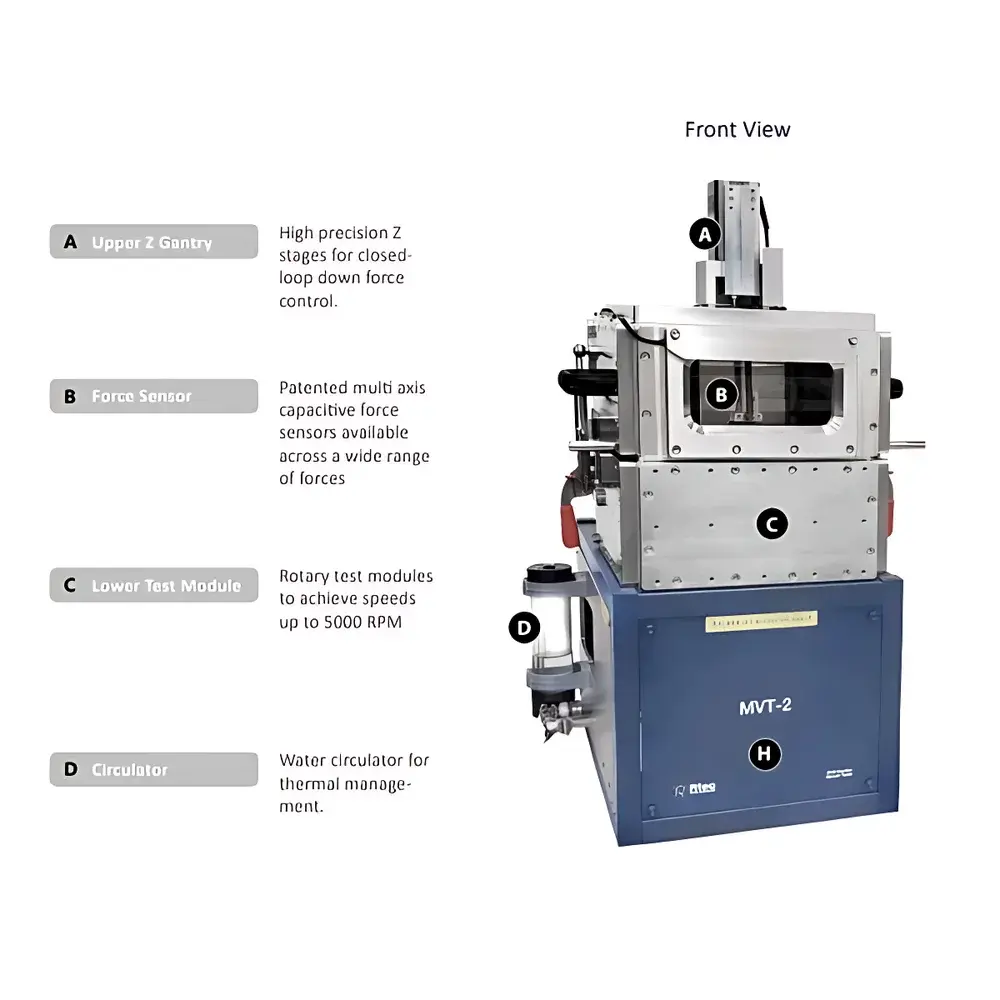
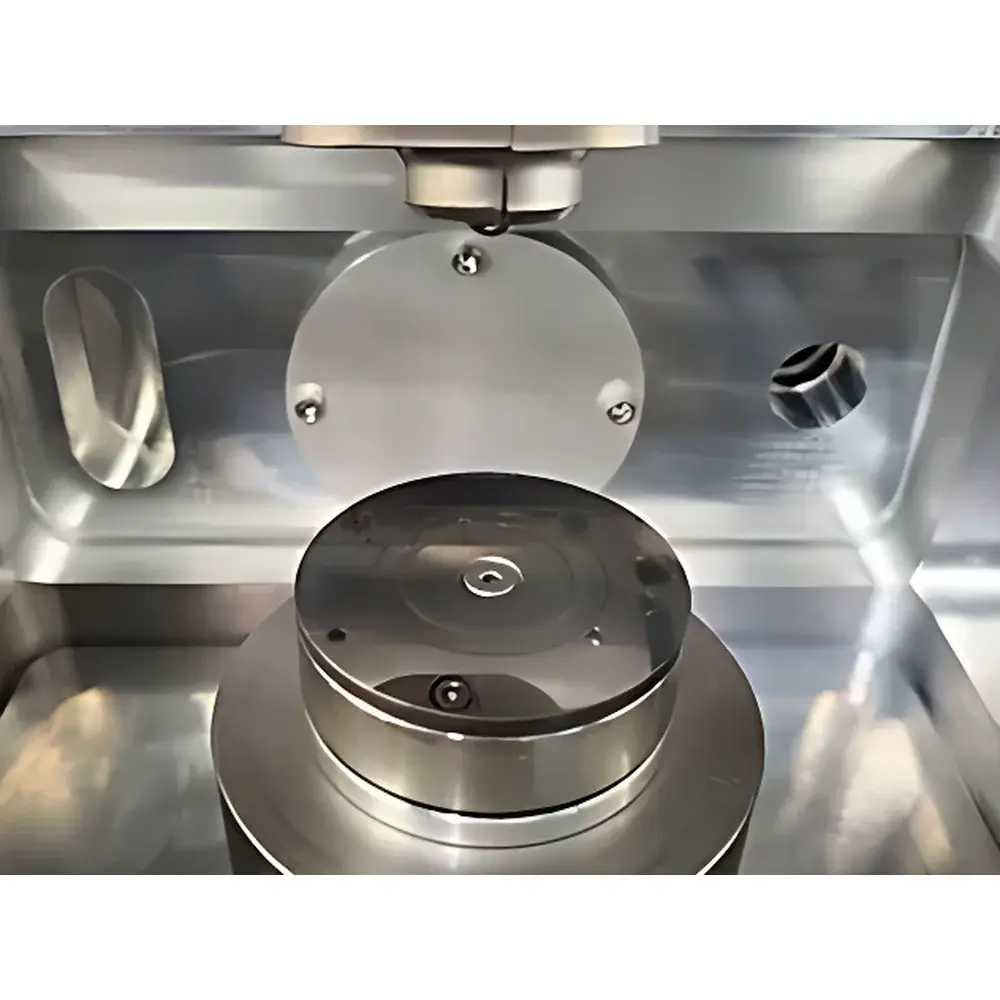
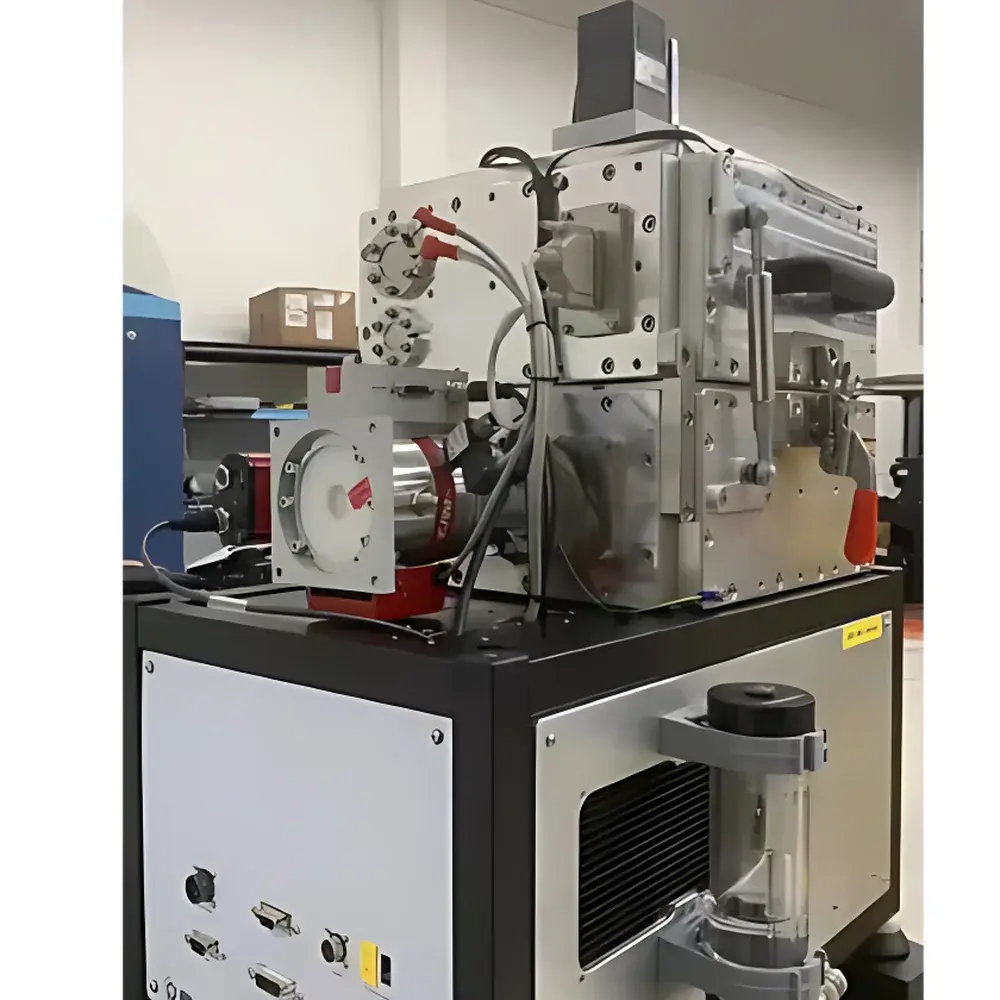
Rtec MVT-2 High-Low Temperature Vacuum Tribological Tester
| Brand | Rtec |
|---|---|
| Origin | Switzerland |
| Model | MVT-2 |
| Instrument Type | Multi-Functional Tribological Tester |
| Maximum Friction Force | 200 N |
| Friction Force Resolution | 0.25 µN |
| Temperature Range | −150 °C to +400 °C (with vacuum) |
| Environmental Control | High-Vacuum Compatible (≤10⁻⁶ mbar), Integrated Cryogenic Cooling & Anti-Condensation System |
| Load Control | Closed-Loop Servo-Driven, Programmable Constant/Linear Ramp Force |
| Motion Control | Precision Servo Motor, Adjustable Rotational/Linear Speed Profile |
| Data Acquisition | Multi-Channel, High-Speed (≥10 kHz), Low-Noise Controller |
| Software | Real-Time Control & Post-Processing Suite with ASTM/ISO Compliant Reporting Templates |
| Compliance | Supports GLP/GMP Audit Trail (21 CFR Part 11 Ready), ISO 20808, ASTM G99, ASTM D3702, ISO 7148-1 |
Overview
The Rtec MVT-2 High-Low Temperature Vacuum Tribological Tester is an engineered platform for precision tribological characterization under rigorously controlled environmental conditions. It operates on the principle of contact mechanics-based force and displacement measurement within a high-vacuum chamber (≤10⁻⁶ mbar), enabling quantitative analysis of friction, wear, adhesion, scratch resistance, and nano/micro-scale mechanical response across extreme thermal gradients—from cryogenic (−150 °C) to elevated temperatures (up to 1000 °C in inert gas environments). Unlike ambient-air tribometers, the MVT-2 eliminates oxidative surface reactions, adsorbed water layers, and hydrocarbon contamination—critical variables affecting interfacial energy, shear strength, and third-body formation. Its design integrates Couette-type rotational and linear reciprocating motion modes, supporting standardized test geometries (ball-on-disk, pin-on-disk, crossed-cylinder, micro-scratch) while maintaining traceable force calibration per ISO 7500-1 and displacement resolution compliant with ISO 20808.
Key Features
- High-fidelity closed-loop servo control for normal load (0.1 mN–200 N) and tangential force (±200 N), with real-time feedback at ≤10 µs latency
- Dual-zone thermal management: integrated liquid nitrogen cooling circuit with anti-condensation shroud and resistive heating elements, enabling stable temperature ramping (±0.1 °C accuracy) and dwell control
- Patented multi-axis piezoresistive sensor architecture delivering 0.25 µN friction resolution and sub-nanometer displacement sensitivity
- Modular transducer interface supporting simultaneous integration of acoustic emission (AE), confocal displacement, optical interferometry, and in-situ Raman spectroscopy modules
- Multi-channel synchronized data acquisition at ≥10 kHz sampling rate, with hardware-triggered event logging for transient wear initiation detection
- Fully programmable test sequences—including stepwise load/speed/temperature ramps, cyclic fatigue protocols, and conditional termination based on predefined wear thresholds or AE burst counts
Sample Compatibility & Compliance
The MVT-2 accommodates substrates and coatings ranging from monolayer 2D materials (graphene, MoS₂) to bulk ceramics, metallic alloys, polymer composites, hydrogels, and optically transparent thin films (e.g., ITO, DLC, TiN). Sample mounting fixtures support diameters from 6 mm to 100 mm and thicknesses up to 25 mm. All vacuum chamber components are UHV-compatible (electropolished stainless steel, metal-sealed flanges), certified to ISO 14644-1 Class 5 cleanroom standards. The system meets ASTM G99 (pin-on-disk wear testing), ASTM D3702 (lubricant film thickness evaluation), ISO 7148-1 (tribocorrosion under electrochemical control), and supports full audit trail generation required for FDA 21 CFR Part 11 compliance when configured with electronic signature and role-based access controls.
Software & Data Management
Rtec’s Tribomaster™ software provides unified control, visualization, and post-processing capabilities. It features a scriptable test definition environment compliant with ASTM E2917 for uncertainty quantification, automated calculation of COF (coefficient of friction), wear volume (via profilometry integration), specific wear rate (k), and Stribeck curve generation. Raw data exports include ASCII (.txt), CSV, HDF5, and MATLAB (.mat) formats; metadata embedding follows ISA-Tab conventions for FAIR data principles. The software maintains immutable test logs with timestamped operator ID, environmental parameters, calibration history, and version-controlled firmware/software revisions—enabling full traceability during GLP audits or ISO/IEC 17025 accreditation assessments.
Applications
The MVT-2 serves as a primary tool in aerospace (solid lubricant validation for satellite mechanisms), semiconductor manufacturing (wafer handling interface durability), biomedical device development (hydrogel articulation against titanium implants), and advanced coating R&D (DLC, ta-C, WS₂, MXenes). It enables systematic investigation of vacuum-induced tribochemical passivation, cold welding thresholds in ultra-clean metals, temperature-dependent shear localization in amorphous polymers, and humidity-independent adhesion hysteresis in layered van der Waals materials. Its compatibility with in-situ optical access also facilitates correlative studies linking real-time friction dynamics with surface topography evolution or phase transformation kinetics.
FAQ
What vacuum level can the MVT-2 achieve, and how is it maintained during thermal cycling?
The system achieves base pressures ≤10⁻⁶ mbar using a turbomolecular pump backed by a dry scroll pump; active pressure regulation and differential pumping zones prevent thermal outgassing from compromising vacuum integrity during cryogenic or high-temperature operation.
Is the MVT-2 compatible with electrochemical tribocorrosion testing?
Yes—optional potentiostat integration enables simultaneous control of electrode potential and current density during sliding contact, supporting ISO 7148-1 and ASTM G199 protocols.
Can wear depth be measured in real time without interrupting the test?
When equipped with the optional confocal chromatic sensor module, sub-micron vertical displacement is acquired at 1 kHz synchronization with force data, enabling live wear volume computation and automatic test termination upon reaching user-defined threshold values.
Does the system support custom fixture design for non-standard sample geometries?
Rtec provides mechanical CAD templates and engineering consultation for bespoke holders; all custom fixtures undergo finite element validation for stiffness and thermal expansion matching prior to qualification.
How is calibration traceability documented for regulatory submissions?
Each instrument ships with NIST-traceable calibration certificates for load, displacement, and temperature sensors; calibration intervals and procedures are embedded in the software and automatically logged with every test run.



