
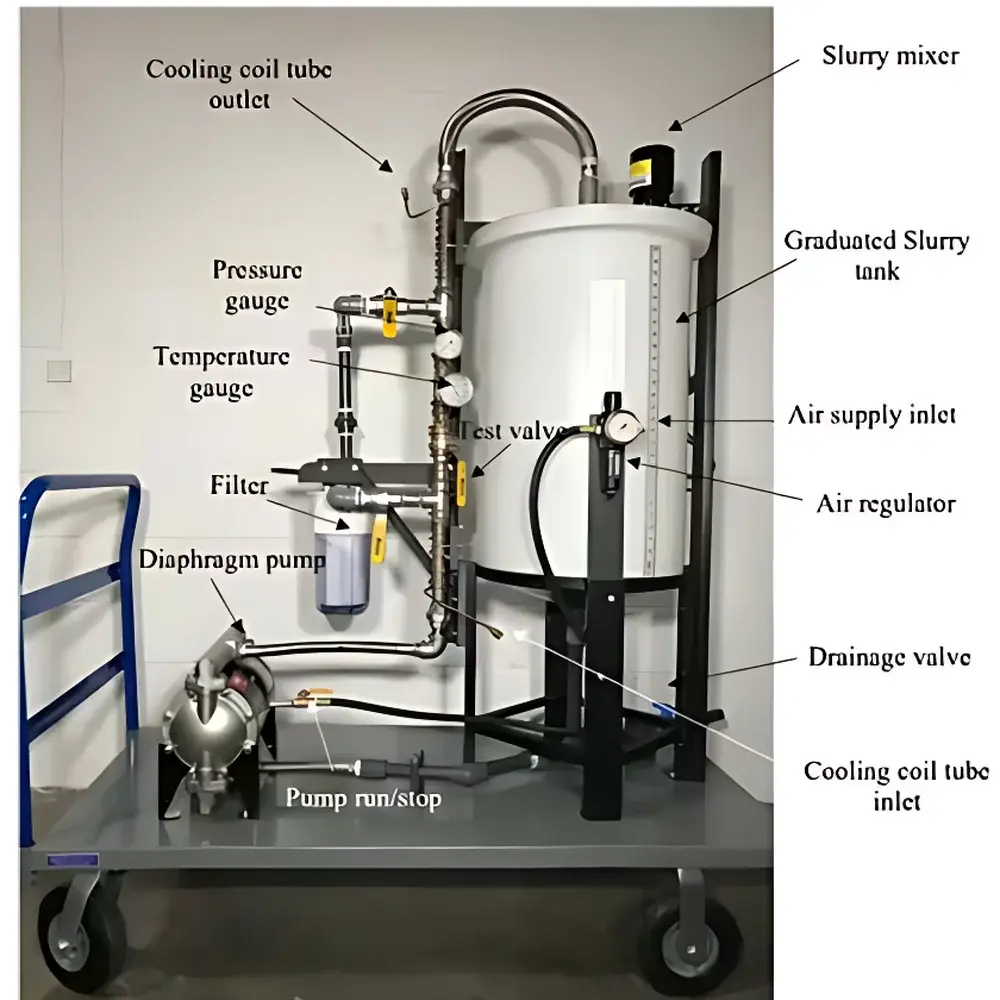
Rtec Slurry-Jet Multi-Functional Tribological Tester
| Brand | Rtec |
|---|---|
| Origin | Switzerland |
| Model | Slurry-Jet |
| Instrument Type | Multi-Functional Tribological Tester |
| Application Category | Erosion & Erosion-Corrosion Testing |
| Compliance Context | ASTM G73, ASTM G119, ISO 8501-1, ISO 12944-5 |
Overview
The Rtec Slurry-Jet Multi-Functional Tribological Tester is an engineered platform for quantitative assessment of solid particle erosion, slurry erosion, and coupled erosion-corrosion behavior under controlled hydrodynamic conditions. It operates on the principle of high-velocity abrasive jet impingement, where a pressurized suspension of calibrated solid particles (e.g., silica sand, alumina, or crushed quartz) is directed at a stationary or rotating test specimen at defined angles (typically 30°–90°), flow rates (0.5–10 L/min), and velocities (up to 120 m/s). Unlike conventional pin-on-disk or reciprocating wear testers, the Slurry-Jet system replicates field-relevant degradation mechanisms encountered in pipelines, pump housings, valve seats, hydro-turbine blades, and offshore drilling components exposed to sand-laden fluids. Its modular architecture supports both single-pass and recirculating slurry configurations, enabling systematic investigation of material loss kinetics, surface topography evolution, and synergistic electrochemical effects when integrated with optional potentiostatic control.
Key Features
- Adjustable nozzle-to-specimen standoff distance (10–100 mm) with precision micrometer positioning for repeatable impact geometry
- Integrated high-pressure slurry delivery system with dual mass flow control: carrier fluid (water, brine, or synthetic seawater) and abrasive phase (particle size range: 50–500 µm, concentration: 1–25 wt%)
- Real-time erosion rate monitoring via high-resolution load cell (±0.01 N resolution) and synchronized digital image acquisition (100 fps, 5 MP resolution)
- Modular specimen stage accommodating flat coupons (max. 50 × 50 mm), cylindrical rods (Ø6–25 mm), or custom geometries with vacuum clamping
- Optional electrochemical module for simultaneous open-circuit potential (OCP) tracking, potentiodynamic polarization, or electrochemical impedance spectroscopy (EIS) during erosion exposure
- IP54-rated enclosure with transparent polycarbonate shield, integrated LED lighting, and exhaust filtration for operator safety and environmental containment
Sample Compatibility & Compliance
The Slurry-Jet tester accommodates metallic alloys (stainless steels, nickel-based superalloys, titanium grades), hardfaced coatings (WC-Co, CrC-NiCr), ceramics (Al2O3, SiC), and polymer composites. Specimens require standard metallurgical preparation (grinding, polishing, etching per ASTM E3) and dimensional verification prior to mounting. Test protocols align with internationally recognized standards including ASTM G73 (Standard Test Method for Liquid Impingement Erosion Using Rotating Apparatus), ASTM G119 (Standard Guide for Determining Synergism Between Wear and Corrosion), ISO 8501-1 (Preparation of steel substrates before application of paints), and ISO 12944-5 (Paints and varnishes — Corrosion protection of steel structures by protective paint systems). Data traceability meets GLP requirements with audit-ready metadata logging (operator ID, timestamp, environmental T/RH, calibration certificates).
Software & Data Management
Rtec’s proprietary Tribometer Control Suite (v4.2+) provides full instrument orchestration via intuitive GUI. Software modules include: (1) Erosion Protocol Builder for defining multi-step sequences (e.g., pre-corrosion soak → erosion burst → post-erosion polarization); (2) Real-Time Erosion Depth Mapping using calibrated profilometry integration; (3) Statistical Wear Volume Analysis with Weibull distribution fitting for lifetime prediction; (4) Export-ready data formats (CSV, HDF5, .tdms) compatible with MATLAB, Python (pandas), and JMP for advanced regression modeling. All user actions, parameter changes, and calibration events are logged with ISO/IEC 17025-compliant electronic signatures and time-stamped audit trails satisfying FDA 21 CFR Part 11 requirements for regulated laboratories.
Applications
- Ranking relative erosion resistance of candidate materials for subsea flowline components operating in high-sand-content petroleum production streams
- Quantifying synergistic material loss in sour service environments (H2S + CO2 + sand) to inform API RP 14E corrosion allowance calculations
- Validating thermal spray coating adhesion and interfacial integrity under cyclic slurry impact loading
- Developing predictive erosion models for centrifugal pump impeller design using CFD-coupled experimental boundary conditions
- Supporting NACE MR0175/ISO 15156 qualification testing of duplex stainless steels in aggressive chloride media
FAQ
What slurry compositions can be used with the Slurry-Jet system?
Standard configurations support aqueous slurries with particles ≤500 µm; non-aqueous carriers (e.g., glycol, oil) require optional chemical-resistant seals and pump upgrades.
Is temperature control available during testing?
Yes—integrated Peltier-cooled specimen stage (–10°C to +80°C) and heated slurry reservoir (up to 60°C) are available as factory-installed options.
Can the system be integrated into an existing electrochemical workstation?
The Slurry-Jet features isolated analog I/O ports (0–10 V, ±5 V) and Ethernet-based communication (TCP/IP) for seamless synchronization with third-party potentiostats from Gamry, BioLogic, or Princeton Applied Research.
What maintenance intervals are recommended for the high-pressure pump and nozzle assembly?
Nozzle inspection is advised after every 20 hours of cumulative operation; ceramic nozzles (Al2O3) typically last 40–60 hours depending on abrasive hardness and concentration. Pump seal replacement is scheduled at 500-hour intervals.
Does Rtec provide method development support for customized erosion standards?
Yes—application engineers offer remote protocol optimization and on-site validation services aligned with internal specifications or emerging industry guidelines (e.g., DNV-RP-F112, Shell DEP 34.19.10.31).



