
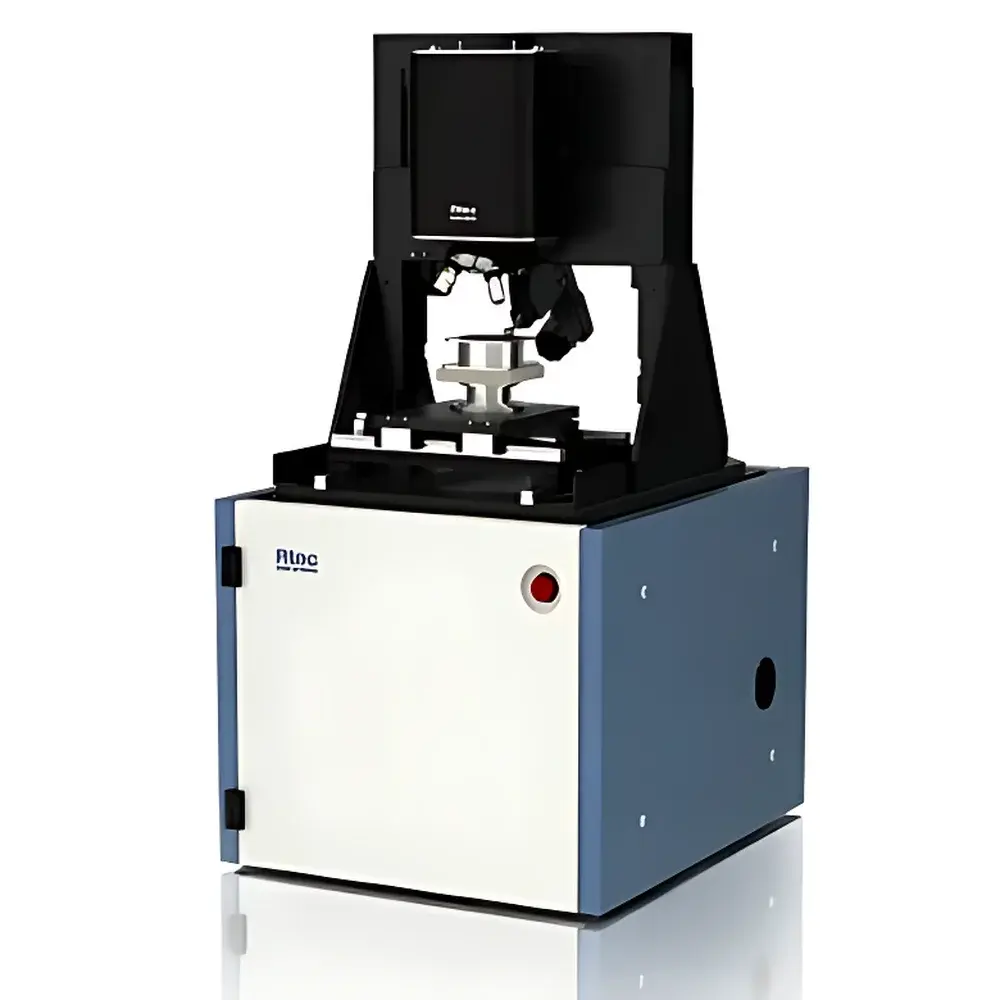
Rtec TM-2000 Micro-Traction Tester
| Brand | Rtec |
|---|---|
| Origin | Switzerland |
| Model | TM-2000 |
| Instrument Type | Multi-Function Tribological Tester |
| Speed Range | ±6 m/s |
| Contact Configuration | 19.05 mm steel ball vs. 46 mm steel disc |
| Control System | Closed-loop servo-driven |
| Temperature Control | Real-time, programmable |
| Data Output | Load, traction force, velocity, SRR, film thickness (optional module) |
| Compliance | ASTM D5001, ISO 12156-1, DIN 51834 (applicable modes) |
Overview
The Rtec TM-2000 Micro-Traction Tester is a precision-engineered tribological instrument designed for quantitative characterization of traction behavior in elastohydrodynamic (EHD) and mixed-lubrication regimes. Based on the well-established ball-on-disc geometry—featuring a 19.05 mm diameter hardened steel ball loaded against a 46 mm rotating steel disc—the system enables controlled generation of varying slide-to-roll ratios (SRR) from –6 to +6 m/s. This wide kinematic range ensures full coverage across boundary, mixed, and full-film lubrication mechanisms. The instrument operates on the principle of direct traction force measurement via high-resolution load cells integrated into a rigid, low-noise mechanical frame. Real-time closed-loop control of normal load (via servo-actuated loading), rotational speed, and sample temperature (–20 °C to +200 °C, with optional upgrade) allows automated execution of Stribeck curves, traction coefficient mapping versus SRR, load, and temperature. Its architecture supports rigorous adherence to standardized test protocols including ASTM D5001 (traction coefficient of lubricating oils), ISO 12156-1 (lubricant traction characteristics), and DIN 51834 (railway grease traction testing), making it suitable for both R&D validation and quality assurance in regulated environments.
Key Features
- Closed-loop servo motor drive system delivering precise, repeatable velocity control across ±6 m/s with <0.1% speed stability at steady state
- High-torque AC servo motor coupled with dynamic load cell (±500 N range, 0.01 N resolution) enabling accurate normal force application and real-time feedback
- Integrated traction force sensor with sub-mN resolution for direct measurement of tangential resistance under variable SRR conditions
- Programmable temperature-controlled stage with PID-regulated heating/cooling, supporting tests from –20 °C to +200 °C (±0.5 °C accuracy)
- Automated XY positioning platform for radial offset adjustment, multi-point mapping, and custom motion profiles (e.g., oscillatory, stepwise SRR sweeps)
- Optional optical interferometry or capacitive film thickness module for simultaneous in situ oil film measurement during traction testing
- Modular design compliant with ISO/IEC 17025 laboratory infrastructure requirements; fully traceable calibration paths available
Sample Compatibility & Compliance
The TM-2000 accommodates standard and custom tribopairs—including metallic (steel, stainless steel, aluminum alloys), ceramic (Si₃N₄, Al₂O₃), polymer (PEEK, UHMWPE), and coated surfaces—enabling evaluation of base oils, formulated lubricants, greases (including railway and electric traction greases), and solid lubricants. Test configurations adhere to internationally recognized standards: ASTM D5001 for traction coefficient determination, ISO 12156-1 for lubricant classification by traction response, and DIN 51834 for railway grease performance assessment. All firmware and data acquisition modules support audit trails, electronic signatures, and user-access controls aligned with FDA 21 CFR Part 11 and EU Annex 11 requirements when deployed in GLP/GMP-compliant laboratories.
Software & Data Management
Rtec’s proprietary Tribometer Control Suite (TCS v4.x) provides intuitive test method definition, real-time visualization of traction coefficient (μ), SRR, load, velocity, and temperature, plus automated Stribeck curve generation. Raw data streams are saved in HDF5 format with embedded metadata (user, timestamp, calibration ID, environmental conditions). Export options include CSV, MATLAB (.mat), and Excel-compatible XML for downstream statistical analysis (e.g., ANOVA, regression modeling). Software architecture supports IQ/OQ/PQ documentation packages and integrates with LIMS via OPC UA or REST API. All test sequences are version-controlled, and raw datasets retain full traceability for regulatory submissions or inter-laboratory round-robin studies.
Applications
- Development and qualification of traction-enhancing additives for railway and tramway lubricants
- Formulation screening of low-viscosity EV transmission fluids under high-SRR conditions
- Quantitative comparison of grease rheology and traction performance across OEM specifications (e.g., UIC 891-6, SNCF E 50-001)
- Fundamental research on EHD film formation, shear thinning, and thermal runaway onset in confined contacts
- Validation of numerical models (e.g., Dowson-Higginson, Grubin approximations) using experimentally derived traction–SRR–load surfaces
- Quality control of batch-to-batch consistency in industrial lubricant manufacturing
FAQ
What distinguishes the TM-2000 from the MFT-5000 platform?
The TM-2000 is optimized exclusively for high-fidelity micro-traction analysis with enhanced SRR resolution and dedicated EHD contact control; the MFT-5000 adds modular test capabilities (HFRR, SRV, four-ball) but trades some traction-specific sensitivity for versatility.
Can the TM-2000 perform tests under vacuum or inert atmosphere?
Yes—optional environmental chamber integration supports operation at pressures down to 10⁻³ mbar and gas purging (N₂, Ar) for oxidation-sensitive formulations.
Is film thickness measurement included as standard equipment?
No—optical interferometry or capacitive film thickness sensing is available as an add-on module requiring separate configuration and calibration.
Does the system support third-party data acquisition or scripting?
Yes—TCS provides Python SDK and LabVIEW drivers for custom automation, external sensor synchronization, and integration into larger test benches.
What maintenance intervals are recommended for long-term metrological stability?
Annual recalibration of load and torque sensors is advised; quarterly verification of thermal uniformity and SRR linearity is recommended per ISO/IEC 17025 internal quality procedures.



